• The 60 Second Leader
  • Seven Secrets of Inspired Leaders
  • The Little Book of Leadership
  • Leadership Hub for Corporates
  • Learning to Live with Huntington's Disease
 

Phil's blog

Three things we can do to help the real leaders of Burma

It’s frustrating and scary, isn’t it, seeing real leaders, unarmed, putting their lives on the line on the streets of Burma at the moment.

“Please use your liberty to help promote ours,” said Aung San Suu Kyi. So, here are some things we can do to help. They may not feel like much, but better than doing nothing:

If you are in the UK

Three things we can do here
1. Send an email to the UK Prime Minister

2. Sign the ‘Free Burma’ petition

3. Donate to the free Burma campaign.

You can do all three on the link above.

If you are in the US, American websites expressing concern over Burma are recommending you email your congressmen and other representatives to ask them to step up pressure on the regime. The Burma Freedom Campaign has links allowing you to email President Bush and Secretary of State Condoleeza Rice if you click here and then scroll down to the bottom of the page.

If you are elsewhere in the world, Google ‘support Burma’ to browse events you may want to take part in, such as candlelight vigils, demonstrations outside embassies…

The link above contains other courses of action if you want to support the people of Burma longer term as they try and take the lead, at such enormous risk to themselves, in freeing themselves. Anita (see below) would be shouting loudest right now in their support. In her absence, we need to shout louder ourselves.


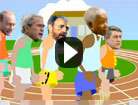
Who’s The Leader? What Nelson Mandela knows that George Bush doesn’t

Capstone, which publishes my book The 60 Second Leader, just created this, which is quite fun. It might take a minute to load:


Anita Roddick

Some nice tributes to Anita Roddick, whom I’ve long-admired as a leader, on her website, particularly from her children, who knew her best, of course. She once agreed to come and address The Inspired Leaders Network, when I worked there. I persuaded her to do so by explaining that the meeting was being held in the atrium of Bloomberg’s HQ in central London (that’s Michael Bloomberg, Mayor of New York and head of the Bloomberg financial information empire), and that she would be talking to some of the biggest moves and shakers within capitalism from within the very belly of the beast. She relished the challenge and got a standing ovation when she’d finished. She is much missed.

“The future lies in finding a broader bottom line to live by. First, you have to have fun. Second, you have to put love where your labor is. Third, you have to go in the opposite direction to everyone else.

We communicate with passion – and passion persuades. What we need is optimism, humanism, enthusiasm, intuition, curiosity, love, humour, magic, fun, and that secret ingredient… euphoria”.
– Anita Roddick


The One and The Many: Real smiles mean something

I’ve just come back from taking my dad to visit his family in Singapore and Malaysia. I was reading ‘One From Many’ by Dee Hock on the way (in between watching Spider Man 3).

Large organizations (in fact all organizations) are still struggling with this basic problem: how to treat large numbers of people as individuals. I think of it as the ‘one and the many’ problem, which is why Hock’s book title appealed to me.

Anyway, it struck me that it can be done, and the flight was an example. I was watching the Singapore Airline cabin crew move down the plane towards us, with headsets or something they were handing out, and every person they handed one to – even though the connection was a second or less – received a very real smile. In less than a second, there was a personal engagement and acknowledgement, repeated hundreds of times down the plane.

This is no mean feat, as we can all tell, instinctively, the difference between a real and a fake smile. There is something called The Duchenne Smile*. And there is what some have dubbed the ‘Pan Am smile’ – the meaningless, ‘have a nice day’ smile that accompanies most service transactions.

The chairman of The Henley Centre for Research told me a few years ago that, despite all the investment in sophisticated Customer Relationship Management systems and automated call centres, the future for customer relations lies in the return of real people interacting with real people, because that’s what customers want in most cases.

He’s clearly right. It’s just a question of resolving that ‘one and many’ thing.

* (From Wikipedia if you can’t be bothered to click above):
The “Duchenne smile”, after the researcher Guillaume Duchenne, is the most studied, and involves the movement of both the zygomaticus major muscle near the mouth and the orbicularis oculi muscle near the eyes. An example of the smile is shown in the girl’s smile in the middle of the page. It is believed that the Duchenne smile is only produced as an involuntary response to genuine emotion, and is therefore what one could call the “genuine” smile. Due to the involvement of the muscle near the eyes, it is sometimes said that one can tell whether or not a smile is “real” by whether or not it “reaches the eyes”.
The “Pan American smile”, on the other hand, is the voluntary smile involving only the zygomaticus major muscle to show politeness; for example, by a flight attendant on the former airline of the same name. Considered “insincere”, this type of smile has also been called the “Professional Smile” by David Foster Wallace in his comedic short story “A Supposedly Fun Thing I’ll Never Do Again”.


Can you spot a fake smile?

Re. the item below about service givers who genuinely smile and those who don’t…

Is this person’s smile fake or real?

Can you spot fake (‘Pan Am’) smiles and real (‘Duchenne’) smiles? This 20 question test is based on the work of Professor Paul Ekman, who has a reputation as a master face reader after his years of research into the subject.


Psychiatric wards and good leadership

Marion Janner, over at the Bright Blog, does a great job of highlighting how good leadership – at all levels – can transform the quality of life for people in acute mental health wards and other psychiatric facilities. Check out her latest post on Wotton Lawn Hospital for an inspiring example.

Marion created the Star Wards programme, which offers acute wards a pack of practical transformational ideas for taking the lead in improving every aspect of life and work in a mental health ward. She then reports in her blog on examples of surprisingly good practice, to inspire others by showing them what can be achieved.

As with so much in healthcare, the differences in practice between some mental health acute wards where people are apparently left lethargic and sitting around versus wards where, as Marion describes in her most recent post, a particularly fragile looking patient was deeply engrossed in potting a seedling in a plastic cup as part of the nursery for the garden, is not down to resources, but to leadership, commitment to enriching people’s lives, imagination and a willingness to improvise and engage.

I’m a great admirer of Marion’s work as she is a powerful example of how to lead change when you may not be the technical ‘leader’ in an organization. She is an outside-in change agent who inspires organizations to change for the better without actually being part of their leadership hierarchy. Which is exactly as it should be today. There shouldn’t be a leadership hierarchy in any organization; just catalysts for change at all levels and a readiness at all levels to listen to their good advice and let people take the initiative by sharing ideas to lead change.

See the Customer Blog for a nice example Marion quotes about the power of improvisation when dealing with customers – in this case acute mental health patients – involving a paper plate and a bit of imagination on the part of a member of staff.


The Leadership Puppets (video)

Er, don’t watch all of it: it’ll drive you crazy. Give it a minute or two to load, then the blank space below this should disappear. I never did like that John C. Maxwell book much, anyway…


Virgin, the co-created airplane and the internet of things

Johnnie Moore spotted a little while ago a report on the PSFK blog on Virgin America’s inaugural flight, which featured a number of innovations for passengers (as you’d expect).

I’ve been musing on this for a while, as what Virgin has done seems to me to take elements of Web 2.0 – in which the users take over the system and create an experience themselves – and apply it to World 2.0. In doing so, they’ve more than subtly changed the whole dynamics of passenger flying, particularly removing some of the passivity and powerlessness that goes with sitting in serried rows and waiting to be served.

The new Virgin America planes are wired to be interactive instead of for one-way communication. This is what allows the pasengers to at least partly take over the creation of their own flight experience.

The usual flight experience is, well, “Sit down and shut up”, apart from when you want to get up for the loo, or to stretch your legs, or annoy the flight attendants by pressing the call button. Beyond that, your active participation in your own flight experience was limited to fiddling with the air jet above your head, adjusting your seat back a few inches one way or the other (and spilling the person behind’s dinner in the process) and generally fidgeting around.

Until the arrival of the in-flight entertainment system, of course, when you could add to your activities fiddling with the headphones to get them to work, finding a music channel that works and trying to find a movie you hadn’t watched before or that you would want to watch if you weren’t held captive in your seat.

The new Virgin planes have taken passenger participation in co-creating the flight experience to a new level. There is a full querty keyboard for each seat, and it’s wired for seat-to-seat chat. So, you can ‘tap someone on the shoulder’ (virtually) in the next aisle and five rows up if you want to chat with them (or chat them up).

You can choose from a ‘movie on demand’ system and select music downloads from the plane’s 3,000 tunes. The next time you fly Virgin, the system remembers what music you like.

The interactive wiring will allow you to play multi-player games with people in other seats, with the screen in front of you doubling as a video console.

Instead of being served painfully slowly from a trolley as each individual transaction is accompanied by the search for the right change in that paper cup air stewards use as a till, you pay for refreshments by swiping your card in a card swipe in the back of the seat in front of you.

Instead of being woken up by the lights coming on at odd hours, the plane’s lighting is programmed to mimic the time of day outside the plane, gradually fading and getting brighter, so that you can adjust to the time zone you are heading to.

The interactive airplane crept up on us a bit over the past few years. But, Virgin America just pushed it forwards into new territory.

I’m struggling a bit to explain the significance of this, but I think it’s huge – This is internet technology being used to make a real world experience interactive and participatory. Web 2.0 doesn’t just happen behind the screen on your desk. It’s merging with our real world experiences to make World 2.0 .

Roland Piquepaille wrote tellingly about this a while ago with his ‘Pigeon that blogs’ story – no, it’s not an allegory, it’s an actual flock of pigeons that blog. They have atmospheric sampling sensors attached to them and air quality information they gather is relayed into the internet by radio transmitters. Piquepaille uses the phrase ‘the internet of things’ to help break us out of our faulty mental model in which the internet happens behind the computer screen and the real world is separate.

If you have customers and want to design their experience, you have to understand this merging of Web 2.0 and World 2.0 from the ground up – as Virgin did when they decided to completely rewire their planes to be interactive.

Carrots taste better in McDonald’s wrappers

So, carrots taste better in McDonald’s wrappers according to Stanford University research published a week or so ago. 63 kids from low income families were presented with identical portions of food, half in McDonald’s wrappers or cartons and half in plain wrapping, and asked which tasted better.

Even carrots, milk and apple juice tasted better in McDonald’s containers, according to the findings.

The researchers, and the press who picked the story up, interpreted the findings as proof that advertising has a deep effect on children. The study’s author Dr. Tom Robinson even said the kids’ perception of taste was “physically altered by the branding.”

I’m not so sure it’s as easy as that, though. I suspect part of it is green Guinness syndrome. Put a black Guinness and a green Guinness in front of someone who likes Guinness and they will prefer the taste of the black one.

The kids who most strongly favoured the McDonald’s wrapped foods were kids who already ate in McDonald’s more often than the other kids in the test. At least partly, it seems to me, the testers in this experiment were reporting on the power of experience in predicting how we will feel about something, not the power of advertising.

I still think people who advertise to young children, given the accepted fact that they cannot distinguish between advertising and other messages and therefore don’t know they are being sold at, have a special level of Hell reserved just for them.


Leaders and Losers: Beckham and Clinton

I usually hate sporting analogies, but bear with me on this one:

I remember my respect for David Beckham going way up eight years ago when I heard him tell this story: Manchester United were 1-0 down to Bayern Munich in the final of the European Champions League. It was the 89th minute of the game. Just one minute remaining on the clock for the most prestigious trophy in European football (OK, soccer, if you must). Beckham was about to take a corner.

This was a trophy United had not won since 1968. Passions were running high. Beckham looked up as he was about to take the corner, with one minute of the match left, and saw the officials in the stand bringing the Champions League Cup out, ready for the presentation. He saw a flash of colour: they had already tied Bayern Munich’s team colours onto the handles of the trophy.

Beckham says one thought ran through his head. And it wasn’t “We’ve lost”. It was “Oh no you don’t!”.

Millions of people watching the game on TV knew that, with one minute to go, United had lost. 70,000 people in the stadium knew that United had lost. 11 members of the Bayern Munich team knew that United had lost. Even the officials in charge of presenting the trophy knew that United had lost.

But Beckham didn’t. And he galvanised his team into a three minute frenzy. From his corner, they equalised. Two minutes later, in extra time, they scored the winning goal. The officials quietly changed the team colours on the handles of the trophy to red and white.

The last minute of the game, before the final goal is scored, is extraordinary to watch (I have it on video: sorry; been a fan since I was tiny and saw them win it in 1968 in black and white on TV). The faces of the German players are complete panic. From knowing they have won, they somehow know they have lost, even before the last goal is scored, even though the statistical probability of anyone scoring in those remaining seconds is minuscule.

I was reminded of this by Gavin Esler’s brilliant series on Radio 4 this morning about the Clinton years in The White House. Like Tony Blair when he first walked into Number 10, Clinton was mystified that the levers of power didn’t seem connected to anything. Nothing went right in his first few months. A friend of his commented that when Clinton was winning, he would coast and needed reminding to push. But, when he was losing, he was at his best. He became so depressed when he lost both Houses to the Republicans that “he moped for months” trying to work out what to do. Then began the most successful period of his presidency. It was a Comeback Kid moment.

Leaders lose well, in the sense described above. Losing makes them stronger.

Gavin Esler’s series on The Clinton Years is compulsive listening. It’s on BBC Radio 4 . At time of writing this, there’s a link to it under the ‘listen again’ heading on the BBC Radio 4 website