• The 60 Second Leader
  • Seven Secrets of Inspired Leaders
  • The Little Book of Leadership
  • Leadership Hub for Corporates
  • Learning to Live with Huntington's Disease
 

Phil's Leadership blog

But, is it really urgent? Real urgency versus false urgency

It’s Manic Monday. It’s no doubt frantic at work – people running urgently from meeting to meeting and emailing the hell out of each other. Have you noticed people emailing from home Sunday nights recently, to try and get ahead so they can hit the ground running on Monday? I have.

How much of the frenetic activity is driven by the urgency of the market, and how much by people’s anxiety to be seen to be doing something?

When we are all being asked to do more with less, now, more than ever, you need to face down the stupid stuff. Got a regular meeting everyone hates that saps time and energy? Challenge it. That’s an act of leadership, no matter what ‘level’ you are at.

We all accumulate regular ‘to dos’. If we all focus on stripping out the non-productive stuff rather than just accepting it, we’ll be in a better position to respond to the genuine urgent call of the market.

There’s a new clip from John Kotter in The Leadership Hub today, on the difference between real urgency and false urgency. You can find it on the Home Page, top left, under the heading ‘Hub TV’. Here’s the link: www.theleadershiphub.com .

Go listen to and watch John Kotter. It takes four minutes. If you’re not too busy, that is.


Boeing leadership…and the limitations of ‘how to behave’ lists

Michael McKinney, in his Leading Blog on the Leadership Now website, points up Boeing’s expected leadership behaviours/behaviors:

“When Ginger Barnes spoke to employees at a leadership development program at the Boeing Leadership Center, she said, ‘Leadership is all about leaders teaching leaders and about relationships. We can execute the daylights out of anything, so ‘finds a way’ and ‘delivers results’ have always been strong traits. Where we need to improve is in the areas of ‘charts the course,’ ‘sets high expectations’ and ‘inspires others.’” That probably true just about anywhere you go. To strengthen the culture of leadership and accountability within the company, Boeing defined its expectations for leaders as:

A Boeing Leader:

* Charts the course
* Sets high expectations
* Inspires others
* Finds a way
* Lives the Boeing values
* Delivers results”

I also like the comment, however, left by Allen Adams on Michael’s post, that a lot of organizations have similar lists of expected behaviours/behaviors in their leaders, yet typically fail to inspire anyone, leading to Dilbert territory – the cynical, defeatist humor/humour coming from uninspiring people spouting but not living inspiring words.

I’m not suggesting that’s Boeing. It was Boeing, after all, that supposedly got 2,000 people in a room (hangar – try finding a room that 2,000 people will fit in) and got them, collectively, to come up with a ‘Critical Mass Intervention’ to steer the company towards its next big product – The Dreamliner. That ‘Wisdom of Crowds’ leadership seems to me to be more pertinent today. It’s a form of leadership everyone is involved in and can buy into.


Trust and leadership

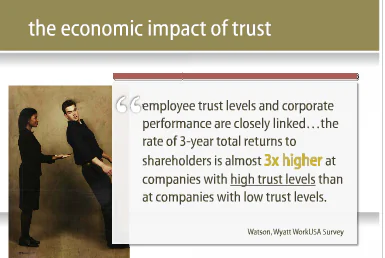
Not enough leaders are trusted. That’s a common theme in workforce surveys. People will trust their peers and subordinates more than they trust their boss. What are you doing about it? The old “They don’t have to like me, since I have the power” approach is dead. If you think it’s not, here’s yet more evidence (above). It’s from the True Colors Consultancy slideshare embedded in The Customer Blog yesterday. They got it from the Watson Wyatt WorkUSA Survey


Martin Luther King on Servant Leadership

Happy MLK Day!


Leadership tip from the Dalai Lama

Well, this one has done the rounds and may be familiar to you. But, it resurfaced for me again today. He doesn’t present it as a leadership tip, just as an insight on how we should live. But, it clearly is a leadership tip anyway:

Follow the three Rs:
Respect for self
Respect for others
Responsibility for all your actions


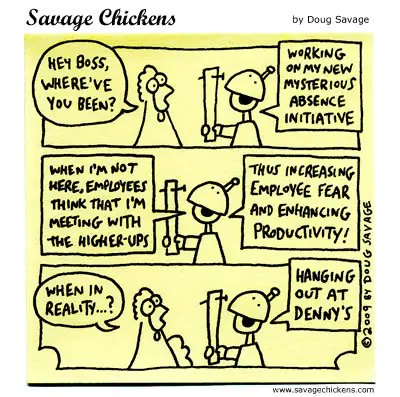
When the Boss says he/she is in a meeting…

More Savage Chickens from Doug Savage here: www.savagechickens.com


Criticism to praise ratio: what’s yours?

Ros Taylor is a workplace psychologist who says that studies in her discipline show we should praise seven or eight times more than criticize, as the ratio for peak performance.

When you track back to find out what studies, they were conducted with teachers and originally applied to how students perform – apparently all the evidence is that the seven or eight to one ratio is the magic formula.

There’s the nice (probably mythical) story of the manager who put eight rounded stones in one pocket each morning and transferred one over to his other pocket every time he praised someone that day and put one back when he criticized. He did it because it takes us time to train ourselves into new habits (Ros says about four weeks) and he needed a physical reminder while he was ‘training’ himself.

It only works if you have pockets and access to pebbles. And I expect you end up with holes in your pockets if you try it, and a lopsided walk. It also doesn’t work if you don’t have pockets. But, it’s a nice story to embed the point in our minds anyway.

Also, just to be awkward, the pockets and pebbles doesn’t add up, does it, unless you only have one employee…(I’m being too literal-minded. Analyze anything too much and it gets destroyed 😉 It’s STILL a good story/metaphor).

What sparked that ramble off was Nick McCormick’s post in The Leadership Hub suggesting your criticism to praise ratio should never be more than one to one and asking what yours is. Here’s the link to Nick’s post: Singing People’s Praises


Validation and leadership

This award-winning 16 minute film is funny, but makes a powerful point about inspiring people through validation. I was put onto it by John Kenworthy, who put a link to it into his ‘What Inspires Me’ uploaded picture of the word ‘Validation’ in The Leadership Hub. Leaders validate. This is an entertaining way of getting the point across. I think the point about ‘validation’ in this film also helps answer Richard’s question in The Hub recently: What is inspiration and how do we inspire ourselves and others:


Four leadership tips from Larry Bossidy

1. What you do your people notice. So, be self-aware and be authentic.

2. Don’t be dismayed at people who are better than you. Embrace them. That’s how you create well-rounded teams.

3. Aim for self-mastery. Get better. Renew yourself.

4. Practise humility. Humility is not thinking less of yourself. It’s thinking of yourself less.

Source: My notes from an interview between Larry Bossidy – former CEO of Honeywell and co-author of Execution and Confronting Reality – and Tom Peters


What have you lived for?

Looking back and looking forward as the year turns helps us make sense of what we are about, what we are for, where we are going. And to adjust course if our lives aren’t going quite the way we had wanted. There’s a sense in which we step out of our daily lives as the year turns, consider it from outside-in, before we step back into it again and get caught up once more. To ‘lead’ our own lives we really need to do this more than once a year, don’t you think?

When we eventually look back, because there is far more ‘back’ to look to and far less ‘forward’, I’d like to be able to say something like this, which comes from Bertrand Russell’s introduction to his autobiography. To be able to look back on a life like this, you have to have planned to live it. I think that’s a key lesson for me in how to lead your own life: think ahead to what you want to look back on. Then make it happen.

So, what do you want to look back on 2009 and say? Here’s the inspiring Bertrand Russell that lives on my wall, looking back on his whole life:

What I Have Lived For
“Three passions, simple but overwhelmingly strong, have governed my life: the longing for love, the search for knowledge, and unbearable pity for the suffering of mankind. These passions, like great winds, have blown me hither and thither, in a wayward course, over a deep ocean of anguish, reaching to the very verge of despair.

“I have sought love, first, because it brings ecstasy – ecstasy so great that I would often have scrificed all the rest of life for a few hours of this joy. I have sought it, next, because it relieves loneliness – that terrible loneliness in which one shivering consciousness looks over the rim of the world into the cold unfathomable lifeless abyss. I have sought it, finally, because in the union of love I have seen, in a mystic miniature, the prefiguring vision of the heaven that the saints and poets have imagined. This is what I sought, and though it might seem too good for human life, this is what – at last – I have found.

With equal passion I have sought knowledge. I have wished to understand the hearts of men. I have wished to know why the stars shine. And I have tried to apprehend the Pythagorean power by which number holds sway above the flux. A little of this, but not much, I have achieved.

Love and knowledge, so far as they were possible, led upward toward the heavens. But always pity brought me to earth. Echoes of cries of pain reverberate in my heart. Children in famine, victims tortured by oppressors, helpless old people a hated burden to their sons, and the whole world of loneliness, poverty, and pain make a mockery of what human life should be. I long to alleviate the evil, but I cannot, and I too suffer.

This has been my life. I have found it worth living, and would gladly live it again if the chance were offered me.”

– Bertrand Russell, introduction to his autobiography