


• The 60 Second Leader
  • Seven Secrets of Inspired Leaders
  • The Little Book of Leadership
  • Leadership Hub for Corporates
  • Learning to Live with Huntington's Disease
 

Phil's Leadership blog

This is a time for leaders

As we are in the middle of turbulent times – getting more turbulent by the minute judging by Lehman, Merrill Lynch, Alitalia, Lloyds TSB/HBOS…the list goes on – more than ever we need to be clear on what leadership actually is. Because it’s leadership that’ll haul us out of the current situation, sooner or later.

Your leadership of your organization, or business unit or whatever you lead, is part of this. Cumulatively, the decisions we all make help set a direction, shape the climate. So, listen up on how to lead through turbulent times, to help us make the right decisions. First up, Rene Carayol:

Management vs Leadership

In predictable times, management is often enough, Rene tells us. But, turbulent times are when you need to push leadership to the fore. What’s the difference?

“If management is what we do, leadership is how we feel.”

“Managers talk strategy. Leaders tell stories.”

– Rene Carayol, Leaders in London Chairman

Next up, Ben Zander, who reminds us that leadership comes down to three things:

“1. Realize it’s all invented. Don’t follow the rules.
2. Radiate possibilities
3. Take the work seriously, but not yourself.”

– Orchestra conductor Ben Zander, speaking at last year’s Leaders in London

Lastly, Al Gore, also from Leaders in London 2008, with perhaps the most important lesson for leaders in the current situation:

“Leadership means inspiring us to manage through our fears.”

Up until the past year or so, most of us have been leading our organizations through optimistic times. Up until the past year, even a muppet of a CEO could return double digit annual growth in some sectors. That was then, this is now. That was easy, this is…something new.

It’s a time for real leadership. People are scared. You may have to deliver bad news, deal with situations you’ve never faced before, reassure and inspire people who are unused to such uncertainty and need steadying. You can’t manage your way through this one. Take that management hat off. Time for you to step up. This is a time for leaders.

But, what kind of leadership do we need?

Hmmm, ‘It’s a time for leaders’ I pompously posted below. I believe it is. But, what is the best kind of leadership for the current turbulence? In the UK, the leadership at the bank Lloyds TSB was, over the past few years, characterized as boring and unadventurous. That’s how other financial institutions viewed its reluctance to gorge on the new financial instruments that have emerged in recent years, making fat short-term profits from repackaging and selling on loans, for example.

The media joined in and contributed to this version of Lloyds TSB – that it was too cautious, not a place to invest in if you want big returns fast, that it was somehow getting left behind by the more adventurous financial institutions at a time when money (credit) was virtually free.

Well-run, safe but boring. That was the general consensus. So, yesterday, Lloyds TSB turns out to be the only bank in a sound enough position to say ‘yes’ to the UK government’s attempt to broker a takeover of HBOS (Halifax Bank of Scotland), the UK’s largest mortgage lender, to head off the possible need for yet another government bailout akin to Fanny & Freddie in the US, and Northern Rock (in the UK).

Sir Brian Pitman’s tenure leading Lloyds TSB helped start off the ‘safe but boring’ cliche, because his sound, unflamboyant leadership set the tone for the bank. Eric Daniels, Lloyds TSB’s chief executive of five years, is similarly known, says the FT today

“as the Quiet American because of his low profile and cautious approach…Under his stewardship Lloyds TSB has been cautious about expanding into more exotic business such as credit products rooted in subprime mortgages”.

Both Brian Pitman and Eric Daniels strike me as what Jim Collins calls Level Five leaders – longterm thinkers who are guided by an inner conviction rather than following the current trend, who are usually ego-lite and happy to stay out of the limelight, and who have a clear view on the horizon as well as the short-term. Unflappable, sometimes mild-mannered, but with the courage of their convictions.

Rene Carayol, the Leaders in London chairman, has said in the past that what characterizes great leadership is a mix of two apparent contradictions: great courage and great humility. That sounds close to Collins’ characterization of ‘the quiet leader’, the Level Five leader.

There’s some research that shows charismatic leaders who make big bold swooping decisions and adopt high risk strategies win bigger than Level 5 leaders when they are winning, but (obviously) lose bigger too. I’ll dig it out and post it here when I find it.

That research, and the contrast between those two types of leader, seem to me to be reflected in the choice of leadership we have before us now. And it seems as if the market is making the decisions for us. In a game of ‘last man standing’, or at least, of consolidation in which the genuinely strong players take over and consolidate the ones that appeared strong but turned out not to be, my suspicion is we’ll see a lot more ‘quiet leaders’ running things once the smoke clears.

Is that what we need? What kind of leadership do you want to see in your organization at the moment? And are you getting it? How about your own leadership? Where do you fall between the two ends of the spectrum mentioned above – the quiet leader at one end and the charismatic risk-taker at the other? Yes, it’s a time for leaders. But, what kind of leadership do we need?


How to lead innovation

Harvard Management Review have a short video clip from Vijay Govindarajan of Tuck Business School, who is currently seconded as GE’s chief innovation guru, and who is coming to Leaders in London later this year to tell us how to lead innovation. The former boss of his current workplace, Jack Welch, will also be sharing leadership lessons with us, live by satellite.

You can find the short clip on the link at the end of this post, where you’ll also find a link to Daniel Goleman’s latest work on social intelligence and leadership. Goleman is leading a workshop for us on this very subject at Leaders in London. Once you click the link below, scroll down to find the video clip.

Vijay Govindarajan, over at Harvard Business Online, on how to lead for innovation


Leadership lessons from Formula One, McLaren and Ron Dennis

This is today’s post from the Leaders in London blog I write. Thought you might find it interesting:

So, just one cut corner robbed Lewis Hamilton of another victory for the Vodafone McLaren Mercedes Formula One team over the weekend. I used to work for McLaren, interviewing their designers and engineers and then piecing together what it is that makes them such a formidable team, and writing it up.

In the post, below, on the Hadron colider, we talk about ‘conscious companies’, in which people at all levels are always thinking, always communicating, always assessing what works and what could be improved, always restless, never satisfied. That’s what I found at McLaren. They seemed to read each other’s minds.

I’d talk with the head of a production department and the head of a design division together and, whereas in other manufacturing organizations I went into and analyzed, where there was a thinly-disguised resentment between design and manufacturing (“Those guys always design stuff it’s impossible to make!” vs “We design a winning design and they always push back and say it can’t be done!”), at McLaren, the equivalent heads of department were so in tune with each other they’d finish each other’s sentences.

What I noticed as a characteristic of how McLaren operates is absolute trust and respect, lack of turf wars, unity behind a common purpose (winning the next race), which combined to destroy the old truth in manufacturing – that quality and speed were two great irreconcilables; that the faster you designed and made something, the lower its quality would be. Maybe everywhere else in manufacturing, I discovered, but not at McLaren.

It takes Ford two years to design, prove and build a new suspension system. When I was interviewing a McLaren designer once, he was designing a new suspension system on his Computer Aided Design system. It was needed in two weeks for the next race, as Ron Dennis and the rest of the team were unhappy with the performance of the current system in the race just finished.

Within two weeks, McLaren had designed, proved and manufactured a new suspension system, flown it out to whatever part of the world the cars were in on the global Grands Prix circuit, fitted it to the cars, tested it, tuned it, and were racing it. Two weeks where it takes Ford two years. They really are an extraordinary group of people.

And at their head is Ron Dennis, an extraordinary, quietly-spoken leader who has made McLaren the most successful British Formula One team of all time. Until Ferrari’s resurgence with Michael Schumacher, McLaren were the most successful F1 team of all time, full stop. With Lewis Hamilton driving for them, whom Dennis himself nurtured and mentored, they aim to reclaim that position and are heading that way.

When I asked McLaren if Ron Dennis would share his approach to leadership at Leaders in London later this year, and talk about how that organization is led in a way that produces extraordinary results, I’m delighted to report he said yes.

Also on the Leaders in London blog today: Lessons in leadership from Manchester United manager Sir Alex Ferguson, courtesy of Richard from the RSPB.


No Big Bang, but a wakeup call in how to generate energy

So, to state the obvious, we’re still here, then. But, it did generate a wave of human energy, didn’t it, all the media coverage about what might happen when the particle accelerator at CERN was turned on this morning (European time). Did you notice how much more ‘alive’ and animated people were/are when talking about it? There was a thrill attached to the minutely possible (or, as most scientists were saying, vanishingly impossible) chance that the mundane would suddenly .

(That’s a writer’s conceit – using the . as a sudden ‘stop’ for impact. First used in the book 1066 And All That, which ends with the words “…and history came to a complete . “)

Apparently the first high speed clashes between particles won’t happen till October 25th or something, so we’ll go through it all again then. But, what interests me from our leadership perspective here is…What can you, as a leader, do to generate that frisson of energy about your organization; that sense of ‘buzz’, sense of aliveness? Leaders tap into, generate and channel energy in people; that’s your main job description.

There’s a line of thinking that says we sleepwalk through most of what we do; that the ‘highs’ people seek are a seeking after a sense of aliveness and alertness that the Hadron collider inadvertently generated today. Most organizations are like this, according to some organizational behaviourists. The routine, the process, the familiarity of the working day, dull our senses and our sense of the possibility.

What’s the alternative? The ‘conscious company’ is the phrase that has emerged in recent years to describe organizations with a sense of buzz, purpose, nimbleness, aliveness about them. So, let the Hadron collider human energy emission that took place this morning (European time) be a ‘wake up call’ for your leadership: what can you do as a leader to help generate the alertness, agility and buzz of energy that will turn your organization into a conscious company?

You could Google ‘conscious company’ for starters. ‘Cos. here’s a clue: the world may not have ended today; but in an overcrowded world marketplace, with far too many suppliers, and tough trading conditions for the next year or more, organizations that haven’t woken up and injected some energy and ‘aliveness’ about them – become ‘conscious companies’ – won’t be around anyway.


How to make a great leadership speech

In leadership, the Obama experience seems to remind us, the speech is the thing. There is something about a great leadership speech – from Kennedy in Berlin way back to Lincoln and the Gettysburg address – that can define a moment, inspire a generation.

On a more mundane level, the leadership speech is a powerful mechanism, if you are any good at it, for reaching all of the people you need to reach – from employees to stockholders – and connecting with them, influencing them. The problem is most leaders are not very good at it. Most leaders are excruciatingly bad at it; yes, even you, who have been through all that expensive presentation training.

Most leaders are bad at it because they use speeches to pronounce, not to speak intimately about themselves and the people they are talking to. A stage or a camera are seen as a cue to speak ‘publicly’ rather than intimately. But, it’s the intimate, the personal, the real, that connects with people. The best leadership speeches tell a personal story about yourself that resonates with the people in the audience – It’s not about ego, about ‘me’ stories; it’s about stories that touch people and illuminate something about shared values and shared purpose.

OK, that means nothing without an example, so the Leaders in London Chairman and Facilitator Rene Carayol has a stunning one over on his website, from Steve Jobs of Apple. You need to earmark at least five minutes to read it. It seems to be a ‘me’ speech, but it actually speaks perfectly to his audience; about their situation as they look ahead to their future and look out to the rest of the world and find their place in it.

Quick extract to give you a flavour/flavor:

“Today I want to tell you three stories from my life. That’s it. No big deal. Just three stories.

The first story is about connecting the dots.

My second story is about love and loss.

My third story is about death.”


The core skill of a leader is…

..social intelligence.

Q: What’s the shortest distance between two people?
A: Laughter

What’s that got to do with leadership?

Empathy – understanding how others tick and being able to connect with them – is at the core of Emotional Intelligence, or ‘EQ’, as the psychologist Daniel Goleman calls it.

Goleman uses laughter as an example of a powerful connection (flowing directly from your limbic system to the other person) that by-passes the brain and creates an instant sense of shared experience.

We now know, from Goleman’s books such as Primal Leadership, that being highly competent won’t make you an effective leader unless you have Emotional Intelligence; the ability to connect with people emotionally and create that sense of shared experience. EQ triumphs over IQ, his research shows.

Goleman’s latest work, published in the Harvard Business Review this month, goes further and explains how and why followers actually ‘mirror’ how their leaders behave.

Now, in tough trading conditions, when you need to keep people engaged and their performance high in the face of uncertainty, you need Social Intelligence more than ever as a core part of your leadership. ‘Social Intelligence’, says Goleman in a new article in the Harvard Business Review this month, is the outward-facing aspects of EQ; a sub-set of Emotional Intelligence if you will. It’s how you relate to others. Social Intelligence includes these seven leadership skills, says Goldman:

1. Empathy
2. Attunement
3. Organizational awareness
4. Influence
5. Developing others
6. Inspiration
7. Teamwork

Action: Goleman’s new paper in the HBR ‘Social Intelligence and the Biology of Leadership’ says you can ‘train your brain’ to develop Social Intelligence – the ability to connect with others positively to develop a high performance, highly co-operative team. Even if you feel you are not a natural at making emotional connections, his research suggests you can rewire your own brain by consciously working at it. His workshop at Leaders in London later this year will explain how to do it.

Click here to:
watch a short video interview with Goldman
link to a summary of the article
read the article itself if you have time (about 20 minutes), and
view a table that shows the seven leadership skills and explains them, so you can pick out which ones you are strong at and which ones need work.


The Great Leader is…

(This is an extract from September’s Taking The Lead, the monthly email newsletter I write for Leaders in London, published today).

Carly Fiorina led the merger of HP and Compaq before being given the order of the golden boot, but has since had her reputation re-built by results: Thanks to her HP strategy, Hewlett-Packard overtook IBM last year as the world’s largest technology company. Tom Peters, the business guru and a past Leaders in London speaker, now refers to her as his “CEO Hero”. Fiorina likes to quote Lao Tsu:

“A good leader is he whom people revere.
An evil leader is he whom people despise.
A great leader is he of whom the people say
‘We did it ourselves’ “

(Or she, of course). Yes, we’ve used that before here, as it’s my favourite leadership quote.

Fiorina is talking about embedding leadership within the system. At the moment, a lot of companies are dealing with the downturn by pulling leadership – as in decision-making about the future of others – back behind closed doors. Those outside the doors wait to learn their fate; who will be cut, who will stay.

The lesson of every downturn is lost on subsequent managers going through this same process; the approach destroys morale and lowers performance, the very attributes that will get you through the downturn. Smart leaders have open conversations with the workforce and enroll them in helping to find efficiency savings, cut costs, abandon inefficient old ways of working and move to new ones.

(If you found that extract useful, you can subscribe to Taking The Lead here


How to lead in a downturn. The most important lesson of all

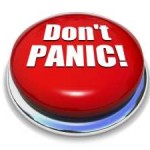
It occurs to me a lot of us are leading through a downturn – tough trading conditions, whatever you want to call it – for the first time. So, Douglas Adams’ advice from The Hitchhiker’s Guide To The Galaxy, is the best of all. It’s on the button below.

Those of us who are old enough to have been through previous downturns are still here. You will be too. And so will your organization if you lead it right (no pressure, then). Hint: part of your leadership job now is helping others not to panic, too. People panic when they feel things are out of their control. You help fix that by clearly setting out what’s happening, consulting with them on how the organization should respond to emerging trading conditions, and doing what you say. ‘Consulting’ doesn’t mean a long drawn-out consultation process. It means using the rapport and open communications channels you have established with individuals and people en masse to let people know where things are going, and involve them in adjusting to get there: you need their agreement and buy-in, as always, and then they’ll help you get there.



Four ways to lead with urgency

More on John Kotter’s new book

Over in Leadership Now’s Leading Blog, Michael McKinney summarizes the four essential things you need to do to inject urgency into the organization, according to Professor John Kotter’s new book, which we previewed below. Michael says:

1. Bring The Outside In
“Kotter offers four tactics to establish a sense of urgency in any environment:

First, bring the outside in. A “we know best” culture reduces urgency. “When people do not see external opportunities or hazards, complacency grows…. With an insufficient sense of urgency, people don’t tend to look hard enough or can’t seem to find the time to look hard enough. Or they look and do not believe their eyes, or do not wish to believe their eyes. Even if seen correctly, and in time, external change demands internal change.”

2. Model it every day
The second tactic is to behave with urgency every day. “Increasingly changing environments create a need for alertness and agility, which demands a sense of urgency that must be modeled by the boss all the time.” A few of the behaviors he details: purge and delegate, speak with passion, walk the talk.

3. Find opportunity in crisis
Third, find opportunity in crises. A problem with a damage control mind-set is often eliminates an opportunity. A properly leveraged crisis can be a valuable tool to break through complacency.

4. Deal with the ‘NoNos’
And fourth, deal with the NoNos – those people that are “always ready with ten reasons why the current situation is fine, why the problems and challenges others see don’t exist, or why you need more data before acting.”

I think 4. is the same as 1. and can be summarized as ‘Challenge denial’. What’s the most powerful force in the Universe? I once heard James Taylor say (no, not THAT James Taylor. This one’s the former CEO of Gateway and co-author, with Watts Wacker of the Five Hundred Year Delta).

Love? Hate? Gravity? Compound interest, as Einstein is supposed to have said? Nope. The most powerful force in the Universe is denial. When I say that in workshops I always expect someone at the back to stick their hand up and say “Oh no, it’s not…” (Think about it).