• The 60 Second Leader
  • Seven Secrets of Inspired Leaders
  • The Little Book of Leadership
  • Leadership Hub for Corporates
  • Learning to Live with Huntington's Disease
 

Phil's blog

The One Good Thing About a Downturn

“Good timbers do not grow with ease;
the stronger the winds, the stronger
the trees…”
– Williard Marriott

The one good thing about a downturn is that it makes you stronger as an organization. Or, at least it should. Most organizations just cut mindlessly, in which case it doesn’t.

Use this time to spot which of your frontline people are most resilient. It is likely that morale and motivation will flag among most, as that is natural in a downturn – people are worried about their own prospects, their spending power outside of work and so on. What you want to try and avoid, of course, is that mood being reflected in your relationships with your customers.

Role model the most resilient frontline employees – those who can continue to smile and provide good service and think proactively of the customer’s needs, rather than be distracted by their own concerns – and use their profiles when recruiting. Also, hold them up as ‘heroes’ to the rest of the organization.

But, don’t dismiss the concerns of those who don’t smile and stay buoyant through down times. Part of your role as a customer-centered leader is to become even more engaged with them and keep them inspired and motivated. That is in stark contrast to what most leaders/managers do in a downturn – become more distant, shut the manager’s door and spend time in meetings with those ‘on high’ which seem to the front-line to be all about which of them are to lose their jobs to cut costs.

So, it’s time for you to step up and show your true colours/colors as a manager and leader that keeps a focus on the customer and on communicating with your frontline people to keep their morale up.


Warren Bennis on Leadership, Emotions and Good Judgement

Emotional Intelligence and Leadership

‘The Dean of Leadership’, according to the FT, Warren Bennis, on emotions, leadership and good judgement. In this two minute clip Bennis references Carly Fiorina, who is coming to talk to Leaders in London. Daniel Goleman will also be helping us become better at this critical area of leadership with his one day optional workshop on Emotional Intelligence for Leaders. Click on the small triangle bottom left if clicking on the big ‘play’ triangle in the middle does nothing.


The Art of Motivation

Motivation and High Performance

Harvard Business Review’s ‘summer reading’ (their big summer edition) has a big piece on motivation. Timely, as motivation can dip drastically in a downturn, with employees worried about their finances, their job and the future.The piece draws on the trendy ‘neuroscience of leadership’ – using MRI scanners to see which areas of the brain light up to show activity and engagement – and says that there are four key drivers of motivation:

1. The drive to acquire – rewards and experiences
2. The drive to bond – building a sense of belonging
3. The drive to comprehend – work must be meaningful
4. The drive to defend – fair play for all

Stefan Stern, in the FT today, points out that motivation remains a big headache for managers and leaders, regardless of the economic climate. A recent Hay Group survey of more than 3,100 organizations found that 41% of employees felt demotivated by their managers.

This reminds me of a true story my friend Henry Stewart, founder of Happy Computers, likes to begin his presentations with: a manufacturing company noted that its productivity figures went up on the weekend. It couldn’t figure out why, till it dug a little deeper and realized the obvious: the managers didn’t go in on the weekend.

Stern says that the ‘powerful new model’ trumpeted in the HBR doesn’t actually add anything to what we know already which, he says, can be summed up in this paragraph from Frederick Herzberg, author, ironically, of one of the HBR’s most widely-read articles, the 1968 piece “One more time: how do you motivate employees”.

Herzberg’s seminal paragraph is this:

“If I kick my dog…he will move. And when I want him to move again what must I do? I must kick him again. Similarly, I can change a person’s battery, and then recharge it, and then recharge it again. But it is only when one has a generator of one’s own that we can talk about motivation. One then needs no outside stimulation. One wants to do it.”

PS So what’s your role in motivating? Providing inspiration and getting out of the way (apart from stepping in to support and ensure people have the resources they need). Inspired leadership is the piece that is missing in most organizations.


Five New Rules For Corporate Success

Peter Georgescu’s Five New Rules for Corporate Success, from his book (see previous post):

1. Creative capacity and the brand integrity that grows from it are an organization’s most important assets
2. Enlightened leaders inspire creativity through understanding, co-operation, and respect
3. Competence and execution are as important as ever, but they must be aimed at building intimacy with the customer
4. Alignment is the critical concept for the twenty-first-century organization
5. Great companies don’t happen without leaders who have transformed themselves

The one good thing about a downturn is it forces you to stop and look at your strategy and competitiveness. I like Georgescu’s framework as an aid to breaking out of business as usual and reassessing where real value actually lies. Also, point 5 is vital. Bosses busy cutting and changing everything else in their organization to help cope with the downturn need to stop for a minute and look in the mirror. Take the opportunity to change yourself, as others won’t accept ‘imposed’ change; they’ll only go along with it if they see you changing, too.


Leaders are not essential: take a break

So, holiday/vacation time? Are you taking any? Did you/Will you take the Blackberry and check in by phone or get the office to call you if they really need you? Ah, me, how essential leaders think they are. Actually, as I learnt from the co-founder of Pret a Manger, Sinclair Beecham, great leaders make themselves inessential.

Sinclair said that he used to welcome the phone ringing with store managers and others bringing him problems to solve. It made him feel essential. As Pret grew, his phone didn’t stop ringing and he realized his idea of leadership doesn’t work. It’s not scalable. He changed his attitude. Instead of seeing himself as chief firefighter and problem-solver, he stepped back and gave people space, permission, indeed insisted, that they find their own solutions.

His phone didn’t ring so much. He felt less essential. At first, this was a bother. But, leadership isn’t about ego and how important you are. It’s about the high performance organization, and that comes from, paradoxically, making yourself inessential as a firefighter and problem-solver. A recent report says true leaders free up 50% or more of their time – they don’t schedule in half their week in their diary. They use that time to lead rather than firefighting. How do you do that? By creating more leaders, of course.

It may make you feel indispensable to be on call when on vacation. But, it actually shows you have a long way to go to be a great leader. If your deputies and the system aren’t coping and leading themselves in your absence, you aren’t doing your leadership job properly.

Nick McCormick, who runs the Be Good leadership blog, has a nice post on this in The Leadership Hub


The key source of value today

The key source of value in today’s corporation (is): the relationship between the informed customer and the creative employee – a relationship that must be built with honesty and integrity.

That struck me as a profound and powerful insight.

It’s from the book The Source of Success, Peter Georgescu


8 Leadership lessons from Nelson Mandela

Lead like Mandela

Over on The Practice of Leadership blog, George Ambler spots a piece in Time Magazine to coincide with Nelson Mandela’s birthday (I was on holiday, so you’re getting it a bit later). Richard Stengel , who worked with Nelson Mandela on his autobiography, “Long Walk to Freedom” has an article in Time titled “Mandela: His 8 Lessons of Leadership”, these 8 lessons of leadership are:

  1. Courage is not the absence of fear — it’s inspiring others to move beyond it. “Mandela was often afraid during his time underground, during the Rivonia trial that led to his imprisonment, during his time on Robben Island. ‘Of course I was afraid!’ he would tell me later. It would have been irrational, he suggested, not to be. ‘I can’t pretend that I’m brave and that I can beat the whole world.’ But as a leader, you cannot let people know. ‘You must put up a front.’ And that’s precisely what he learned to do: pretend and, through the act of appearing fearless, inspire others. It was a pantomime Mandela perfected on Robben Island, where there was much to fear. Prisoners who were with him said watching Mandela walk across the courtyard, upright and proud, was enough to keep them going for days. He knew that he was a model for others, and that gave him the strength to triumph over his own fear.”
  2. Lead from the front — but don’t leave your base behind. “For Mandela, refusing to negotiate was about tactics, not principles. Throughout his life, he has always made that distinction. His unwavering principle — the overthrow of apartheid and the achievement of one man, one vote — was immutable, but almost anything that helped him get to that goal he regarded as a tactic. He is the most pragmatic of idealists.”
  3. Lead from the back — and let others believe they are in front. “Mandela loved to reminisce about his boyhood and his lazy afternoons herding cattle. ‘You know,” he would say, “you can only lead them from behind.’ He would then raise his eyebrows to make sure I got the analogy. As a boy, Mandela was greatly influenced by Jongintaba, the tribal king who raised him. When Jongintaba had meetings of his court, the men gathered in a circle, and only after all had spoken did the king begin to speak. The chief’s job, Mandela said, was not to tell people what to do but to form a consensus. “Don’t enter the debate too early,” he used to say. … The trick of leadership is allowing yourself to be led too. ‘It is wise,’ he said, ‘to persuade people to do things and make them think it was their own idea.’”
  4. Know your enemy — and learn about his favorite sport. “As far back as the 1960s, mandela began studying Afrikaans, the language of the white South Africans who created apartheid. His comrades in the ANC teased him about it, but he wanted to understand the Afrikaner’s worldview; he knew that one day he would be fighting them or negotiating with them, and either way, his destiny was tied to theirs.”
  5. Keep your friends close — and your rivals even closer. “Many of the guests mandela invited to the house he built in Qunu were people whom, he intimated to me, he did not wholly trust. He had them to dinner; he called to consult with them; he flattered them and gave them gifts. Mandela is a man of invincible charm — and he has often used that charm to even greater effect on his rivals than on his allies. On Robben Island, Mandela would always include in his brain trust men he neither liked nor relied on.… Mandela believed that embracing his rivals was a way of controlling them: they were more dangerous on their own than within his circle of influence. He cherished loyalty, but he was never obsessed by it. After all, he used to say, ‘people act in their own interest.’ It was simply a fact of human nature, not a flaw or a defect.”
  6. Appearances matter — and remember to smile. “When Mandela was running for the presidency in 1994, he knew that symbols mattered as much as substance. He was never a great public speaker, and people often tuned out what he was saying after the first few minutes. But it was the iconography that people understood. When he was on a platform, he would always do the toyi-toyi, the township dance that was an emblem of the struggle. But more important was that dazzling, beatific, all-inclusive smile.”
  7. Nothing is black or white. “Life is never either/or. Decisions are complex, and there are always competing factors. To look for simple explanations is the bias of the human brain, but it doesn’t correspond to reality. Nothing is ever as straightforward as it appears. Mandela is comfortable with contradiction. As a politician, he was a pragmatist who saw the world as infinitely nuanced. Much of this, I believe, came from living as a black man under an apartheid system that offered a daily regimen of excruciating and debilitating moral choices: Do I defer to the white boss to get the job I want and avoid a punishment? Do I carry my pass? …. Mandela’s calculus was always, What is the end that I seek, and what is the most practical way to get there?”
  8. Quitting is leading too. “Knowing how to abandon a failed idea, task or relationship is often the most difficult kind of decision a leader has to make. In many ways, Mandela’s greatest legacy as President of South Africa is the way he chose to leave it. When he was elected in 1994, Mandela probably could have pressed to be President for life — and there were many who felt that in return for his years in prison, that was the least South Africa could do.…. ‘His job was to set the course,’ says Ramaphosa, ‘not to steer the ship.’ He knows that leaders lead as much by what they choose not to do as what they do.”

How to keep customers in a downturn

Keeping Customers In Tough Trading Conditions

Here’s some ammunition to convince the boss or the finance director (or you, if you are the top boss or finance director) that customer-facing resources deliver profit and need to be sustained, not cut back, in tough trading conditions.

1. Cutting service problems increases profit

“1% cut in customer service problems could generate an extra £16m in profits for a medium size company over five years.”

Source: Henley Centre

2. Keep the ones you’ve got

“It can cost six times more to buy new customers than retain existing ones.”

Source: US Office of Consumer Affairs

3. Service leaders are more resilient in a downturn

“Service leaders…

Charge on average 9 to 10 percent more for their basic products and services

Grow twice as fast as their low-service competition

Improve market share an average of 7 percent per year. (Low flyers lose market share by as much as 2 percent annually.)

Have an average return on sales of 12 percent compared to 1 percent for low flyers.”

Source: Strategic Planning Institute, USA. (Research into ‘low cost’ vs ‘high service’ as two extreme customer propositions on which to base your business)

4. Your bills get paid

We all know that large business customers start shifting you from 30 day to 60 day payments or even the 90 day payment run, often without telling you in advance, to preserve their own cashflow in a downturn.

“Many people feel that the only measure is the ‘bottom line’. However, a survey* of 3,000 businesses showed the benefits of customer service. This found that where there was high customer satisfaction then, on average, bills were paid at least 14 days earlier than where there was poor customer satisfaction. So, Customer Service creates money”.
*(PriceWaterhouseCoopers/University of Bradford, UK).

5. Reducing customer defections improves profits

Customers are more likely to shop around in a downturn, increasing the risk of defection. So, pay even closer attention to them. It doesn’t have to be expensive.

“Reducing customer defections can boost profits by 25-85%. In 73% of cases, the organisation made no attempt to persuade dissatisfied customers to stay; even though 35% said that a simple apology would have prevented them moving to the competition.”

Source: NOP/Ventura survey of 1,000 UK consumers

6. What did we say in Number 5? Here it is again

Points 1, 2, 5 and this one are all about keeping the customers you have and not losing them. Also bear in mind that in an economic downturn it’s far easier to win market share from the competition, so becoming defensive-minded is not always a sensible strategy.

Tough trading conditions can prompt the Board to look inward, at processes and resources, and to look outward, at suppliers and customers, through a lens that has written on it “Where can we make savings?” Not by cutting down on how customers are treated. Big, big mistake…

“68% of customer defection takes place because customers feel poorly treated.”

Source: Research by TARP (e-Satisfy)

5. How not to treat customers in a downturn

This is a 3 minute and 30 second clip you might want to share with your customer-facing staff to give them a lift. Click on the link, scroll down a little bit when you get into the page it links to, then click on the triangular play button to play the clip:

How not to treat customers in a downturn


How to lead a bank

“If you don’t fully understand an instrument, don’t buy it.

If you would not buy a specific product for yourself, don’t try to sell it.

If you do not know your customers very well, don’t lend them any money.

If you do these three things, you will be a better banker, my son.”

– Emilio Botin, 73-year-old Chairman of Spanish bank Santander, whose bank has emerged unscathed from the credit crisis, “delivering a tongue-in-cheek lecture on the basic tenets of banking” (FT) at the Euromoney Awards, where Santander was named ‘World’s Best Bank’.


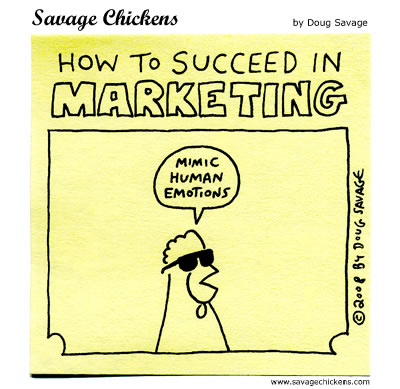
How to succeed in marketing

More Savage Chickens