
• The 60 Second Leader
  • Seven Secrets of Inspired Leaders
  • The Little Book of Leadership
  • Leadership Hub for Corporates
  • Learning to Live with Huntington's Disease
 

Phil's blog

How to lead in a downturn. The most important lesson of all

It occurs to me a lot of us are leading through a downturn – tough trading conditions, whatever you want to call it – for the first time. So, Douglas Adams’ advice from The Hitchhiker’s Guide To The Galaxy, is the best of all. It’s on the button below.
Those of us who are old enough to have been through previous downturns are still here. You will be too. And so will your organization if you lead it right (no pressure, then). Hint: part of your leadership job now is helping others not to panic, too. People panic when they feel things are out of their control. You help fix that by clearly setting out what’s happening, consulting with them on how the organization should respond to emerging trading conditions, and doing what you say. ‘Consulting’ doesn’t mean a long drawn-out consultation process. It means using the rapport and open communications channels you have established with individuals and people en masse to let people know where things are going, and involve them in adjusting to get there: you need their agreement and buy-in, as always, and then they’ll help you get there.

Four ways to lead with urgency

More on John Kotter’s new book

Over in Leadership Now’s Leading Blog, Michael McKinney summarizes the four essential things you need to do to inject urgency into the organization, according to Professor John Kotter’s new book, which we previewed below. Michael says:

1. Bring The Outside In
“Kotter offers four tactics to establish a sense of urgency in any environment:

First, bring the outside in. A “we know best” culture reduces urgency. “When people do not see external opportunities or hazards, complacency grows…. With an insufficient sense of urgency, people don’t tend to look hard enough or can’t seem to find the time to look hard enough. Or they look and do not believe their eyes, or do not wish to believe their eyes. Even if seen correctly, and in time, external change demands internal change.”

2. Model it every day
The second tactic is to behave with urgency every day. “Increasingly changing environments create a need for alertness and agility, which demands a sense of urgency that must be modeled by the boss all the time.” A few of the behaviors he details: purge and delegate, speak with passion, walk the talk.

3. Find opportunity in crisis
Third, find opportunity in crises. A problem with a damage control mind-set is often eliminates an opportunity. A properly leveraged crisis can be a valuable tool to break through complacency.

4. Deal with the ‘NoNos’
And fourth, deal with the NoNos – those people that are “always ready with ten reasons why the current situation is fine, why the problems and challenges others see don’t exist, or why you need more data before acting.”

I think 4. is the same as 1. and can be summarized as ‘Challenge denial’. What’s the most powerful force in the Universe? I once heard James Taylor say (no, not THAT James Taylor. This one’s the former CEO of Gateway and co-author, with Watts Wacker of the Five Hundred Year Delta).

Love? Hate? Gravity? Compound interest, as Einstein is supposed to have said? Nope. The most powerful force in the Universe is denial. When I say that in workshops I always expect someone at the back to stick their hand up and say “Oh no, it’s not…” (Think about it).


Courage and Leadership: More from Alper Utku

More from Alper Utku’s Open Heart Leadership blog. He and I have a weekly dialog/ue where I challenge Alper’s ideas and the ones that survive being hit with a hammer go through to form Alper’s blog posts. Please feel free to comment on them yourself to help Alper sharpen his definition of a form of leadership fit for the 21st century. He’s posting on Courage this week and next. Here’s an excerpt from his second post:

I was talking with a friend, Stuart Turnbull, who is particularly interested in love in organizations, and we realized that the word ‘courage’ has its root in ‘heart’. ‘Cour’ = ‘coeur’ (’heart’ in French). That explains why Courage seems to sit at the core of Open Heart Leadership, as it is about acting from the heart.

In Turkish, we have the same connection as the Latin root: being courageous almost translates directly to being ‘heartful’. That brings us to the word ‘encouraging’, which also has ‘heart’ at its core, and is about nurturing courage in others to do the right thing – an essential part of leadership.

If we follow this ‘heart’ link, it is a vital topic in different philosophies. In Sufi-ism, the heart is the ‘house of the divine’ and you are promised a state of no fears, no worries if you connect completely with the heart.

Manfred Clynes, the psychologist (see the MindMap jpeg in the post below) has a basic construct of emotional rhythms he calls ‘Sentic States’. He says they are universal, shared across cultures by all humanity. The seven Sentic States have been linked to the seven chakras of the body by Peter Hawkins of the Bath Consultancy Group, who has used the model in training.

The seven Sentic States are:

Post continues here (August 26th)


Courage and Leadership

I’m working with Alper Utku to help him define a kind of leadership that matches what we need as individuals and organizations in the 21st Century. Alper dubs it Open Heart Leadership and has started a blog to try and define it in theory and in practice.

Here’s his first post on the subject, which I worked with him to create:

Courage and Open Heart Leadership

“OK, so we’ll use these posts to chip away at the definition of Open Heart Leadership, like a sculptor, by working through some critical elements – Courage, Realness, Intimacy and so on.

Let’s start with a few posts on Courage. Below is link to a MindMap on the Open Heart Leadership blog that I created to help me think this through. If you want to take a look, click on the jpeg of the MindMap a couple of times to get your ‘magnifier’ to work, so you can read it. Or, download the jpeg and use your viewer to magnify it so you can read it.

I’ll then blog further this week on some of the elements in the MindMap to pull together how Courage is part of Open Heart Leadership.

Here’s the link (It’s posted on August 25th): The Open Heart Leadership Blog: Courage; The MindMap


Tyer Brule on making people wait

Great article in Tyler Brule’s column in the FT.

Apparently making people wait for a meeting to show how important you are has gotten out of control in the US. And it shows a culture that simply doesn’t care about the time of people who have come to see you, whether they be a general business appointment or a customer who is left clicking their heels in reception. Here’s a brief extract:

“On a recent trip to New York, a colleague and I were on the brink of getting in the lift without a word and leaving: our host had showed no interest in keeping her appointment and the receptionist was more interested in running a nail bar behind her big desk than playing the role of mistress of first impressions.

But at the moment we were about to leave, an attentive gentleman rescued his colleague and his company’s reputation with a tactful show of diplomacy and charm. It shouldn’t have been necessary.

“As the ailing economy chokes business and consumers, only those companies that take a cold hard look at how they are treating the people that keep their coffers full – and act accordingly (by improving service) – are the ones that deserve to survive.”

More from Brule’s column on the link below. On the same subject, I spotted this in the FT over the weekend, which is a good eight-word rule to solve the problem:

“Be gracious with people and ruthless with time.” – Martin Addison, MD, Video Arts

More from Tyler Brule here: Tyler Brule’s FT column


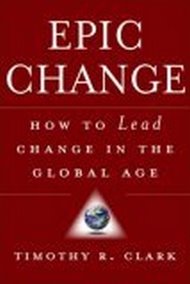
Book Recommendation: EPIC Change

Tim Clark sent me his book on change,

EPIC CHANGE: HOW TO LEAD CHANGE IN THE GLOBAL AGE BY TIMOTHY R. CLARK.

Two particular points are at the core of his book and I find them compelling. They are:

1. The leaders’ ability to draw out people’s discretionary efforts is more important in success than strategy or other issues that are usually assumed to be primary success factors.

2. The leader’s role is largely one of energy management within an organization; generating, releasing and channeling people’s energy:

From the flyleaf
“The EPIC (Evaluate, Prepare, Implement and Consolidate) approach for change management draws on the research-based “power curve of change.” As Clark explains, change fails less often for poor strategy or technical difficulty. Rather, it is a leader’s inability to draw out the discretionary efforts of people that usually signals failure. The EPIC approach teaches leaders the critical points of leverage for energy management within an organization and offers a comprehensive guide to change leadership – arguably the most critical competency of the twenty-first century”.


Leadership lessons from Bruce Springsteen

Remember the Four Ps of Marketing? As part of his 100 Ways To Succeed series of occasional posts, past Leaders in London speaker Tom Peters lists The Boss’s 6 Ps as:

Passion!
Persistence!
Partners!
Performance!
Painstaking!
Presence!

The actual Boss he is talking about, from whom he suggests all bosses should learn, is Bruce Springsteen, whom Peters had just seen in concert, which is what inspired him to pull together his Six Ps.


How to use Twitter for Customer Service

Skip to slides 89-95 (-ish) for examples of how Southwest Airlines and Zappos use Twitter for customer service. Micromedia, small interactions building to have big effects – it’s important to be aware what you can do with this stuff in customer service

[slideshare id=515573&doc=wamicromediajuly2008-1216234727186072-9]


Can you lead with kindness in a downturn?

Leadership is a hard-nosed thing, right? Especially in a downturn. If you’re too soft, people will take advantage, won’t strive to hit their targets (aka to please you, in these days of evaporating bonuses) and you won’t be a strong leader, right? Well, it’s not really as simple as that, is it.

Being a ‘hard but fair’ leader, a disciplinarian who keeps on top of people to ensure they do what they are supposed to do, and that they constantly report back to you for a pat on the head and try hard to avoid your temper if they did wrong…It’s all a bit old-fashioned and uninspiring, isn’t it; both for you and the people you lead. Yes, you need some of the elements of a ‘hard but fair leader’ – setting expectations for yourselves and others and ensuring you and others strive for high performance – but all the baggage that goes with it is increasingly outmoded.

If you’re anything like me, you want people to perform to a high level and do the right thing regardless of whether you are there or not, whether you will know about it or not, whether you will shout about it or not. You want them to do it because they are inspired to do it, not because they are afraid of the boss if they don’t do it.

Over on his Leadership Now blog, Michael McKinney re-visits this whole ‘tough leader or kind leader’ thing and says it’s not a case of opposites, not a case of hard or soft leadership. Michael looks at the book LEading With Kindness, to ask if it’s possible and to break the idea that tough/hard/demanding leadership is the opposite of kind/soft/undemanding leadership. Michael says:

Bill Baker and Michael O’Malley have done a service with their book, Leading With Kindness. As awkward as that title might seem at first blush, the authors aren’t suggesting that kind leaders have a soft personality, or are sissies, or are well liked at all times. (“You can be hard-nosed and kind.”) Leading with kindness is not a hot-tub leadership where the participants pass the torch singing Kumbaya. In fact they write, “They muddle through life much like the rest of us, mostly unnoticed except by those around them who are keenly aware that they are in the presence of someone special.”

(That last sentence reminds me that great leaders are not great because they are super-human. Instead, they are ordinary but growth-oriented people with character that have chosen to make a commitment to a bold course of action that is in the best interest of those they serve despite the odds.)

Gets my vote. Click on the blog link, above, to read more. Just because trading conditions get hard, doesn’t mean your leadership style has to.


Paris Hilton: “I’m, like, totally ready to lead”

Paris Hilton for President

I’ve wondered about the connection between celebrity and leadership for some time. People increasingly ‘follow’ the lives of celebrities – ‘follow’ as in read about them, watch news items about them, live their own life vicariously through the life of the celebrity. There is something of the ‘uber-you’ about celebrity culture (projecting your own life onto the more glamorous life of someone else) which mirrors some less desirable elements of ‘followership’ in leadership theory – the tendency to give up on ‘self’ and instead follow the will of the leader.

So, when John McCain’s people created an attack ad last week claiming Barrack Obama’s whole persona was more celebrity than leader – likening him to Paris Hilton and Britney Spears – they opened a whole can of worms. Here’s Paris Hilton taking up the challenge by saying to “that white haired dude” that she is, like, totally ready to lead, and that she is busy looking for a vice-presidential running mate. Worryingly, her energy policy (towards the end of the clip) sounds like it’s worth a second listen.