

When trading conditions get tough, you have to take even more care of the customers. If that message isn’t clear from leaders at all levels in the organization, watch out for this kind of customer service as a result (the clip is about three and a half minutes):
Phil's blog
Happy Birthday Woody Guthrie
Jul 14th, 2008 | Leadership | 0 Comments »

“I hate a song that makes you think that you are not any good,” he explained in Ed Cray’s popular biography Ramblin Man. “I hate a song that makes you think that you are just born to lose…I am out to fight those songs to my very last breath of air and my last drop of blood. I am out to sing songs that will prove to you that this is your world.”More at Wired Magazine
Sounds like leadership to me…
Why I hate Ikea, Ryanair and Capital One
Jul 14th, 2008 | Customer Service | 0 Comments »
Not me. But Shaun Smith, who writes a nice piece on this in the GCCRM July e-newsletter, which you can read here:
“There are some brands that I hate: Brands like Ryan Air, IKEA and Capital One. Yet I admire them for their singularity of purpose, clarity of vision and superior returns.I hate Ryan Air because it …full story
Describe your leadership in six words
Jun 24th, 2008 | Leadership | 0 Comments »
 Sir Terence Conran was once asked to describe himself in ten words. He replied ‘Ambitious, mean, kind, greedy, frustrated, emotional, tiresome, intolerant, shy, fat.’
Dan Pink says we can go even shorter in describing ourselves. He points to the book ‘Not Quite What I was Planning’, six word memoirs by a collection of people, both famous and obscure.
Now, this sounds trivial, but we live in a world of digest, where your leadership ‘brand’ has to be conveyed fast and deep. Remember Tom Peters’ powerful idea ‘Brand You’; that you have to brand yourself through your behaviour as a leader to stand out as unique, because the market tells us difference wins, sameness doesn’t?
So, here’s a useful exercise: what six words sum you up as a leader? Come up with six word then try them out on your colleagues to see if they agree. It’ll help you sharpen your leadership brand – aligning how others perceive you with how you perceive yourself as a leader.
Dan tried it at a business conference he was attending and these are a few of the replies. They aren’t specifically about leadership, but you get how it works by reading them:
* Did what I was supposed to.
* Happy, sad, angry, confident, really happy.
* Unsure, but you would never know.
I like that last one in particular – describes a lot of people in leadership positions.
Not all marketers should die
Jun 24th, 2008 | Customer Service | 0 Comments »
Though I sympathise with the Bill Hicks’ ‘all marketers should die’ rant that Johnnie Moore re-discovered on You Tube lately, I’d exclude the creators of this, just because it’s so creatively cheeky:

It’s a flyer for a pizza company, disguised as a pizza delivery boy that you see through your front door spy hole. Here’s how they do it:
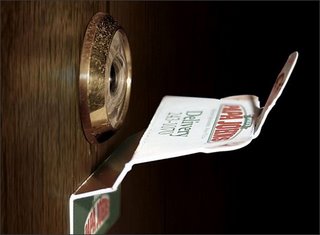
Spotted on the Firewire blog.
My favourite Jack Welch story: When Jack Blew Up The Plant
Jun 12th, 2008 | Leadership | 0 Comments »
One of the first things Jack Welch did as a 24-year-old manager of a GE plant was blow up the part of the plant he was responsible for.
The head of the plant called him to his office to explain.
Welch, assuming this was the end of his managerial career, duly explained that he was experimenting with a different mixture from the standard one and it had caused an explosion. The plant boss probed further, asking him why and what he had hoped to achieve.
Satisfied that Welch had
a) learnt a lesson from the experiment and
b) had practised sound thinking, just needed to adjust his risk analysis, the plant head protected Welch and he kept his job.
Welch says that act of leadership had a profound effect on him for the rest of his life. As head of GE, Welch championed experimentation, learning from mistakes and not blaming people if an attempt at something new went wrong…unless they repeated the same mistake more than once, that is.
Source for this story: My notes from a conversation between Jack Welch and the journalist Kirsty Wark. She had spotted the story in his book Jack, Straight From The Gut and so asked him about it. A secondary learning point: he tells that story to make it clear that leaders are not infallible and need to admit to their own mistakes – admit their own fallibility – if they are to create a culture in which others are honest and admit to mistakes, too. Otherwise you get the myth that the leader can’t be wrong and everyone covers up evidence to the contrary, and also never admit that they themselves are wrong.
The secret of happiness is…
Jun 12th, 2008 | Customer Service | 0 Comments »
…low expectations.
When you have no choice and you are disappointed, the world is responsible.
When you have 100s of choices and you are still not happy with the ones you make, you blame yourself.
The more options we have, the more we regret what we didn’t choose. This opportunity cost becomes a lingering regret that subtracts from the satisfaction of the choice.
That’s a distillation of the core of Barry Schwartz’s excellent book The Paradox of Choice: Why More Is Less, which Schwartz says he wrote after counting 175 different salad dressings and 75 iced teas on his local supermarket shelves and thinking, “This is crazy”.
If you have the time, here’s a 20 minute talk Barry Schwartz gave at Ted on how the abundance of choice makes us (consumers) unhappy. Think about it if part of your customer strategy is the assumption that offering more choice makes customers happier.
Heroes or Villains: Does the workplace make them?
Jun 6th, 2008 | Leadership | 0 Comments »
“Heroes don’t have a special personality. They are not more compassionate, more altruistic, more or less of anything. They are simply people that in a particular situation where most people, observing something bad, do nothing, then the hero is the one who steps out of the crowd and challenges the definition of the situation, challenges the authority, dissents, defies, rebels and does not comply.”
That’s psychologist Philip Zimbardo talking to BBC Radio 4 in an interview this week.
Zimbardo is famous for the classic Stanford Prison Experiment when back in 1971 he turned the university basement into a fake prison where the young men playing the guards soon started abusing the people they were told were their prisoners. He showed how much circumstances can distort how individuals behave and how, given complete control over others, anyone can act as a monster.
Now he’s turned his attention to how to create environments in which people do the opposite – act heroically. His definition of ‘a hero’, above, maps onto the everyday leaders carrying out acts of leadership up and down the organization, regardless of position, that we need today.
I can’t reproduce a transcript here of much more of the item than the quote above without breaching the BBC’s copyright. But, if you have Real Player installed and go to this link, you should be able to listen to it yourself. After you hit the link, below, and once you are in the BBC site, look for the ‘All In The Mind’ programme title and click on that to listen again. If it doesn’t let you in jump down this page to the other link, which also lets you take this further:
BBC Radio 4, All In The Mind Programme, Thursday June 5th
In case that doesn’t work for you, this link, below, goes to a blog post from Zimbardo in which he talks about stimulating the heroic imagination.
“I believe that an important factor that may encourage heroic action is the stimulation of the “heroic imagination”– the capacity to imagine facing physically or socially risky situations, mentally struggle with the hypothetical problems these situations generate, and consider one’s actions and the consequences.”
Your role as a leader, then, becomes stimulating the heroic imagination in people – making them realise what they are capable of. There’s a clip in The Leadership Hub, on the Home Page at time of writing, that gives a fictional example of a teacher stimulating the heroic imagination – the belief that someone can take the lead and accomplish something great – in the movie Paying It Forward. Here’s the link to the Zimbardo blog post:
What century is this?
Jun 6th, 2008 | Customer Service | 0 Comments »
Economists called the 20th century ‘The American Century’ because of the US domination of the world economy. So, will this be another American century or, as many Americans fear, will the balance of power shift to China or India, making this century The Chinese Century or The Indian Century?
None of the above. This century is The Customer Century. Last century, suppliers had the power. This century, with over-supply the major feature of the global economy, customers have the power. So, stop thinking in terms of which country will dominate; that’s a limited way of thinking and stops you focusing on where power really is.
Remember the Mattel toy recall? Most of those toys were made in China. That was an example of American consumers exercising their power over suppliers who were both American (Mattel) and Chinese (Mattel’s suppliers). China’s product quality and safety standards are being forced up by the demands of the American consumer.
So what are you doing to change your organization’s practices to recognize that power now lies with the customer?
Moments of Truth: Four people rules
Jun 6th, 2008 | Customer Service | 0 Comments »
I’m re-reading Jan Carlzon’s book Moments of Truth. He’s the CEO who turned around the Scandinavian airline SAS.
He starts the book with these four statements. They are a mini manifesto for getting people engaged and energized throughout the organization. The four rules apply particularly to the steps you need to take to free up your front line people to serve customers more effectively.

1. Everyone needs to know and feel that he or she is needed
2. Everyone wants to be treated as an individual
3. Giving someone the freedom to take responsibility releases resources that would otherwise remain concealed
4. An individual without information cannot take responsibility. An individual who is given information cannot help but take responsibility.
Source: Taken from the opening of Jan Carlzon’s book Moments of Truth.

 LinkedIn