



• The 60 Second Leader
  • Seven Secrets of Inspired Leaders
  • The Little Book of Leadership
  • Leadership Hub for Corporates
  • Learning to Live with Huntington's Disease
 

Phil's blog

Injecting personality into customer communications

Jim Sterne, one of my favourite web people, got this confirmation email when he ordered a CD from CD Baby: shows you can inject a little personality into the dullest of customer communications if you try. Mind your brand, though: this kind of humour only works for some…

“Your CDs have been gently taken from our CD Baby shelves with sterilized contamination-free gloves and placed onto a satin pillow.

“A team of 50 employees inspected your CDs and polished them to make sure they were in the best possible condition before mailing.

“Our packing specialist from Japan lit a candle and a hush fell over the crowd as he put your CDs into the finest gold-lined box that money can buy.

“We all had a wonderful celebration afterwards and the whole party marched down the street to the post office where the entire town of Portland waved ‘Bon Voyage!’ to your package, on its way to you, in our private CD Baby jet on this day, Sunday, November 18th.

“I hope you had a wonderful time shopping at CD Baby. We sure did.

“Your picture is on our wall as ‘Customer of the Year.’ We’re all exhausted but can’t wait for you to come back to CDBABY.COM!!

“Thank you, thank you, thank you!

“Sigh…

“Derek Sivers, president, CD Baby
the little store with the best new independent music
http://cdbaby.com cdbaby@cdbaby.com (503)595-3000”


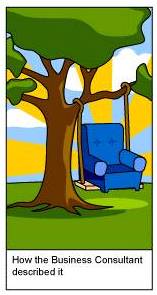
Projects 1 of 10: Why Customers never get what they want

From a post by Jason Cowsill in The Leadership Hub


How to Make Friends (and influence them to be loyal)

From Chris Daffy’s latest newsletter:

“When I’m in Bucharest, which is now almost once every month, I usually stay at the J W Marriott. It’s a great hotel and the people there always make me feel very welcome. Each night, after the room attendant has turned down my bed they leave a chocolate, feedback form and a card with a ‘thought for the day’ on it. During my last stay one of these thoughts got me thinking about customer service and loyalty. It was –

“The only way to have a friend is to be one” – Ralph Waldo Emerson

This got me thinking that “The only way to have loyal customers is to be loyal to them”. But that’s not the way most organisations approach it. They see loyalty as a one sided thing and focus on what they can do to make customers loyal to them, but give little or attention to what they could do to show how loyal they are to their customers.

I’m also reminded of one of Stephen Covey’s 7 habits, “Seek first to understand, then to be understood”. This too reflects the theme of give first to receive later. So I think I’m going to create my own First Rule of Loyalty, which is –

‘First demonstrate loyalty to customers; then seek ways to earn it back.’


Why we cry out for creative leadership

“A Harvard Business School study looked at job satisfaction. Orchestra players came just below prison guards. Chamber musicians came in at number 1. What’s the difference? The presence of a conductor.”
Boston Philharmonic Conductor Ben Zander, speaking at Leaders in London 2007

Rosamund Zander, Benjamin’s wife, wrote: “There is no guiding institution that speaks compellingly to people. Markets have replaced institutions and markets do not speak in a human tongue. This radical shift cries out for creativity. Art is about rearranging us.”

The leader, according to Zander, is the one who is masterful at creating and holding distinctions. Learning and leading is not about the transference of information, from conductor to orchestra or leader to employee. It is about the opening up of new categories to help people make sense of and thrive in a fast-changing world in which existing categories are not creative enough. “Framemakers create new frames. There is no problem that can’t be solved if you are willing to make a new frame, a new category.”

More from Zander at the Leaders in London blog, which I write weekly.


When it takes two to be great

Heard a great leadership lesson from the unlikely world of ballet today. Wayne Sleep, the former Royal Ballet dancer, described how Ninette de Valois, founder and then director of The Royal Ballet, brought together Dame Margot Fonteyn, then 41 and on the verge of retiring, with the virtually unknown 21-year-old Rudolf Nureyev, to dance Romeo and Juliet in 1963.

There was nervousness and apprehension on all sides: from the two principals themselves and from the ballet world in general. De Valois could have been setting everyone’s reputation up for a spectacular fall, including her own.

But, her instincts told her that this pairing could create something great, accelerate Nureyev’s development by pairing him with the greatest dancer of her generation, and revive Fonteyn’s career. In effect, it lifted the latter to even new heights, and she continued dancing, astonishingly, until she was 61.

By breaking convention and seeing the possibility that others couldn’t see, de Valois created possibly the greatest pairing in modern ballet. They went on to dance twenty roles together in the next decades.

I am personally completely unmoved by ballet; it leaves me cold. But, there are so many leadership lessons in that story that I lost count. The three that stuck, for me, are:

1. Tom Peters is fond of quoting Warren Bennis – “Great leaders revel in the talent of others”. Absolutely. Bringing other people together and watching them reach heights no-one had dreamt of is an act of leadership.

2. Great leaders are prepared to look foolish, as Sir John Hoskyns said. Any of us who step up, in any situation, and say or do what needs to be said or done, regardless of ridicule, regardless of established convention, is performing a powerfully creative act of leadership.

3. The myth of individual creativity and of the individual as leader: It can take two, or more, to unleash incredible creativity. The same with leadership – from Hewlett and Packard to Pret a Manger founders Sinclair Beecham and Julian Metcalfe, it often takes two or more to lead creatively and some of the best leadership acts and the most creative cultures are formed by a partnership…or even by a mass of people all leading and following each other simultaneously (flash mobs, for example).

Wayne Sleep was talking on Radio 4’s Woman’s Hour.


Turkey and gravy soda anyone?

At MyJones soda, you upload your own picture to go on the label, suggest recipes and write your own blurb on the back of the label. Then they deliver it to you in 12-packs.

In Canada, it’s now the second largets drinks company after Coke, according to Peter Fisk.

Their most popular flavour? Turkey and gravy soda. You can order a whole Thanksgiving or Xmas meal in soda version, in fact, including cranberry soda to mimic the side order of cranberries with your turkey. It’s one of the best-selling Thanksgiving gifts in North America.

Co-creation with customers…call it what you will. With MyJones soda and the growth of ‘design your own’ t-shirt websites that follow a similar pattern, the world of branding is now very different from how it used to be.


From Product-focussed to Customer-focussed

Nice example here from Rob Lawton of how he helped the State of Missouri’s revenue department reduce their customer tax refund turnaround time from 45 days to just 2 days, by switching from product-centred to customer-centred thinking and adapting one of their products accordingly. Try picking on one product of yours and reverse engineer it from the customer’s point of view, as Robin describes here, and see what benefits you can achieve (may take a minute or two for the clip to load):


Bill Clinton on how to deal with strategic decay


Changing rooms: This time it’s personal

My friend Marion returns from a trip to the States full of interesting observations – She has an eye for spotting the new and interesting.

On the customer front, she spotted an article about “Toronto’s trendiest changing room”, which is in a yoga-wear shop. A sale’s assistant writes the shopper’s name on a wipe-board on their changing room – “my own personalised compartment”, wrote the journalist.

Clever and simple. What do you do to make your space the customer’s space?

At St. Lukes, the radical advertising agency in London, major clients have their own themed room, which they can work from as if it’s their own office, whenever they are in the area. So, meetings with executives from Clarks, the shoemakers, take place in the Clarks room. In typical St. Luke’s style, the Clarks room is themed around shoes – even the coffee table wears shoes; the legs on the table have feet on the end, which sport Clarks footwear.

How at home do St. Luke’s clients feel, do you think? ‘Put yourself in your customers’ shoes?’ At St. Luke’s they even put their furniture in their customers’ shoes.


The Birthday of Strangers

I’m a bit late on this, and thanks to Leadership Hub member Annalie Killian for drawing it to my attention:

“A study claims that between the ages of 20 and 40 people lose about one friend every year. Writer Theodore Zeldin, who has spent a lifetime studying friendships, wants to celebrate his 74th birthday with everyone – but only if you promise to have a proper conversation with a stranger.”

Zeldin wants us all to have deeper and richer conversations:

“…the Zeldin Method is a rather exacting solution.

His menu of conversation usually takes around two hours to complete and took up to four when the strangers were French.

However, he claims 99% of the participants found it enlightening and enjoyable, and a reflection that while we may be talking all the time we avoid discussing things in any depth.

He is also not a fan of small talk and gossip. It is, he says, like apes grooming one another.

It helps bond us but it fails to help us understand one another.”

More of the above article here: The Birthday of Strangers
And more on Zeldin’s ‘Muse Conversations’ approach to deepening our communication here: Muse Conversations