• The 60 Second Leader
  • Seven Secrets of Inspired Leaders
  • The Little Book of Leadership
  • Leadership Hub for Corporates
  • Learning to Live with Huntington's Disease
 

Phil's blog

Out of Control: Swarm intelligence and how 900 people can fly a plane

Ashridge College have a leadership conference coming up and one of the sessions caught my eye:

Swarm Intelligence
This is a highly interactive session in which all participants interactively experience the power of Swarm Intelligence. We show how all of the participants collectively can fly a virtual aircraft through certain targets, whereas individuals are unable to this. We make links to companies who have used the insights from this to enhance their business.

Apparently it’s the new conference interactive thing: the audience flies a plane together. Unilever UK did it at their annual management conference. At Argos, the home delivery company, 900 pilots flew a plane together at a Telford conference recently.

This reminded me of a passage in the Kevin Kelly book Out of Control that explains the principle of group intelligence, specifically how group decisioning beats individual decision-making.

An audience holds up red and green panels to control a game of ‘pong’ (as the Americans call it) or ‘tennis’ (remember the old simple video game on the Sinclair Spectrum. You don’t? Is it just me who’s that old, then?) on a giant video screen. They can’t lose, whereas a single person playing the game just needs to lose concentration for a micro-second and loses.

The Kevin Kelly example is on the Swarming Intelligence site

Leaders who think it’s your job to make the decisions for others to act them out, because a leader is the best decision-maker: do you get it yet?


Leadership throughout the system

I’m reading Primal Leadership by Daniel Goleman et al and came across this reinforcement for my point in the Roger Bannister world record post, below, about the need to cultivate ‘Leadership’, not alpha ‘Leaders’; the latter being, without exception in my experience, simply egotists, not great leaders:

“As the sociologist Max Weber argued a century ago, institutions that endure thrive not because of one leader’s charisma, but because they cultivate leadership throughout the system.”


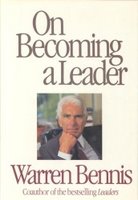
Warren Bennis, On Becoming A Leader

OK, I have to ‘fess up to being a fan of Warren Bennis, whom the Financial Times dubbed ‘The Dean of Leadership’. I chaired a leadership seminar he gave in Florida a couple of years ago and he was possibly the nicest man I have ever met: wise, generous with his insights, and he carried on an email conversation with me afterwards to help me clarify my own thoughts on leadership.

Here are some of the bits that I find most inspiring from Bennis’ book On Becoming A Leader:

Drucker on what leadership is for

As Peter Drucker has pointed out, the chief object of leadership is the creation of a human community held together by the work bond for a common purpose.

Example is all. Integrity and Authority

Emerson says, “What you are speaks so loudly I cannot hear what you say.”

Authenticity: Invent yourself

I cannot stress too much the need for self-invention. To be authentic is literally to be your own author (the words derive from the same Greek root), to discover your own native energies and desires, and then to find your own way of acting on them.

On learning and Leading

* One: You are your own best teacher.
* Two: Accept responsibility. Blame no one.
* Three: You can learn anything you want to learn.
* Four: True understanding comes from reflecting on your experience

Learn by watching and emulating leaders you admire

“One thing I did when I first got here was to sit in the office of the studio head all day, day after day, and watch and listen to everything he said or did. So when writers would come, when producers would come, I would just be there. When he was making phone calls, I would sit and listen to him, and I would hear him contend with what a person in his position contends with. How does he say no to someone, how does he say yes, how does he duck, how does he wheedle and coax? I would have a yellow pad with me, and all through my first many months, any phrase I didn’t understand, any piece of industry jargon, any name, any manoeuvre I didn’t follow, any of the deal-making business financial stuff I didn’t understand, I’d write it down, and periodically I would go trotting around to find anyone I could get to answer.” (Sidney Pollack, the movie director)

Leaders and Failure / Mistakes

“In organizations where mistakes are not allowed, you get two types of counterproductive behaviour. First, since mistakes are ‘bad’, if they’re committed by the people at the top, the feedback arising from those mistakes has to be ignored or selectively reinterpreted, in order that those top people can pretend that no mistakes have been made. So it doesn’t get fixed. Second, if they’re committed by people lower down in the organization, mistakes get concealed.”

Leadership & Instinct

A part of whole-brain thinking includes learning to trust what Emerson called the “blessed impulse,” the hunch, the vision that shows you in a flash the absolutely right thing to do. Everyone has these visions; leaders learn to trust them.

Leaders & Innovation

A leader is, by definition, an innovator. He does things other people haven’t done or don’t do. He does things in advance of other people. He makes new things. He makes old things new.

It’s not about Charisma

Some would argue that the answer is charisma, and either you have it or you don’t. I don’t think it’s that simple. In the course of my study, I met many leaders who couldn’t be described as charismatic by any sort of rhetorical stretch, but they nevertheless managed to inspire an enviable trust and loyalty in their co-workers. And through their abilities to get people on their side, they were able to effect necessary changes in the culture of their organizations and make real their guiding visions.

Buy The Book: Warren Bennis,On Becoming A Leader, Random House Business Books. First published 1989.

The Consumer is a Myth

“Eric Hoffer said:

‘You can never get enough of what you don’t really need to make you happy.’

That defines the consumer. And ‘consumers’ are increasingly aware of this.

The industrial age bubble has burst because the industrial economy is based on profound contradictions.

One of the biggest myths within it is the myth of the consumer who is defined by ‘How much I have and how much I spend’.

We are all realising today that we are no longer consumers. Because consumption isn’t bringing happiness. In a fundamental sense, it isn’t ‘natural’.”

Peter Senge, speaking in London last month at European Customer Management World 2007


Who’s the leader?

So, in this clip of Roger Bannister breaking the 4 minute mile, who, exactly, is the leader?

Chris Brasher is the leader.
Then Chris Chataway is the leader.
Then Roger Bannister is the leader.

All within the space of four minutes. Well, 3 minutes, 59.4 seconds.

It wasn’t a race, by the way. Brasher and Chataway were pacesetting for Bannister; leading him, pulling him on to succeed, supporting him. Like great leaders do.

Acts of leadership like this one are in fact collaborations in which people take turns to lead. The myth of ‘the leader’ stops us recognizing this obvious truth. Stop viewing leadership through the lens of ‘the leader’. Start thinking ‘acts of leadership’ rather than ‘leader’ and you are better equipped to help build an organization, team or unit full of acts of collaborative leadership.


Nothing new under the sun

I’ve been reading Machiavelli’s The Prince out of curiosity – to see if there is anything relevant to modern organizational leadership.

If you tiptoe through the Realpolitik and sidestep the recurring need for Princes to slaughter whole towns to prove they are not to be trifled with, you can find some interesting stuff relevant to leading Mergers and Acquisitions and one or two other modern leadership problems.

But, overall, Machiavelli is a bit too literal on reducing headcount to be of much use today.

Then I came across this:

“There is nothing more difficult to plan, more doubtful of success, nor more dangerous to manage than the creation of a new system. For the initiator has the enmity of all who would profit by the preservation of the old institutions and merely lukewarm defenders in those who would gain from the new one.”

That was written in 1513.

Nothing new under the sun.


Leaders and Legacy

I heard Greg Dyke, former Director General of the BBC, say this today, when asked what he had achieved as boss of that organization. “It’s a popular thing to talk about legacy now; what your legacy is. I just wanted people to be happier than they were before I arrived at the BBC.”

Which reminded me of this story that I heard Nigel Paine, Head of People Development at the BBC, tell:

When Dyke resigned suddenly, eight thousand BBC employees massed in the street outside his office. It was spontaneous. “When he came back into the offices after going out to thank them, he didn’t realise that half his face was plastered with lipstick. He looked like a circus clown. These people just wanted to thank him for inspiring them”, said Nigel Paine. “It was an extraordinary, spontaneous outburst.”

Sounds like he achieved it. Would people take to the streets in protest when you leave? Of course leadership isn’t a popularity contest. But, this was about inspiring people and reconnecting them with the reasons they joined the BBC in the first place. That’s what they were showing appreciation for.


You cannot market an experience

C. K. Prahalad, speaking at European Customer Management World in London last week:

“You cannot market an experience. You co-create it. It’s contextual and depends on who you are with.

Customer-centricity does NOT mean the firm becomes more customer oriented. It means the consumer becomes part of the unit of analysis, becomes part of the value creation.

When we talk about CRM, what is the assumption we make? That WE can manage the relationship, that the consumer is passive and a recipient. When you buy CRM systems from Siebel or someone, this is the dominant frame you are working within.

Ubiquitous connectivity means 3 billion people are now talking to each other. Are we adjusting to that? Or are you trying to control or block bloggers?

People are going to participate in your value creation whether you like it or not.

And, as my mother used to say: ‘Friends may come and go, but enemies just accumulate. “


Buy genes online. Do-It-Yourself evolution

Now you can buy genes online , and use them to practise “directed evolution”.

Now you can buy genes online , and use them to practise “directed evolution”.

Thanks to “a completely new and patented technology for producing synthetic gene constructs on a fully-automated production plant” scientists no longer have to rely “on tedious manual cloning procedures”.

Can just imagine the conversation on the customer helpline:
Call centre agent: “Could I take your name and how can I help you today?”

Caller: “God here. I need to put in an order for a new line in elephants…”

Time you started re-thinking your customer relationships if you haven’t already. It’s a strange new world.


David’s signature

I just received a very nice email from the brilliant David Taylor, author of The Naked Leader, and spent ages staring at his signature at the end of the email. It’s here:

Fulfilling the promise of your first few seconds

While ensuring no regrets in your last

I love that. It’s like a mantra for leadership: making sure that we ourselves and others we encounter fulfill our promise.

The Naked Leader