“The original sense of the hipster term ‘cool’ referred to the capacity of African American jazz musicians who could control their rage at the racism of the times, even as they channeled that anger into an extraordinary expression of deep feeling. Effective leadership demands the same sort of capacity for managing one’s own turbulent feelings while allowing the full expression of positive emotions.” – Primal Leadership, Daniel Goleman
You pick up all kinds of interesting information in Daniel Goleman books…
Source: Lewis MacAdams, Birth of Cool: Beat, Bebop and the American Avant-Garde, New York, Free Press, 2001
I’m usually wary of books that change their name – this one used to be called ‘Got Game’ when it was published as a hardback in 2004 – but in this incarnation, it was recommended by Euan Semple and Johnnie Moore, so I thought it worth another look.
And it is.
Beck and Wade’s research findings and views on how to lead and be led by the gaming generation in the workplace are illuminating. I particularly like the section heading “Leaders? We don’t need no stinking leaders” and the explanation that “For starters, in the world in which gamers grow up, leaders are basically useless…”.
True. But there again, even for the non-gamer generation, leaders are basically useless. Some research I was involved with a while back showed that nine out of ten managers find their own line manager or organizational leader ‘uninspiring’. In my book that makes ninety per cent of supposed ‘leaders’ in organizations useless.
I’m not convinced by some of the arguments in The kids are alright, such as differing attitudes to risk when you have a reset button to push lead to the need to help younger employees manage risk more effectively.
But, there are useful explanations to ease culture clash in the workplace, for example, in pointing out that a manager approaching a gamer generation employee who has one ear piece in their ear, listening to their iPod, an IM window open on their desktop, two documents and a U Tube window open, and may not even stop using the keyboard as the manager is talking to them, may indeed be listening. Just not the way you and I listen.
It’s not that the gamer generation can multi-task, say Beck and Wade. Technically, there is no such thing as multi-tasking. Their brains are just more adept at leaping from task to task and back again in ways that disorientate non-gamers. They don’t have the timelag.
I bought this book – The New Culture of Desire, by Melinda Davis – because I was tempted by the big Tom Peters endorsement of it and because the author was presented as the brains behind the futurist Faith Popcorn. I have a lot of respect for Faith Popcorn, so bought the book. Turns out Faith Popcorn is the brains behind Faith Popcorn. There is some good thinking in this book, but the hype – the attempt to coin new marketing buzzwords in particular – shrouds it too well. Don’t bother buying it. I extracted the best bit, a list of how consumers are different today and what they want, and summarised it in The Customer Blog entry for March 13, 2007. You can find it over there. It’s worth a look.
Leaders in London blog readers: scroll down for your Robert Kennedy clip
Do we think ourselves into new ways of acting or act ourselves into new ways of thinking?
The evidence suggests the latter works. Act ‘as if’ you are leading and you lead. Stephanie West Allen has a fascinating post over at her blog idealawg based on an article written by herself and Jeffrey Schwartz. Schwartz coached Leo DiCaprio for his role as Howard Hughes in The Aviator. DiCaprio’s acting out of Hughes’ Obsessive Compulsive Disorder (constantly washing his hands) for the movie led to the actor showing symptoms of OCD himself.
There’s also a brilliant webinar given by Jeffrey Schwartz and David Rock on the neuroscience of Leadership on the Strategy+Business webinars site. I have some notes from it if you don’t have the time to listen to it all (email me Phil@60Secondleader.com if you want the notes).
Just came across this, from Albert Einstein, in this book:
“All religion, arts and sciences are branches of the same tree. All these aspirations are directed towards ennobling man’s life, lifting it from the sphere of mere physical existence and leading the individual towards freedom.”
Am I being naive, or is that a wonderful definition of what leadership should be today (including self-leadership – leading ourselves towards freedom)?
Now this is how organization should communicate with their customers:
“Broadband. How that word excited us. What sweeping vistas of possibility it conjured in the mind’s eye. What wondrous traffic it ushered through its mighty doors. What a leap forward from the drudgery of dial-up.
But what is it today?
Standardband. Same-as-my-Dadband. The ‘information superhighway’ is now everyone’s M25. Increasing one lane at a time. Another small step for Internet-kind. Well isn’t this the 21st century? Give me back the leaps.
Give me the potential to reach speeds that will make me dizzy. Let me download without limits. Build this new online world on the principles of honesty and value, and always listen to what I may say. Bind me not by annual contracts, but win my loyalty through effort. And give me telephone support in case I tire of reading text.
Don’t cease to innovate. Don’t give me less than the best.
And don’t ever cap my dreams.”
It’s BeThere broadband. Someone’s been reading The Cluetrain Manifesto. Thank God. More please.
Leaders in London blog readers : scroll down for your Robert Kennedy clip
This is Dr. Milton Wexler, an extraordinary leader who died last month, aged 98. When Dr. Wexler’s wife died of Huntington’s Disease, decades ago, this amazing man – a psycho-analyst, not a specialist in hereditary diseases – later supported by his daughter Nancy, galvanised scientists around the world, bringing them together in collaborative groups to unlock the mysteries of HD. Thanks to their efforts, and the Hereditary Diseases Foundation, which they founded and funded, the gene was discovered a decade ago. Much of the momentum towards finding a cure for this illness over the past few decades has come initially from this one man and subsequently from his daughter Nancy and her sister Alice.
There’s a wonderful short article in The Examiner (but it is not linkable to) explaining how Wexler, a Hollywood psycho-analyst, came into the hereditary research field from outside and quickly became its global leader and inspiration, with his daughter Nancy taking up the baton. Here’s an extract with lessons for other leaders and would-be leaders in how to step from one field into another and shake it up by inspiring people to look for a new way of doing things:
“In the early 1970s, Wexler began to recruit young scientists to help find a cure. The freewheeling workshops – inspired by his therapeutic sessions with artists – stressed brainstorming and were innovative in biomedical research.In 1983, scientists nurtured by Wexler – and later also by Nancy, a clinical psychologist – found the genetic marker for Huntington’s. In 1993, they located the gene itself. ‘The search for the Huntington’s gene became the paradigm for all such gene hunts,’ said Dr. Francis Collins, director of the government-supported National Human Genome Research Institute in Bethesda, Md. ‘That all came out of that wonderful intellectual ferment that Milton and Nancy created.’ “
Yes, I have a personal interest in this as you can see from the Home Page of this site.
What is it with Gillette? I had just come to terms with needing two blades in my razor. Then they brought in that third blade with the Mach III. “Interesting development, but sets a dangerous precedent. I don’t think there’s room for many more blades in that thing,” quipped Tom Peters at one of our ecsw.com conferences.
Turns out he was wrong: last count there were FIVE blades, and still counting.
What Gillette is doing, of course, is keeping its edge. Or, er, edges. As Shaun Smith points out in his book mentioned below, the old days of ‘If it ain’t broke, don’t fix it’ are gone. Constant re-invention is how to keep ahead of customers. You need to think of yourself and your colleagues as one of those Gillette razors.
“Pan-Am, Wang, C&A, Swissair. Where are they now? Engineers have a term for this: entropy, the natural tendency for things to lose energy and become less effective over time. Strong service brands avoid withering away by constant re-invention to keep ahead of customers.” – Shaun Smith, co-author of Managing The Customer Experience
So, there you have it: you are a razor. Go sharpen yourself. I must be doing something wrong, though. I still manage to remove more flesh than stubble, no matter how many blades and lubricating strips Gillette stick in that thing.
At last year’s Leaders in London, John Kotter told a story about Robert Kennedy on the night Martin Luther King was killed that reminded me what a great almost-president he was.
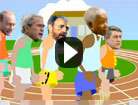
I’ve been searching for film of the impromptu speech Kennedy made that night and just found it on You Tube. It’s below. Ignore the Italian subtitles. There’s a preamble, below, you might want to read before clicking on the clip to fully appreciate it.
Kennedy was due to give a campaign speech in a poor black part of Indianapolis. He knew, but the crowd didn’t, that Martin Luther King had been killed that night. You can hear him say at the start of the clip “Do they know about Martin Luther King?”
The sheriff’s department tried to get him to cancel the speech, because it was too dangerous to address a crowd that night. He refused. From the back of a flatbed truck, he abandoned his campaign speech and made this one instead.
There were riots in sixty American cities that night in outrage and grief at Dr. King’s death. The one major city that saw no riots was Indianapolis, where Robert Kennedy had made this speech.
The end of his speech is cut off in this clip, so I’ve reproduced it below.
John Kotter – professor of leadership at Harvard – says that when he showed this clip once, a member of the audience came forward at the end and explained that the speech was only half the act of leadership Kennedy carried out that night that stopped the violence in one part of the States at least.
After stepping off the plane at Indianapolis, he gathered together the 100 or so volunteer campaign stewards who were there to help organise the event and told them Dr. King was dead and that he was going to tell the crowd. One of the young stewards was the man attending Prof. Kotter’s seminar: he had been there.
Their task, said Kennedy to his young volunteers, was to go out into the centre of Indianapolis after he had talked to the crowd, and look for people out on the streets who were raging over Dr. King’s death, and to console them, to counsel them. Kennedy explained that he couldn’t tell them what to say because he didn’t know himself what he was going to say that night.
He also said that he realised this was not what they had signed up for when they volunteered to help him make a campaign speech and that it could be dangerous, so they should feel free to leave with a clear conscience. Only two of the hundred or so young people walked away.
Kennedy then went up onto his flatbed truck, and his peace emissaries dispersed to join the crowd.
A nearly-President who quotes, off the top of his head, his favourite poet, Aeschylus, and who asks the people to follow the lead of the Ancient Greeks. And thereby prevents a night of violence. Oh, how sadly different from what we have now…
ROBERT KENNEDY’S IMPROMPTU SPEECH THAT PREVENTED A NIGHT OF VIOLENCE
“I have sad news … and that is that Martin Luther King was shot and killed tonight.
Martin Luther King dedicated his life to love and to justice for his fellow human beings, and he died because of that effort.
“In this difficult day, in this difficult time for the United States, it is perhaps well to ask what kind of a nation we are and what direction we want to move in.
“For those of you who are black—considering the evidence there evidently is that there were white people who were responsible–you can be filled with bitterness, with hatred, and a desire for revenge. We can move in that direction as a country, in great polarization–black people amongst black, white people amongst white, filled with hatred toward one another.
“Or we can make an effort, as Martin Luther King did, to understand and to comprehend, and to replace that violence, that stain of bloodshed that has spread across our land, with an effort to understand with compassion and love.
“For those of you who are black and are tempted to be filled with hatred and distrust at the injustice of such an act, against all white people, I can only say that I feel in my own heart the same kind of feeling. I had a member of my family killed, but he was killed by a white man.
“But we have to make an effort in the United States, we have to make an effort to understand, to go beyond these rather difficult times.
“My favorite poet was Aeschylus. He wrote: “In our sleep, pain which cannot forget falls drop by drop upon the heart until, in our own despair, against our will, comes wisdom through the awful grace of God.”
“What we need in the United States is not division; what we need in the United States is not hatred; what we need in the United States is not violence or lawlessness; but love and wisdom, and compassion toward one another, and a feeling of justice toward those who still suffer within our country, whether they be white or they be black.
“So I shall ask you tonight to return home, to say a prayer for the family of Martin Luther King, that’s true, but more importantly to say a prayer for our own country, which all of us love–a prayer for understanding and that compassion of which I spoke.
“We can do well in this country. We will have difficult times; we’ve had difficult times in the past; we will have difficult times in the future. It is not the end of violence; it is not the end of lawlessness; it is not the end of disorder.
But the vast majority of white people and the vast majority of black people in this country want to live together, want to improve the quality of our life, and want justice for all human beings who abide in our land.
“Let us dedicate ourselves to what the Greeks wrote so many years ago: to tame the savageness of man and make gentle the life of this world.
Let us dedicate ourselves to that, and say a prayer for our country and for our people.”
This is relevant to leadership and customer issues, so I’ll post this in both blogs.
From BBC News today comes another example of how people cheat when they have to work in a target-based performance management system – even with the best intentions and even the most senior people (what, you only expect call centre agents to cheat their targets? Target-based systems distort everything and most people’s behaviour).
Again, this one is from the National Health Service, and follows on from sporadic stories of ambulances having to wait outside hospitals with patients in the back (because the Accident and Emergency ‘waiting time limit’ for patients, imposed by central government, is measured from when they come in through the door, and the hospital would have broken its limit and been penalised if the patients waited inside the hospital for treatment, so they were kept in ambulances).
This isn’t evidence of pernicious people. It’s brilliant, dedicated people pushed into ludicrous behaviour by top-down target-setting. Top-down targets distort. Check out any of the lean service analysts and consultants to see how flawed the whole thing is. Anyway, here’s the latest example of what bad targets do to good people – and the terrible damage it does to the reputation of a much-loved institution:
FROM THE BBC
Patient waiting lists ‘manipulated’
Last Updated: Saturday, 07 April 2007, 12:28 GMT
A senior cancer specialist has admitted giving patients unnecessary treatments to manipulate hospital waiting lists.
Chris Hamilton, consultant clinical oncologist at Hull’s Princess Royal Hospital, told the BBC the problem was a government requirement that all treatment began within 31 days of diagnosis.
He says it means some low-risk patients are being treated before more urgent cases.
Mr Hamilton told the BBC he had given some prostate cancer patients hormone therapy to move them down the waiting list.
He said: “You’re caught in a bind. Either you give them unnecessary treatment with hormones and reclassify them or you put them to the front of the queue where they shouldn’t really be.”
He added that he knew other hospitals were carrying out a similar practice and he had informed national cancer director Mike Richards.
The Prostate Cancer Charity condemned Mr Hamilton’s claims saying it was “deeply unethical” to give patients treatment they did not need.
Dr Chris Hiley, head of policy and research, said: “It would be totally unacceptable if hormone treatment were being prescribed for men with prostate cancer simply in order to meet treatment target times – when it is not required to treat their cancer.
“It has nothing to do with patient centred care or good medicine.
“When men are diagnosed with prostate cancer, they need personal support and timely treatment. Providing the wrong treatment to meet NHS targets shows no regard for what patients need – the right treatment given at the right time with care and respect.”


 “The original sense of the hipster term ‘cool’ referred to the capacity of African American jazz musicians who could control their rage at the racism of the times, even as they channeled that anger into an extraordinary expression of deep feeling. Effective leadership demands the same sort of capacity for managing one’s own turbulent feelings while allowing the full expression of positive emotions.”
 I’m usually wary of books that change their name – this one used to be called ‘Got Game’ when it was published as a hardback in 2004 – but in this incarnation, it was recommended by
 I bought this book – The New Culture of Desire, by Melinda Davis – because I was tempted by the big Tom Peters endorsement of it and because the author was presented as the brains behind the futurist Faith Popcorn. I have a lot of respect for Faith Popcorn, so bought the book. Turns out Faith Popcorn is the brains behind Faith Popcorn. There is some good thinking in this book, but the hype – the attempt to coin new marketing buzzwords in particular – shrouds it too well. Don’t bother buying it. I extracted the best bit, a list of how consumers are different today and what they want, and summarised it in The Customer Blog entry for March 13, 2007. You can find it over there. It’s worth a look.
 Just came across this, from Albert Einstein, in this book:
 Now this is how organization should communicate with their customers:
 This is Dr. Milton Wexler, an extraordinary leader who died last month, aged 98. When Dr. Wexler’s wife died of Huntington’s Disease, decades ago, this amazing man – a psycho-analyst, not a specialist in hereditary diseases – later supported by his daughter Nancy, galvanised scientists around the world, bringing them together in collaborative groups to unlock the mysteries of HD. Thanks to their efforts, and the Hereditary Diseases Foundation, which they founded and funded, the gene was discovered a decade ago. Much of the momentum towards finding a cure for this illness over the past few decades has come initially from this one man and subsequently from his daughter Nancy and her sister Alice.

 At last year’s Leaders in London, John Kotter told a story about Robert Kennedy on the night Martin Luther King was killed that reminded me what a great almost-president he was.
 This is relevant to leadership and customer issues, so I’ll post this in both blogs.
 LinkedIn