• The 60 Second Leader
  • Seven Secrets of Inspired Leaders
  • The Little Book of Leadership
  • Leadership Hub for Corporates
  • Learning to Live with Huntington's Disease
 

Phil's Customer Service blog

Can you spot a fake smile?

Re. the item below about service givers who genuinely smile and those who don’t…

Is this person’s smile fake or real?

Can you spot fake (‘Pan Am’) smiles and real (‘Duchenne’) smiles? This 20 question test is based on the work of Professor Paul Ekman, who has a reputation as a master face reader after his years of research into the subject.


Virgin, the co-created airplane and the internet of things

Johnnie Moore spotted a little while ago a report on the PSFK blog on Virgin America’s inaugural flight, which featured a number of innovations for passengers (as you’d expect).

I’ve been musing on this for a while, as what Virgin has done seems to me to take elements of Web 2.0 – in which the users take over the system and create an experience themselves – and apply it to World 2.0. In doing so, they’ve more than subtly changed the whole dynamics of passenger flying, particularly removing some of the passivity and powerlessness that goes with sitting in serried rows and waiting to be served.

The new Virgin America planes are wired to be interactive instead of for one-way communication. This is what allows the pasengers to at least partly take over the creation of their own flight experience.

The usual flight experience is, well, “Sit down and shut up”, apart from when you want to get up for the loo, or to stretch your legs, or annoy the flight attendants by pressing the call button. Beyond that, your active participation in your own flight experience was limited to fiddling with the air jet above your head, adjusting your seat back a few inches one way or the other (and spilling the person behind’s dinner in the process) and generally fidgeting around.

Until the arrival of the in-flight entertainment system, of course, when you could add to your activities fiddling with the headphones to get them to work, finding a music channel that works and trying to find a movie you hadn’t watched before or that you would want to watch if you weren’t held captive in your seat.

The new Virgin planes have taken passenger participation in co-creating the flight experience to a new level. There is a full querty keyboard for each seat, and it’s wired for seat-to-seat chat. So, you can ‘tap someone on the shoulder’ (virtually) in the next aisle and five rows up if you want to chat with them (or chat them up).

You can choose from a ‘movie on demand’ system and select music downloads from the plane’s 3,000 tunes. The next time you fly Virgin, the system remembers what music you like.

The interactive wiring will allow you to play multi-player games with people in other seats, with the screen in front of you doubling as a video console.

Instead of being served painfully slowly from a trolley as each individual transaction is accompanied by the search for the right change in that paper cup air stewards use as a till, you pay for refreshments by swiping your card in a card swipe in the back of the seat in front of you.

Instead of being woken up by the lights coming on at odd hours, the plane’s lighting is programmed to mimic the time of day outside the plane, gradually fading and getting brighter, so that you can adjust to the time zone you are heading to.

The interactive airplane crept up on us a bit over the past few years. But, Virgin America just pushed it forwards into new territory.

I’m struggling a bit to explain the significance of this, but I think it’s huge – This is internet technology being used to make a real world experience interactive and participatory. Web 2.0 doesn’t just happen behind the screen on your desk. It’s merging with our real world experiences to make World 2.0 .

Roland Piquepaille wrote tellingly about this a while ago with his ‘Pigeon that blogs’ story – no, it’s not an allegory, it’s an actual flock of pigeons that blog. They have atmospheric sampling sensors attached to them and air quality information they gather is relayed into the internet by radio transmitters. Piquepaille uses the phrase ‘the internet of things’ to help break us out of our faulty mental model in which the internet happens behind the computer screen and the real world is separate.

If you have customers and want to design their experience, you have to understand this merging of Web 2.0 and World 2.0 from the ground up – as Virgin did when they decided to completely rewire their planes to be interactive.


Carrots taste better in McDonald’s wrappers

So, carrots taste better in McDonald’s wrappers according to Stanford University research published a week or so ago. 63 kids from low income families were presented with identical portions of food, half in McDonald’s wrappers or cartons and half in plain wrapping, and asked which tasted better.

Even carrots, milk and apple juice tasted better in McDonald’s containers, according to the findings.

The researchers, and the press who picked the story up, interpreted the findings as proof that advertising has a deep effect on children. The study’s author Dr. Tom Robinson even said the kids’ perception of taste was “physically altered by the branding.”

I’m not so sure it’s as easy as that, though. I suspect part of it is green Guinness syndrome. Put a black Guinness and a green Guinness in front of someone who likes Guinness and they will prefer the taste of the black one.

The kids who most strongly favoured the McDonald’s wrapped foods were kids who already ate in McDonald’s more often than the other kids in the test. At least partly, it seems to me, the testers in this experiment were reporting on the power of experience in predicting how we will feel about something, not the power of advertising.

I still think people who advertise to young children, given the accepted fact that they cannot distinguish between advertising and other messages and therefore don’t know they are being sold at, have a special level of Hell reserved just for them.


Guy Kawasaki’s Top Ten Truemors of The Week

“Truemor #1: 24% of the bottled water bought in the US is tap water processed and branded by Coke and Pepsi.”

From Guy Kawasaki’s neat Top Ten Truemors podcast, lasting about a minute and a half and very entertaining, which you can find here:

Top Ten Truemors


Don’t lose your corporate memory

We focus so much on change that we can drift away from the origins that made us compelling to customers without noticing it. So, this is a reminder to check that, in the melee of change all organizations go through, you haven’t drifted away from what made customers come to you in the first place:

“The biggest threat to an organization always comes from within. It stems from complacency: losing touch with the customer and losing touch with the outside environment. It is called losing the corporate memory. When a number one brand hits the buffers, its fall from grace can be surprisingly fast. Marks & Spencer, once famed for its 15 per cent share of the women’s clothing market and for selling a third of all women’s underwear in the UK, had a spectacular slump in the late 90s shortly after delivering a record £1.2 billion in profits.

“After that the chain, one of Britain’s oldest, most solid names, stumbled from one turnaround strategy to another, really recovering only in the past few years. One thing you can be sure of now is that the architect of its recovery, chief executive Stuart Rose, is not going allow the chain to become complacent again. He refused to declare a recovery at M&S until January 2007, after months of successive growth, and is determined that his team will not lose focus, despite the admiring remarks of business commentators.”

That’s from Allan Leighton’s new book On Leadership. I’ll post more customer-related snippets here as I come across them.


Why Deming gave up on TQM

In the last few years of his life, W. Edwards Deming, the father of Total Quality Management, refused to use the acronym TQM or the phrase Total Quality Management.

He said he could count on the fingers of one hand the companies that get it and do it right. And that had nothing to do with the thousands of companies claiming they were doing it.

Deming said the problem was that language had replaced action; new words and procedures had been laid down like wallpaper over existing attitudes and ways of doing things, giving an illusion of change but the same underlying reality.

Littering your annual report, your training and your procedural manuals with ‘customer focus’ and ‘TQM’ won’t get you anywhere. It’s the transformation of the prevailing system of management you need.

Peter Senge (see below), knew Deming and was a student of his. He says this gap between what organizations say and what they actually do is prevalent and astonishing. It’s the “Your call is important to us” recorded message that denies the reality that the system is structured to make you wait, because that’s cheaper for the supplier.

The real test of integrity over illusion is if an organization says the same thing in its business plan, in its Board meetings and to its shareholders and investors as it does to its customers. But, in 90% of cases, there are two versions of reality here; one driving the business and one the veneer presented to customers: in the former, the agenda is to achieve maximum ‘share of wallet’, in other words, to take as much of the customer’s money as possible on as regular a basis as possible. The latter is the rhetoric of ‘customer first’ and customer service as lip service.

But, of course you wouldn’t do that to your customers…would you?


What are you selling?

I was just reminded of this story:

A consultant at Black & Decker was giving a talk to his clients and held up a drill. “Is this what you sell?” He asked. He got a resounding yes. “So, do you think this is what your customers are buying?” Again, he got a yes. “No, they’re not,” he says. He produces a piece of wood with a hole in it, and points to the hole. “THAT’s what they are buying.”

‘Customer solutions’ not ‘products’ is the way to think of what is going on between you and customers. So, are you selling drills when your customers are buying holes?


The Consumer is a Myth

“Eric Hoffer said:

‘You can never get enough of what you don’t really need to make you happy.’

That defines the consumer. And ‘consumers’ are increasingly aware of this.

The industrial age bubble has burst because the industrial economy is based on profound contradictions.

One of the biggest myths within it is the myth of the consumer who is defined by ‘How much I have and how much I spend’.

We are all realising today that we are no longer consumers. Because consumption isn’t bringing happiness. In a fundamental sense, it isn’t ‘natural’.”

Peter Senge, speaking in London last month at European Customer Management World 2007


You cannot market an experience

C. K. Prahalad, speaking at European Customer Management World in London last week:

“You cannot market an experience. You co-create it. It’s contextual and depends on who you are with.

Customer-centricity does NOT mean the firm becomes more customer oriented. It means the consumer becomes part of the unit of analysis, becomes part of the value creation.

When we talk about CRM, what is the assumption we make? That WE can manage the relationship, that the consumer is passive and a recipient. When you buy CRM systems from Siebel or someone, this is the dominant frame you are working within.

Ubiquitous connectivity means 3 billion people are now talking to each other. Are we adjusting to that? Or are you trying to control or block bloggers?

People are going to participate in your value creation whether you like it or not.

And, as my mother used to say: ‘Friends may come and go, but enemies just accumulate. “


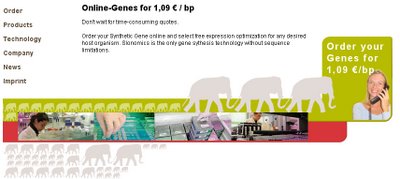
Buy genes online. Do-It-Yourself evolution

Now you can buy genes online , and use them to practise “directed evolution”.

Now you can buy genes online , and use them to practise “directed evolution”.

Thanks to “a completely new and patented technology for producing synthetic gene constructs on a fully-automated production plant” scientists no longer have to rely “on tedious manual cloning procedures”.

Can just imagine the conversation on the customer helpline:

Call centre agent: “Could I take your name and how can I help you today?”

Caller: “God here. I need to put in an order for a new line in elephants…”

Time you started re-thinking your customer relationships if you haven’t already. It’s a strange new world.