• The 60 Second Leader
  • Seven Secrets of Inspired Leaders
  • The Little Book of Leadership
  • Leadership Hub for Corporates
  • Learning to Live with Huntington's Disease
 

Phil's Customer Service blog

Changing rooms: This time it’s personal

My friend Marion returns from a trip to the States full of interesting observations – She has an eye for spotting the new and interesting.

On the customer front, she spotted an article about “Toronto’s trendiest changing room”, which is in a yoga-wear shop. A sale’s assistant writes the shopper’s name on a wipe-board on their changing room – “my own personalised compartment”, wrote the journalist.

Clever and simple. What do you do to make your space the customer’s space?

At St. Lukes, the radical advertising agency in London, major clients have their own themed room, which they can work from as if it’s their own office, whenever they are in the area. So, meetings with executives from Clarks, the shoemakers, take place in the Clarks room. In typical St. Luke’s style, the Clarks room is themed around shoes – even the coffee table wears shoes; the legs on the table have feet on the end, which sport Clarks footwear.

How at home do St. Luke’s clients feel, do you think? ‘Put yourself in your customers’ shoes?’ At St. Luke’s they even put their furniture in their customers’ shoes.


Six ways to be sticky

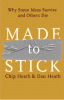
In their book Made To Stick, brothers Chip and Dan Heath make the case for six factors (in combination) making the difference between what’s memorable and what isn’t.

Their six factors are:

1. Simplicity (any idea over one is too many)

2. Unexpectedness (a surprise grabs our attention)

3. Concreteness (the more dimensions of details the more hooks our minds use to create a memory)

4. Credibility (even untrue stories don’t stick unless there’s a hint of truth, such as beware of what’s too good to be true in the urban legend that opens the book)

5. Incite Emotions in Listeners (we remember emotional experiences much more than anything else; we care more about individuals than groups; and we care about things that reflect our identities)

6. Combine Messages in Stories (information is more memorable and meaningful in a story form

SOURCE: The book Made To Stick, and Donald Mitchell’s Amazon review of the book


Pretty cool for a bank

I have to say it. Almost without exception (Grameenbank being an exception), all banks suck.

First Direct was a UK exception (up to a point), but seems to have stopped developing and started slipping back into deploying traditional banking techniques.

But this bank doesn’t suck: I first heard of South Umpqua Bank from Jerry Fritz of the University of Madison-Wisconsin five years or so ago. Now, as ‘Umpqua Bank’ (there never was a ‘North Umpqua Bank’), it is possibly the coolest thing to come out of the US Northwest since Nirvana.

There’s a book that explains how they did it. It’s mentioned over in my Leadership blog.


How to create devoted customers

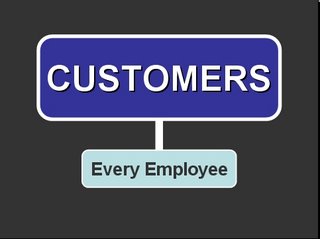
Very nice slideshow from Andy Hanselman on Slideshare. Click the play button, below, to advance the slides:


How was your meal?

Or, “Everything OK over here?”

…and we always say “Fine, thanks,” even though the potatoes were lumpy and the gravy cold.

Ritual exchanges do not elicit real information, and too many of the exchanges between people who serve and customers now fall into the category of ritual exchanges.

So, ask real questions instead of getting people to go through the motions. As Ken Blanchard puts it:

“Ask them questions they can answer. If you are a restaurant manager, this doesn’t mean “How was your meal?” as the answer will always be ‘Fine’. It means ask them ‘What is one thing we could have done differently that you’d expect us to do better?’ Then look for commonality in the answers.”


Starbucks’ Organization Chart

Brand Autopsy’s John Moore reminds us that this is the real organization chart. No matter what your over-complicated existing one claims to be, it’s not reality. This is. John says this is Starbucks’ organization chart, though they have one of the complicated ones, too. Sounds like trying to have your latte and drink it.


Crowdsourcing

From Shaping Tomorrow, I learn this new word, which I love: Crowdsourcing. Inspired by the book The Wisdom of Crowds, of course. Here’s what it means, according to the Shaping Tomorrow crew:

“We all know something
We all have unique ideas. We can all contribute to our futures. And, though as individuals we might be blind to tomorrow, collectively we can see much of what is coming.

Stakeholder views
We have learned from direct experience that companies miss the most obvious source of information on how the future will be different; their stakeholders. An organisation’s people, its suppliers and customers often have deep insights into many aspects of the future that management ignores. Tapping this source is easy and fast using tightly framed questions about how the future will be different and what you should be doing about it.”


The resurrection of Wispa

Cadbury Schweppes stopped making its Wispa chocolate bar four years ago due to flagging sales. Over the summer, after massive noise from customers on FaceBook and YouTube called for its return, the company announced it would re-introduce the chocolate bar to the UK this month (October).

Nearly 14,000 people joined ‘bring back Wispa’ groups on Facebook, ‘This is the first time that the power of the Internet played such an intrinsic role in the return of a Cadbury brand,’ the company said.

A spokesman for Wolff Olins, the design and branding consultants, noted: ‘It took discarding the brand for people to really want it. This is a good example of consumers owning the brand, versus the corporation.’

So who owns your brand? Some marketing analysts now recommend that Cadbury hand over ‘ownership’ of the brand positioning for Wispa bars to this customer community of 14,000, to maintain the customer loyalty and sense of ownership of the brand they have built up. Any lessons there for you to think about?

Scott Bedbury, the brand guru who was in charge of marketing at Nike and Starbucks during both those companies’ most spectacular growth periods, says one of the biggest blind spots organizations have is the idea that they own their own brand. In fact, he says, you have very little control over your own brand as it lives ‘out there’ in your customers’ heads. The resurrection of Wispa is a perfect example of that this month.


The ants have megaphones

“For a generation of customers used to doing their buying research by search engine, a company’s brand is not what the company says it is, but what Google says it is. The new taskmasters are us. Word of mouth is now a public conversation, carried on in blog comments and customer reviews, exhaustively collated and measured. The ants have megaphones.”

Chris Anderson, Editor-in-Chief, Wired, from his book The Long Tail: Why the future of business is selling less of more. If you are one of the many organizations that assumes that 80% of your profits come from 20% of your customers, you really need to look closely at the new phenomenon of the ‘long tail’ to see ifyou need to revise the figures.


The One and The Many: Real smiles mean something

I’ve just come back from taking my dad to visit his family in Singapore and Malaysia. I was reading ‘One From Many’ by Dee Hock on the way (in between watching Spider Man 3).

Large organizations (in fact all organizations) are still struggling with this basic problem: how to treat large numbers of people as individuals. I think of it as the ‘one and the many’ problem, which is why Hock’s book title appealed to me.

Anyway, it struck me that it can be done, and the flight was an example. I was watching the Singapore Airline cabin crew move down the plane towards us, with headsets or something they were handing out, and every person they handed one to – even though the connection was a second or less – received a very real smile. In less than a second, there was a personal engagement and acknowledgement, repeated hundreds of times down the plane.

This is no mean feat, as we can all tell, instinctively, the difference between a real and a fake smile. There is something called The Duchenne Smile*. And there is what some have dubbed the ‘Pan Am smile’ – the meaningless, ‘have a nice day’ smile that accompanies most service transactions.

The chairman of The Henley Centre for Research told me a few years ago that, despite all the investment in sophisticated Customer Relationship Management systems and automated call centres, the future for customer relations lies in the return of real people interacting with real people, because that’s what customers want in most cases.

He’s clearly right. It’s just a question of resolving that ‘one and many’ thing.

* (From Wikipedia if you can’t be bothered to click above):
The “Duchenne smile”, after the researcher Guillaume Duchenne, is the most studied, and involves the movement of both the zygomaticus major muscle near the mouth and the orbicularis oculi muscle near the eyes. An example of the smile is shown in the girl’s smile in the middle of the page. It is believed that the Duchenne smile is only produced as an involuntary response to genuine emotion, and is therefore what one could call the “genuine” smile. Due to the involvement of the muscle near the eyes, it is sometimes said that one can tell whether or not a smile is “real” by whether or not it “reaches the eyes”.
The “Pan American smile”, on the other hand, is the voluntary smile involving only the zygomaticus major muscle to show politeness; for example, by a flight attendant on the former airline of the same name. Considered “insincere”, this type of smile has also been called the “Professional Smile” by David Foster Wallace in his comedic short story “A Supposedly Fun Thing I’ll Never Do Again”.