• The 60 Second Leader
  • Seven Secrets of Inspired Leaders
  • The Little Book of Leadership
  • Leadership Hub for Corporates
  • Learning to Live with Huntington's Disease
 

Phil's Customer Service blog

What’s your customer manifesto?

Now this is how organization should communicate with their customers:

“Broadband. How that word excited us. What sweeping vistas of possibility it conjured in the mind’s eye. What wondrous traffic it ushered through its mighty doors. What a leap forward from the drudgery of dial-up.

But what is it today?

Standardband. Same-as-my-Dadband. The ‘information superhighway’ is now everyone’s M25. Increasing one lane at a time. Another small step for Internet-kind. Well isn’t this the 21st century? Give me back the leaps.

Give me the potential to reach speeds that will make me dizzy. Let me download without limits. Build this new online world on the principles of honesty and value, and always listen to what I may say. Bind me not by annual contracts, but win my loyalty through effort. And give me telephone support in case I tire of reading text.

Don’t cease to innovate. Don’t give me less than the best.
And don’t ever cap my dreams.”

It’s BeThere broadband. Someone’s been reading The Cluetrain Manifesto. Thank God. More please.

What’s your customer manifesto?


Keep sharpening your edge

Picture credit: www.worldnetdaily.com

What is it with Gillette? I had just come to terms with needing two blades in my razor. Then they brought in that third blade with the Mach III. “Interesting development, but sets a dangerous precedent. I don’t think there’s room for many more blades in that thing,” quipped Tom Peters at one of our ecsw.com conferences.

Turns out he was wrong: last count there were FIVE blades, and still counting.

What Gillette is doing, of course, is keeping its edge. Or, er, edges. As Shaun Smith points out in his book mentioned below, the old days of ‘If it ain’t broke, don’t fix it’ are gone. Constant re-invention is how to keep ahead of customers. You need to think of yourself and your colleagues as one of those Gillette razors.

“Pan-Am, Wang, C&A, Swissair. Where are they now? Engineers have a term for this: entropy, the natural tendency for things to lose energy and become less effective over time. Strong service brands avoid withering away by constant re-invention to keep ahead of customers.” – Shaun Smith, co-author of Managing The Customer Experience

So, there you have it: you are a razor. Go sharpen yourself. I must be doing something wrong, though. I still manage to remove more flesh than stubble, no matter how many blades and lubricating strips Gillette stick in that thing.


Another example of why targets don’t work

This is relevant to leadership and customer issues, so I’ll post this in both blogs.

From BBC News today comes another example of how people cheat when they have to work in a target-based performance management system – even with the best intentions and even the most senior people (what, you only expect call centre agents to cheat their targets? Target-based systems distort everything and most people’s behaviour).

Again, this one is from the National Health Service, and follows on from sporadic stories of ambulances having to wait outside hospitals with patients in the back (because the Accident and Emergency ‘waiting time limit’ for patients, imposed by central government, is measured from when they come in through the door, and the hospital would have broken its limit and been penalised if the patients waited inside the hospital for treatment, so they were kept in ambulances).

This isn’t evidence of pernicious people. It’s brilliant, dedicated people pushed into ludicrous behaviour by top-down target-setting. Top-down targets distort. Check out any of the lean service analysts and consultants to see how flawed the whole thing is. Anyway, here’s the latest example of what bad targets do to good people – and the terrible damage it does to the reputation of a much-loved institution:

FROM THE BBC

Patient waiting lists ‘manipulated’
Last Updated: Saturday, 07 April 2007, 12:28 GMT

A senior cancer specialist has admitted giving patients unnecessary treatments to manipulate hospital waiting lists.

Chris Hamilton, consultant clinical oncologist at Hull’s Princess Royal Hospital, told the BBC the problem was a government requirement that all treatment began within 31 days of diagnosis.

He says it means some low-risk patients are being treated before more urgent cases.

Mr Hamilton told the BBC he had given some prostate cancer patients hormone therapy to move them down the waiting list.

He said: “You’re caught in a bind. Either you give them unnecessary treatment with hormones and reclassify them or you put them to the front of the queue where they shouldn’t really be.”

He added that he knew other hospitals were carrying out a similar practice and he had informed national cancer director Mike Richards.

The Prostate Cancer Charity condemned Mr Hamilton’s claims saying it was “deeply unethical” to give patients treatment they did not need.

Dr Chris Hiley, head of policy and research, said: “It would be totally unacceptable if hormone treatment were being prescribed for men with prostate cancer simply in order to meet treatment target times – when it is not required to treat their cancer.

“It has nothing to do with patient centred care or good medicine.

“When men are diagnosed with prostate cancer, they need personal support and timely treatment. Providing the wrong treatment to meet NHS targets shows no regard for what patients need – the right treatment given at the right time with care and respect.”


Goodhart’s Law: Why targets don’t work, according to an economist

USEFUL CONCEPT TO EXPLAIN MY RANT ABOUT TARGETS, BELOW: Goodhart’s Law. Named after a chief economist at the Bank of England. Goodhart’s Law states that if a measure becomes a target it loses its value and ceases to be a measure. Controlling an indicator of a problem will not cure the problem. Goodhart himself phrased it like this: `Any observed statistical regularity will tend to collapse once pressure is placed upon it for control purposes’.

SOURCE: Central Banking, Monetary Theory and Practice: Essays in honour of Charles Goodhart, page 96. Systems thinking, as practised by Toyota and other high-performing organizations, stresses that target-based systems distort behaviour and make your organization inflexible. John Seddon’s book Freedom From Command & Control is helpful in understanding systems thinking and how you can lead more effectively by using it. Peter Senge’s work is also instructive on systems thinking and how it can help you avoid falling into the trap of target-based attempts to lead change.

More on the misuse of targets in attempts at leading change – which is obviously a bug-bear of mine – in The 60 Second Leader, my book, due out April in the UK and June in North America. Damn, I plugged. But, I’m angry about this target nonsense, so researched it and put it in the book. So that plug was based on passion, not self-promotion. Honest.


Improvisation in mental healthcare: good customer service practice

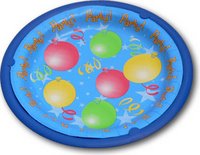
There’s a nice example from Marion Janner in her latest post over on the Bright Blog of how a bit of imagination and improvisation can improve the customer experience no end – in this case by overcoming boredom and lethargy, a constant problem in any institutional setting, with the spontaneous help of a paper plate adapted as an indoor Frisbee to lift the spirits of a group of patients in an acute mental health ward.

Here’s what Marion wrote:

“Two of the things that impressed me most were improvisations. One of the dynamic HCAs who is an activity co-ordinator…described how there was a rather lethargic atmosphere on the ward one day. Spontaneously she found a paper plate and suddenly there was an animated game of indoor Frisbee!

And a ward with a kitchen which has no oven (excessively risk averse planning, presumably) hasn’t stopped the creative ward manager from regular cooking sessions for patients. They use a bread-making machine, make microwave and freezer cakes and harness the relaxed sociable potential of communal meals there.”

This use of improvisation and initiative isn’t trivial: it’s vital. And it’s often cost-free. Read Marion’s latest post to see how the culture of improvisation she describes is an integral part of the overall culture of extremely good customer care the hospital she was visiting operates, and how it centres on allowing frontline people to take the initiative to enrich people’s lives.

Leaving customers sitting around bored is probably one of the worst things you can do. It’s exactly what Easyjet did to me a couple of weeks ago: crammed all of us into a small departure lounge with stairs leading to no plane (we could all see there was no plane, but they crammed us into the tiny departure gate area nonetheless), many people having to stand because there weren’t enough seats, and the gate staff walking backwards and forwards among us doing important things with tickets, doors, phones, and other procedures without for a moment thinking their job might include talking to the customers and giving us a clue as to what was going on – or even a clue that they noticed we were there. We just sat – or stood – there for half an hour till the plane arrived and we were told to board, with no explanation or apology.

At Southwest Airlines the gate attendants have a stock of pipe cleaners under the desk. If a plane is delayed for any reason, rather than keeping people waiting with no messages or interaction from the gate staff whatsoever, they take out the pipe cleaners, hand them around and offer a prize for the best pipe cleaner figure customers can come up with. Maybe you don’t want to play: but it’s better than being ignored.


What does your business sound like?

Organizations spend millions on visual identity. But almost nothing on aural identity – what you sound like to customers. Yet sound has a massive impact on your customer experience. Apparently two sounds that put customers’ teeth on edge are espresso machines and diesel engines, according to this book. The latter is not surprising but the former gives you pause for thought if you are a Starbucks-a-like and think your proposition is a relaxing place for a quiet cup of coffee…but your espresso machines are the equivalent to finger nails on a blackboard to your customers.

I am interested in this book for the same reason Martin Lindstrom’s Brand Sense and Shaun Smith’s See, Feel, Think, Do books are interesting: they help us think more clearly about designing a customer experience based on all the senses with which the customer experiences your brand. Treasure is one of the few experts in the neglected area of sound design. Even the word ‘design’ has visual origins, so excludes sound.

Treasure includes a CD with his book that lets you listen to turn-ons and turn-offs that will keep your customers relaxed and happy or tense and running for the door (often without realising why).

At Glasgow airport they play natural, ambient sounds (birds singing, plus soothing chillout music underneath it) over the loudspeakers to relax travellers. Sales in the airport shops went up 10%. Supermarkets have always been good at this manipulation of the senses and I don’t like the underhand aspects of that. But the rest of Treasure’s proposition is, er, sound.


When is a hotel not a hotel?

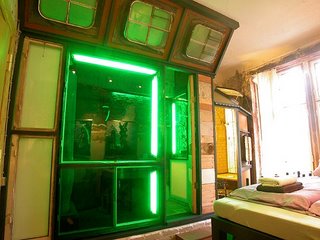
When it’s a work of art. I stayed at the Propellor Island City Lodge in Berlin this weekend. Its creator says it gives you the chance to ‘live in a work of art’.

This is the Glass House Room, which I was in. There is also the Flying Bed room and many others.

As hotels become increasingly boring, there is a growing niche market for themed boutique hotels like this, bringing some playfulness and innovation to staying away.

This room was immersive, by the way. The artist who created it and the hotel is also a musician and the room’s stereo bathes the room in his ethereal music.

The challenge for big hotel brands, I guess, is to build in a personality in the way that small, wacky, creative brands like this one can. Repeatably meeting expectatione – which is what branding is about: offering reassurance based on knowing what you will find inside in advance – inevitably has a downside: lack of surprise is a weakness as well as a strength. Surprise is what delights customers, not meeting or exceeding expectations.


WHAT 21st CENTURY CUSTOMERS REALLY WANT

21st century customers are contradictory. What they (we) say they want isn’t always what they (we) really want. Take choice. Customers say they want more choice and control. In reality, we are all overloaded with choices. So, offering your customers yet more choice won’t necessarily make them like you more. Confusing, isn’t it. Melinda Davis and her Human Desire Project have developed five insights to help you figure out what your customers really want:

1. EACH CUSTOMER IS MANY PEOPLE
What’s going on inside our heads keeps getting more complicated. People are dividing themselves into multiple, virtual identities as a way to handle an increasingly complex, chaotic world. Sony’s popular role-playing game EverQuest has nearly 400,000 registered users, who have created more than 7 million characters. At the 2002 World Economic Forum, one of the most popular seminars was called “How to Become Somebody Else.” The implication for you: Each of your customers is actually many customers (different people at different times)

2. THEY ARE HUNGRY FOR YOUR STORY
In a world where there are fewer hard truths and clear-cut answers, people seek meaning through narrative and archetype. Tell us a story, weave us a tale; we long to find instruction in the mysteries of our lives. BMW woos buyers through short movies. Bulgari commissions a novel by Fay Weldon titled ‘The Bulgari Connection’ . The long tale is the new sound bite. The truth of the story really doesn’t matter. Today, we see life as a choice of spins: It’s the journey that gives us pleasure. Purposeful deception will always spell disaster, but pleasurable spinning is a road to success.

3. YOU DON’T SELL PRODUCTS OR SERVICES
You sell peace of mind. Or even bliss. Consumers who once put houses, cars, and gizmos at the top of their aspirational lists now cite ‘a safe, happy home’ and ‘peace of mind’ as their number-one priorities. People are looking for an experience that goes by many names: the zone of the athlete, the inner bliss of a religious person…(an antidote to the stressed-out, complicated rest of their lives. And you thought Starbucks just sold coffee?)

4. MAKE ME A STAR
Besides peace of mind, everybody wants to matter. Our craving for a happy balance inside our heads is fuelling several big trends. Chief among them is ‘luxe populi’ , the quest to stay visible by becoming one of the ‘important people’. Luxe populi is a deeply held, even militant belief that we are all entitled to the finest, the best designed, the coolest. Luxury marketing is no longer about selling to the few but about selling to as many as possible. (In banking, they call this the death of the ‘richness vs reach’ equation: the idea that you offer a rich experience at a high charge to few people and a basic experience at low cost to the masses. The new expectation is a contradiction in terms: mass exclusivity).

5. TOO MUCH CHOICE? A YODA IT IS THAT YOU NEED
As life becomes even more complicated, the consumer will choose a chooser. By choosing a higher helper, a Yoda figure, you choose your own reality: your news, your information, your shopping choices.Oprah Winfrey is a perfect example of this metabrand. She tells us which issues we should be interested in. She tells us what to read.

Richard Branson is taking a shot at being a kind of Yoda of hip commercialism. Amazon.com clearly has its sights on creating the definitive online-shopping Yoda state. Wal-Mart is making an ambitious push to extend its private label – Sam Walton’s vision of middle-American values – across every category of product and service it sells. Where is the limit to THAT Yoda-like sphere of influence?

SOURCE:
Melinda Davis, talking to Bill Breen of Fast Company magazine. Elsewhere, she has expanded the ‘Yoda’ idea, suggesting that employees look for their leaders and managers to be Yoda-like figures. In 1996, Davis launched the Human Desire Project, a programme funded by some big consumer brands to figure out the major motivators of the 21st century, to glean what people want and why they want it, and to come up with insights that will let companies connect with consumers in deeper, more meaningful ways. Some of her main findings are captured in her book ‘The New Culture of Desire: 5 Radical New Strategies That Will Change Your Business and Your Life’.

No-one believes your advertising

What generates excitement about your products or services?

Radio 0%
Billboards 1%
TV ads 4%
Print ads 4%
Magazines 15%
Referral by colleagues or family 40%

See: we’re in the referral economy now.

Source: Euro RSCG Worldwide survey into what gets people excited about consumer electronics products


Don’t confuse function with purpose

“The front-desk’s purpose is not to check people in. That’s its function. The purpose is to welcome the customer.”

– My notes from listening to Theo Gilbert-Jamison, V-P. Training & Organizational Effectiveness, The Ritz-Carlton Hotel Company

More from Theo…

“Purpose is too often ignored in favour of function. Functional competence can be commoditized – you’re just as good at checking people in (or whatever the process is) as your competitor.

But, purpose is something that frees people up to contribute with imagination and even passion.”