• The 60 Second Leader
  • Seven Secrets of Inspired Leaders
  • The Little Book of Leadership
  • Leadership Hub for Corporates
  • Learning to Live with Huntington's Disease
 

Phil's Customer Service blog

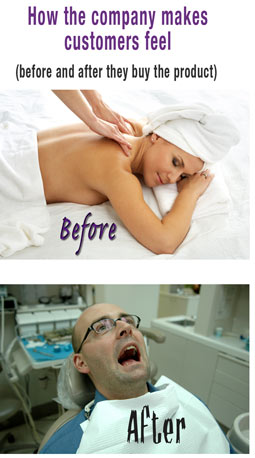
How companies make customers feel

How the company makes customers feel

How the company makes customers feel

(Click on the pic. for a bigger version)

Brilliant post by Kathy Sierra on why attempts to build relationships with customers are too often like marriages.

Spotted by Johnnie Moore, who seems to be the source of most of the good links I end up finding 🙂 .


Why you go to McDonald’s

“Brands are used as risk reduction in an over-crowded world of choice. That’s why you go to McDonald’s – you have in advance a certainty of the taste, the experience and the exact level of disappointment you will feel.”

– Funky Business author Kjell Nordstrom

Kjell Nordstrom tells us to be constantly inventive and to surprise customers and make them smile. You can do it in the smallest things. That’s the back of his head on his business card, top left, for example, with a Post-It over the private details:


Legendary service without breaking the bank

Extraordinary acts that go above and beyond the call of duty should be just that – extraordinary: If they happen every day to every customer, you become bankrupt, as your ‘cost to serve’ thresholds would be constantly breached.

This does not mean, however, that you should not encourage extraordinary acts that go above the cost to serve for an individual customer…Just that you should ration them sensibly.

Here’s my tip for breaking the paradox:

i) In a call center/centre environment, have a rota system for ‘extraordinariness’. One person can spend half an hour a day in ‘extraordinary’ mode, proactively offering imaginative service to clients with the specific aim of generating word-of-mouth stories. Or, maybe nominate one person as ‘hero for the day’, whose job is to jump in, emergency service-style, when there is a service failure, and achieve an extraordinary recovery.

ii) In a non-call center/centre environment, perhaps encourage your people to aim for and report back one heroic encounter with a customer per day, week or month (whichever is appropriate: be flexible – this is guidance on the principle, not the detail). That’s enough to generate the legends without breaking the bank.

This tip is from the March edition of my series One A Day For Customers, which will be on www.lulu.com in, er, March.


Close to the customer: 25 years on, we seem to have forgotten…

USEFUL CONCEPT

Close to the customer. In most organizations, distance from the customer denotes seniority. The more contact you have with customers, the lower your status must be (though this is not said openly). Tom Peters and Bob Waterman put customers and the frontline at the heart of the business agenda with the phrase ‘close to the customer’ in the book In Search of Excellence in 1982. A quarter of a century later, many leaders still don’t realize that they have to take this phrase literally and spend a significant portion of their time where their business actually is.

USEFUL CONCEPT

Close to the customer. In most organizations, distance from the customer denotes seniority. The more contact you have with customers, the lower your status must be (though this is not said openly). Tom Peters and Bob Waterman put customers and the frontline at the heart of the business agenda with the phrase ‘close to the customer’ in the book In Search of Excellence in 1982. A quarter of a century later, many leaders still don’t realize that they have to take this phrase literally and spend a significant portion of their time where their business actually is.


Are you a bank?

“Ford is a bank
that uses cars
to sell finance packages
to its customers…”

Edward de Bono

“Ford is a bank”, de Bono famously said to the car giant’s Board to provoke them into thinking more creatively about their customer proposition, “that uses cars to sell finance packages to its customers.” This kind of lateral insight into how re-shape your customer proposition led to industrial giants such as GE setting up GE Capital Bank, to help customers finance their purchases. Finance arms now account for 50% or more of manufacturers’ and some retailers’ profitability.

There’s another de Bono insight over in the Leadership blog that shows the value of re-thinking what your customer proposition is.

So, are you a bank? Or something else? I’ll post something I heard Philip Kotler the marketing guru say a while back that may help you with this kind of radical reframing. You remember Kotler’s famous ‘Four Ps of Marketing’? Well, whether you do or not, they’re old hat because they are supplier-centred rather than customer-centred.

Kotler realised this and translated them into ‘The Four Cs’ of marketing – each taking a customer perspective instead of a supplier perspective. Looking outside-in at your organization like that – just changing the language to change how you see your organization – is immensely powerful. I’ll dig out the Kotler stuff and post it in a day or two so you can see what I mean.

In the meantime, I’ll leave you to annoy your colleagues by asking them “Are we really a bank?” as a provocation. Er, don’t do it if you ARE a bank, though. Actually, on second thoughts, do…


Customer satisfaction isn’t enough: ask different questions

“Too often we focus all our attention on customer satisfaction surveys that say ‘You just bought this: are you happy with it?’ Of course they are happy with it! If it’s a car, they’ve just spent £10,000 on it, so what do you expect?

‘The really important questions are ‘What about the people who didn’t buy?’ or ‘What about the people who were customers and who left?’ What do you do to find out about that? Do you contrast how customers behave to find out what is really going on?’

– Clive Humby, the mathematician co-founder of Dunnhumby, the brains behind Tesco’s Clubcard, which gives the retailer far more insight into its customer base than any other retailer I know. I heard Clive say a while back “Tesco is no longer a supplier. It is now a buyer on behalf of its customers.”


Show customers you love them: Overcoming the happiness deficit

Show customers you love them

If you are reading this on February 14th, it’s Valentine’s Day, so here’s a Valentine-ish thing to mark the day: show customers some love.

The research organization The Henley Centre has identified something it calls a ‘happiness deficit’ among modern consumers. It says that the more affluent we have become, the more quietly frustrated we all are that increased access to consumer goods doesn’t bring an automatic increase in happiness.

“Understanding why consumers are unhappy, and helping them to bridge the gap, could be one of the biggest opportunities of the 21st century,” says The Henley Centre. Many analysts say the problem is customers (us) are alienated by service providers who treat us primarily as a source of money and rarely with real human warmth. This has prompted Yahoo’s Tim Sanders to argue that “Love is the Killer App” in his book of the same name.

Other customer commentators and analysts (including me) think there is a point in this: occasionally showing customers something economists call “the abundance mentality” instead of “the scarcity mentality” is a powerful thing to do.

Quick example of “the abundance mentality” would be if you work in a hotel coffee shop and a customer is looking distracted and maybe a little depressed, and is fumbling to find the right money to pay for their coffee. Instead of taking payment, you say with a smile “Don’t worry. You look hassled. Have that on us.” Staff at Pret a Manger (the sandwich stores) do this several times a week, particularly if a customer has had to wait too long in the server’s view. Pret founder Sinclair Beecham once explained it to me this way: “For a few free lunches a week, the goodwill it creates makes it worth it. You can make someone’s day with just a small gesture.”

Quick example of “the scarcity mentality”: Those coat hangers with no hooks at the top that you find in some hotels, expressly designed so that you won’t take them. There is an assumption of bad faith about them that comes across as mean-minded.


Things discovered by accident

I heard Charles Dunstone, CEO of Carphone Warehouse, recently explain how texting is an accidental market – The text function on the phone wasn’t intended for customer-to-customer communication. It was put on there so telecoms engineers could communicate with customers to keep them updated about fixes.

As your organisation comes up with all kinds of innovation processes for ‘industrialising’ innovation to keep ahead of customer wants, spare a thought for the role of randomness, as with these Things Discovered By Accident, from Fast Company magazine:

“The list of things created by accident is certainly impressive;

Aspirin,
Band-Aids,
Diners Club,
DNA finger printing,
dynamite,
inoculation,
jelly,
Lamborghini,
microwave ovens,
nylon,
penicillin,
velcro and
Vodafone.”

I’m not sure how ‘Lamborghini’ or even ‘Vodafone’was discovered as an accident: “Oh, look, we dropped the molten metal and it’s formed itself into a 500 brakehorsepower car by accident. Let’s call it a Lamborghini Diablo!.” But, anyway…

As well as randomness, there’s the totally unexpected innovative opportunity if you watch how how customers use existing products. Gary Hamel, the strategy guru and a previous speaker at ecsw’s European Conference on Customer Management, cites the example of the microwave manufacturer who put webcams in student dorms to see how the students used their product.

They discovered that their microwaves were being used by students to dry their pants after doing the laundry. And, yes, microwave clothes dryers are on the way as a result. Keep an eye on those customers: they’re a strange lot.


Feb Edition of One A Day For Customers

UPDATE: The February edition of One A Day…For Customers, my monthly self-directed action learning series, is now available. Click on the little orange Feb book cover in the masthead of this site, above, to view it. This is a monthly handbook of bottom-up change: coaxing your frontline people into continuous improvement in your customer service with one new tip or insight a day plus ‘action learning’ pages to help them put the tip into action. Top-down change doesn’t work. This series is a low-cost system (£1 or $2 per week per person) of action training – learning by doing – in which your front line people drive customer-centred change themselves.


There are no little things

“Sometimes when I think of the tremendous consequences that come from little things, I think…there are no little things.” – Bruce Barton.

He’s right. When most organizations look similar to customers, it’s the small things that make you stand out in their eyes.

Here’s an example…

Virgin Atlantic has a number of legendary employees who epitomize Virgin Flair (the personality they look for in employees and then allow them to express). One was Sue Rawlings, an in-flight attendant. People at Virgin still talk about her years after she left the organization.

Just before serving the ice-cream that Virgin offers to passengers when they are watching the in-flight movie, Sue would duck into the galley, smear ice cream all around her mouth, then emerge and start serving.

As she moved down the cabin, she would pronounce very loudly, so people would look up as she passed, “I never touch this stuff myself as I’m watching my weight, but people tell me it’s delicious. Enjoy!”

The effect was a wave of laughter that moved down the cabin with her, as passengers looked up from plugging in their headphones or fiddling with the volume control in preparation for the movie, and saw the ice-cream smeared around her face.

Is this a big thing? Of course not. Is it expensive to do? Of course not. Is it a memorable customer experience that those passengers talked about to family, friends and everyone else they met for ages afterwards? Of course it is.

Virgin pioneered ice-creams with in-flight movies. And Sue Rawlings added further to the experience for passengers. Compared with the cost of a Boeing 747, the cost of serving ice-cream is virtually nothing. Yet it is the small thing – the small extra – that differentiates here because all the other airlines fly Boeing 747s, too.

As Seth Godin puts it in his new book title, Small is the New Big. You don’t have to spend a lot to stand out from the competition in your customers’ eyes and provide them with a memorable customer experience that makes them want to come back for more.

You just need some imagination and personality.

Source: The Sue Rawlings story was told to me by Lyell Strambi, Executive Director at Virgin Atlantic, and I used it in my book Seven Secrets of Inspired Leaders.