



It’s from the Gallup Management Journal, which measured customer attachment. See the post below for the link to the article.
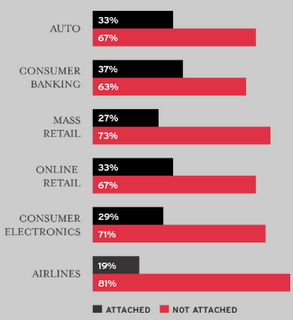
It’s from the Gallup Management Journal, which measured customer attachment. See the post below for the link to the article.
Stephen Lukac over at the McGill International Executive Institute in Montreal has spotted a new way consumers can compare and search for what they want. It claims to be the world’s first visual search engine.

Very clever, if a bit clunky for now. Are you watching, Google? www.like.com
This is a tip from Ron Kaufman’s brilliant Up Your Service newsletter, which you can subscribe to at www.ronkaufman.com
Ron writes:
“The manager who tells the team “Get out there and serve!” while he stays comfortably in back is not a service leader at all. The real service leader gets out on the frontline to help whenever she can, especially when times are busy, customers are angry or staff are overloaded.
At a leading hotel in London, the General Manager spends one day every three months dressed in a bellman’s uniform and doing the bellman’s job. Here’s what happens:
1. The General Manager meets customers in a completely different way.
He asks real questions, and gets honest answers. The bellman hears a lot of unvarnished feedback that guests may be reluctant to share with the General Manager.2. The General Manager gets a first hand taste…
of what it’s like to work on the frontline. He wears the uniform, stands by the door, carries the bags, and eats in the staff cafeteria. This first hand experience means small things that might irritate staff get noticed quickly, and fixed quickly.3. Most of all, the hundreds of other staff working in the hotel
…see their General Manager doing frontline work with dignity and respect for the customers, and their colleagues. This respect is returned with a shared dedication to providing superior service.”
SOURCE: Ron Kaufman, a customer service consultant and teacher based in Singapore whom I have a lot of respect for
A while ago I posted The New Golden Rule. The classic Golden Rule is ‘do as you would be done by’ or, in the Christian tradition ‘do unto others…’. Every major religion has an equivalent at its heart, saying treat others as you want to be treated yourself.
But it needs updating. You need to treat customers as THEY want to be treated, not as you would like. There are universal basics about how people should treat each other, yes, of course. But beyond the basics of politeness, attentiveness, friendliness, efficiency, etc…You need to discern what the customer wants and how they want it.
Chris Daffy has come to the same conclusion (which is reassuring, as I respect Chris’s view and get a bit worried if I am out on a limb and don’t notice anyone else independently saying the same thing). Chris gives one or two nice examples in his latest email newsletter, which I’d recommend. Chris concludes:
“…great service is not the service you would like, it’s the service the customer would like.
Tips #1 and #2 on this, from the great Horst Schulze, founder of the Ritz-Carlton hotel chain, are below this post. Here’s the third tip based on his practice:
“So, after hiring and orientation you have training. Here’s something powerful and simple that we do:
“The best room service waiters write the training manual for the new room service waiters.”
Source: My shorthand notes from a talk given by Horst Schulze at a conference I helped organize in London
This tip is a sample from a book series I am putting together calledOne A Day
365 Practical Ways to
Get Closer
to Your Customers
Tip #1 on this, from the great Horst Schulze, founder of the Ritz-Carlton hotel chain, is below this post. Here’s his second tip for after you’ve hired:
“Orientate them to WHO WE ARE so they can become part of the company, not just work for the company. This applies to everyone, even, say, dishwashers. I have only ever fired three General Managers. One of them was a man who said to me ‘You want to give a dishwasher a process?’ How arrogant of him!
“At every new hotel, I gave the orientation myself. I have done it at 45 hotels so far.
“From the busboy to the housekeepers to the room service chefs, I line up the new hires and say to them:
” ‘Who’s more important to this hotel, you or me? It’s you! If I don’t go to work on Monday morning, nobody knows. Nobody cares. If you don’t, the food doesn’t get served, the beds don’t get made. You are far more important than me!’
Source: My shorthand notes from a talk given by Horst Schulze at a conference I helped organize in London
This tip is a sample from a book series I am putting together called
One A Day
365 Practical Ways to
Get Closer
to Your Customers
High employee turnover can bedevil your attempts to build a customer-centric culture. With people constantly coming and going you use up masses of resources and never get a customer-focussed culture to embed. The customer, presented with a parade of constantly-changing faces, can never build relationships with any of them.
In some sectors that rely on temporary employees this doesn’t matter. But, in most it does. So, here’s a tip from Horst Schulze, founder of the Ritz-Carlton hotels, on how to reduce your employee turnover:
“We derive our employee selection profile from our best dishwasher, manager etc. We analyze what the best ones do then we hire against that profile. Annual employee turnover is typically over 100% in the American hotel industry. In the Ritz-Carlton in 1992 it was 80%. By 2000 we had reduced it to 24%. It was because of the process.”
Selection was only part – but a significant part – of the process Schulze introduced and embedded. I’ll return to other parts of the process in later tips.
Source: My shorthand notes from a talk given by Horst Schulze at a conference I helped organize in London
This tip is a sample from a book series I am putting together called
One A Day
365 Practical Ways to
Get Closer
to Your Customers
Talking of Gary Hamel (see previous post), I’ve just come across this, from him, which made me laugh:
“Not so long ago, IBM celebrated “The Year Of The Customer.” One wonders what the company celebrated in other years – “The Year of the Monkey?” perhaps?”
It’s in the foreword to Stuart Crainer’s very readable book The Ultimate Business Library: 50 Books That Made Management, which I am working through at the moment.
Gary Hamel told me this recently in an interview:
“Companies have relied rather too much on traditional customer research and consumer marketing. If you look at those that have really changed the customer experience and customers’ expectations, most of them have done it from a deep insight into unarticulated needs.
We’re talking about things that customers can’t even know yet, so no point asking them! By the time a customer starts talking about something and asking for it or complaining that you don’t do it, it’s too late.”
Other ‘gurus’ like Tom Peters recommend seeking out ‘leading edge’ customers – the awkward ones who seem to be in advance of the others and are always making demands on you that you can’t currently meet. Maybe they are too small and too kooky for you to pay attention to. But one or two of them are early arrivals at where your other customers will arrive soon. So, listen to them to get ahead. Hamel says something similar. I have a quote from him about Nokia that I will dig out and post to reinforce the point.
This tip is a sample from a book series I am putting together called
One A Day
365 Practical Ways to
Get Closer
to Your Customers
We are blogging over at the Execubooks ‘thought leaders’ blog (they think I’m a thought-leader and so invited me: stop laughing; I can hear you from here) on Fred Reichheld’s book The Ultimate Question, which claims there is one question you should ask customers instead of all those time-wasting, self-serving customer satisfaction questionnaires that have become an industry in themselves.
So, I’m committing the sin of almost repeating my post over there over here, if you see what I mean.
Fred’s ultimate question is “Would you recommend us to a friend?” And it’s a great question. He recommends scrapping all your satisfaction surveys and replacing them with this one ultimate question. Enterprise Rent-a-Car has done something similar, and to great effect.
But, it’s still a question about intention. And customer intentions are slippery beasts. There is a better question.
I heard Chris Pilling, the CEO of the UK bank First Direct describe a better question that they ask customers:
“HAVE you recommended us to a friend?”
It’s a measure of actuality, not intent; of what customers are doing now, not what they say they might do.
He gets a massive positive reaction to that question from First Direct customers: an astonishing 96% of customers say ‘yes’, 86% saying they have recommended the bank in the previous year. As a result, 36% of all new customers come from existing customer recommendations.
Reichheld told me off once when I interviewed him and had the temerity to ask “Is loyalty dead, Fred?”. But, I didn’t mind, as it was a cheeky question. He has converted thousands of marketers from a ‘get customers’ mentality to a ‘keep customers’ mentality. And you have to love him for that. Still a long way to go, of course…
This tip is a sample from a book I am putting together called
One A Day
365 Practical Ways to
Get Closer
to Your Customer




 LinkedIn