




Hmmm, looks like this brand wasn’t designed to travel well in the new global economy.

Hmmm, looks like this brand wasn’t designed to travel well in the new global economy.
Heard Rene Carayol say this at Leaders in London. Very true. HR departments in large organizations who are currently working away diligently on your standardised, desired leadership behaviours, please note:
” We have been told for years now that there is a standard homogenised great leader type or template we have to aspire to. Organizations deliver one training programme, people are expected to become clone leaders. That doesn’t work. The marketplace tells us that difference works. Challenging the status quo and standing out from the pack is what makes a great leader. There is one question you need to find the answer to in order to define your difference: What do you stand for? “
I have a separate problem with the whole notion of ‘great leaders’ but I will come back to that in another post.
I heard this customer service announcement on the London Underground myself while running to catch a tube train at Westminster Station, so I know it’s true, as opposed to the ones that circulate in emails. Ah, the power of CCTV:
“Will the gentleman on the eastbound District Line platform stay exactly where you are. Yes, we can see you. We’re rushing a mop and bucket down to you right now and you can clean that up yourself”.
No, it wasn’t me.
Nice example of how to lead talent in an episode couple of nights ago of the TV series Bones, about a female pathologist. In this episode Bones has a new boss, also female, and clashes with her throughout the episode. Bones decides she has to quit, reluctantly. She loves her job, but cannot take being told what to do. She is a genius at what she does. The new boss can see what’s coming and wants to find a way they can work together. The conversation goes like this, at a table in a diner:
Bones: “We have a problem…I have a problem with control and authority.”
New Boss: “Can you see a way out of it?”
B: “No. (Seems to be preparing to offer her resignation).”
NB: “Look: I’m in charge. But, out of respect for you…Do you play Monopoly?”
B: (Frowns, puzzled). “Y-e-s”.
NB: “Well, in Monopoly they have that thing called a Get Out Of Jail Free card. Like I said, I’m in charge, but out of respect for you, you have permission to defy me. No consequences.”
B: “How many can I have?”
NB: “One a week.”
B: “Five per case.”
NB: “Three per case.”
B: “Done.”
They shake hands.
Lesson? Creative talent often has a problem with authority. A creative leadership response is to flex where necessary. Good leaders break rules and give others leeway to do so too. Creativity and rule-breaking go together.
We all know the power of sticking a senior executive in front of a customer and letting them absorb how the customer feels. It’s how you bring them down from whatever ivory tower they are in and get them to ‘confront reality’ as Bossidy & Charan put it in their book of the same name.
Here’s an example, from Renee Mauborgne and W. Chan Kim. Mauborgne was impressive at last week’s Leaders in London conference. So, I dug this example out of my research notes for the 60 Second Leader book that I am supposed to be finishing off right this minute (manuscript submission deadline Friday week. Gulp…). It’s an example of how to try and trigger an epiphany in people so they suddenly stand in their customer’s shoes and see things the way they really are – from the customer’s standpoint:
“Philips Lighting North America was a very proud company. So proud that the sales force were convinced they were doing a first-class job even though they weren’t gaining market share and General Electric dominated the industry.
“That’s when the new business head had his sales force listen in on a phone conversation between himself and Bernie Marcus, the founder of Home Depot, the largest retail customer in the US lighting industry.” On this occasion, the cognitive ‘kingpin’ the head of sales was looking to hit was the entrenched assumption by the sales force that they were better than they actually were.
‘So, Bernie,’ he said, ‘How is our sales force doing?’ Marcus replied: ‘Your sales force?’ (His voice rose to a near-shout). ‘They never follow through with what they commit to, deliveries are late, quantities and styles are wrong. It’s a disaster. There are only excuses, no corrective action.’
A dramatic attitudinal and behavioural turnaround occurred fast, as there was no place left for the sales force to hide.”
SOURCE: Renee Mauborgne & W. Chan Kim, authors of the best-selling Blue Ocean Strategy, writing on how to achieve ‘Tipping Point Leadership’ – making big change happen despite few resources. You can find the full texts in their article Tipped For The Top, People Management magazine, April 2003 and the INSEAD Quarterly, 2004.
I heard General Colin Powell tell this Gorbachev story at Leaders in London last week. Powell was Secretary of State at the time of the story:
“I remember going to see President Gorbachev when he was leading his country through Perestroika and Glasnost. He said to me “You are not doing enough to help! You know what we are trying to do here and you need to help us do it!” I sat back and made it clear that, well, he was still a Commie, I guess, and the USSR had been the enemy for decades. He leant forward and smiled. “Mr. Secretary,” he said, “I am afraid you will need to find yourself a new enemy.” “
I’m convinced you get glimpses of true leadership in the true firsthand anecdotes people tell rather than in the official versions. Every firsthand anecdote I’ve heard about Gorbachev simply reinforces what a great leader he was, despite the way he is vilified today within Russia. Rene Carayol, for example, tells this story about him:
Carayol on Gorbachev:
“I was part of an event where Gorbachev was due to speak. This was in the days when Raisa, his wife, was still alive. They were, you will remember, devoted to each other. He was sitting next to her at a table. It was a very high-powered meeting.
“When it was his turn to speak, he rose, looking a little tense. But Raisa touched his hand. He looked down at her; she said something to him. He seemed to relax, smiled and went over to the lectern. I couldn’t resist sidling over to his interpreter and asking what she had said. “She said ‘You will be fine. It will be OK’,” he said.
“This man had changed the course of history, had faced down some of the most reactionary power bases in the world, had put in motion forces that had led to the Berlin wall tumbling. Outside Russia he is recognized as a world statesman of great bravery and stature. Yet he was nervous about talking to this gathering of people in a room. It was a nice reminder that brave leaders aren’t fearless; they just conquer that fear; in this case, with a little help.”
It is often said we cannot measure customer emotions, so they remain elusive and intangible. ‘How satisfied are you on a scale of 1 to 5?’ doesn’t really cut it in the emotion measurement stakes. That’s head, not heart.
But back in 2001 Gallup created a customer emotion thermometer of sorts that sounds a lot more useful than the usual ‘satisfaction’ questions. It is made up of eight key measures, grouped into four ‘constructs’:
CONFIDENCE
XXX is a name I can always trust
XXX always deliver on what they promise
INTEGRITY
XXX always treats me fairly
If a problem arises, I can always count on XXX to reach a fair and satisfactory solution
PRIDE
I feel proud to be a XXX customer
XXX always treats me with respect
PASSION
XXX is a perfect company for people like me
I can’t imagine a world without XXX
The highest rung of the emotional ladder is passion, says Gallup, not surprisingly. You can instantly see how useful a tool an emotional thermometer like Gallup’s might be in assessing how warmly your customers feel towards you and in helping you focus on where you need to improve to heat the relationship up.
Source: A paper by Alec Applebaum called The Constant Customer , in the Gallup Management Journal. See also Amy Wong’s article ‘The role of emotional satisfaction in service encounters’, Managing Service Quality, Vol 14, Number 5, pp 365-376.
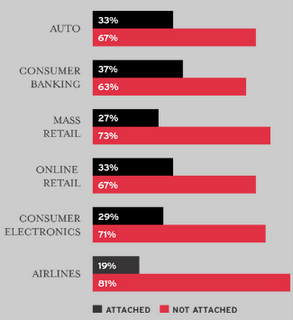
It’s from the Gallup Management Journal, which measured customer attachment. See the post below for the link to the article.
Q: Head or Heart?
A: 60% follow their heart
…according to the self-styled “world’s leading self-discovery site”. Don’t know about that, but it shows that trying to lead with just rational analysis alone won’t get you very far. Daniel Goleman was right.




 LinkedIn