



• The 60 Second Leader
  • Seven Secrets of Inspired Leaders
  • The Little Book of Leadership
  • Leadership Hub for Corporates
  • Learning to Live with Huntington's Disease
 

Phil's blog

The people formerly known as the audience

What can Prince (or the artist formerly known as…) teach us about customers?

Came across this wonderful phrase that liberates the mind, as the most powerful pieces of language do, from the concrete boots of normal thinking and lets it leap free with a single bound…

“The people formerly known as the audience” – Bruce Lewin

Some pieces of language just define what is coming, what is emerging, half-formed from beneath us (the future isn’t ahead, it’s here already and emerging from the edges of the present: we’re just too busy looking at the middle instead of the edge), and tease it into shape. Bruce’s phrase does just that.

It emerges out of a discussion of the book The Long Tail, which is useful for helping us redefine what profitable customers are or will be.

It’s on an old Harvard discussion board from last year run by the ever-readable Jim Heskett. I’ll dig out the links and add them here in a bit.

If you know Lewin’s phrase already and I’m behindhand here, I usually am, but I get there in the end, so consider this a reminder of something important rather than a new insight.

If you haven’t heard it before and think “Why is this significant? What are you on about?” then I wish I could explain better in a short post just why this is so important.

Participation. Co-creation. Web 2.0. Life 2.0. 15 minutes of fame. Fragmenting markets. Post-mass consumption. Post-supplier/consumer relationships. A post-consumer age (-ish). Economics of abundance vs economics of scarcity…It’s all about all of that and more.

The audience is on the stage. The users run the system. You have to re-define customers accordingly.

The other 80%: trust and leadership

It’s Davos time of year. The world’s leaders – elected and self-appointed, political and business – meet at the World Economic Forum‘s annual brains trust in the snow.

A snippet from this year on leadership and trust. Philip Edelman, founder of Edelman the global PR company, said this morning at Davos that

30-35% of people at work will trust a frontline worker
50% of people will trust someone they see as a peer (presumably those polled were not frontline workers, then) and…
20% of people at work will trust a Chief Executive

Since the foundation of leadership is trust, ‘Where’s the other 80% and what do I do to get it back?’ is the question chief executives have to deal with.

Anyway, as we all know leadership isn’t confined to the top of the organisation. And, if the trust quotient is anything to go on, that’s where there is, in fact, less of the capital on which leadership is built – trust – than anywhere else in an organisation.


What do customers really want?

It’s really hard to tell sometimes, don’t you find?


New Year’s present for you – Free book chapter

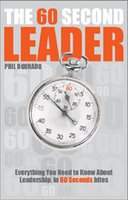
Ooh, I’ve just finished the 60 Second Leader book manuscript (‘So what!’ I hear you cry: fair enough, but I’m excited anyway).

With the 60 Second Leader I’m trying to pioneer a new form of business book, based on the fact that none of us have time to read business books.

So, each chapter only takes 60 seconds to read. I guess this takes us into ‘when is a book not a book’ territory – that strange place you get into when you try and subvert any form and change it too radically. The publisher, for example, tells me “But, they’re not chapters. You can’t call them chapters.” Well, they are. So, there. I’m too tired and elated to take that line of argument further at the moment. And I don’t want to bore you too much before giving you a freebie for the start of 2007.

I increasingly think business books should be about distillation and essence, not over-elaboration and the laborious building of an argument or proposition chapter by chapter.

Anyway, here’s a free chapter for you so you can see if the idea of a non-book business book full of non-chapter chapters is useful in this time-poor age. Would love to hear whether you find this approach useful and how it could be improved next time.

Leadership and Failure: sample chapter from The 60 Second Leader


NEW ACTION LEARNING BOOK AVAILABLE NOW

NEW CONTINUOUS IMPROVEMENT SELF-DEVELOPMENT SYSTEM: I have just made this new book available as a ‘print on demand’ book. You order it online, it’s printed and sent to you. Take a look if you are interested:

Take One A Day For Customers…January

It’s a tip-a-day work book. Should take your people five minutes a day to fill in. The tips stimulate self-led continuous improvement for organizations that want their frontline people to take the initiative and improve customer service daily.

If you run a call centre or customer service department or have a network of branches containing frontline people I’ve priced this continuous improvement development system cheaply enough for you to dip into your training budget to buy everyone a copy as their personal daily action development programme – five minutes a day to stimulate regular self-directed collaborative improvements.


Don’t predict the future. See the present.

Aha! I’ve just discovered my notes from an interview I did with Gary Hamel, the strategy expert, academic and author. I’ve been trying to find them to post this extract for you, as too much writing about innovation says it is about predicting, forecasting, inventing the future. No, it’s not. It’s about understanding the present more deeply than your competitors do. I loved the way Hamel explained it in this interview. It’s a good way to start 2007…

“People who innovate successfully are not forecasters. They are in touch with what’s happening, whereas the competition simply haven’t noticed. People who innovate successfully don’t see the future. They see beneath the surface of the present. And they pull together what they see into a proposition that has instant appeal for customers, but which customers didn’t even know they wanted until it appeared.

“They’re not customer-led; they understand what customers want better than customers do themselves. So, how do you do this? Nokia are a great example. Fifteen years ago the top people at Nokia got together in a cold room just outside the Arctic Circle and decided they were going to beat Motorola. Very funny. Motorola was and still is one of the most respected companies in the world, up there with GE.

Nokia succeeded because they saw what was changing and exploited it. There are three steps to doing this:

1. Find the fringe

2. Look for the pattern

3. Data is not enough: Experience, feel and understand what’s happening.

It’s at the margin that you notice change happening first. Nokia sent its engineers from Finland and told them to live in places where exciting things were happening. They sent them to spend time in nightclubs in Tokyo, in the King’s Road in London, on Venice Beach in southern California. Their brief was to observe marginal trend-setting lifestyles and blend in, then report back.

It was that experiential learning, getting under the skin of the ‘now’ by actually living it rather than conducting a questionnaire, that brought Nokia’s engineers back to Finland with an emphasis on aesthetics and design and on more elegant, user-friendly interfaces. And that was how they did, indeed, beat Motorola in the phone handset market.”

Source: An interview between me and Gary Hamel.


Puts things into perspective

“Textbooks would make my job so much easier.”

Miriam Coulibaly, who teaches 195 pupils at a school in Mali, quoted today in the New York Times.

Puts into perspective any resource problems we might feel faced with at work in 2007, doesn’t it. Not wanting to get preachy about it, but there is a great thing called The Reverse Book Club that helps with this situation by the way. I was attracted by its marketing strapline a while back: something like “Four books a month for a fiver and you never get to see a single one of them.”


Darwinism, leadership and the blind pelican

On the news this morning was yet another report bemoaning the fact that top bosses had awarded themselves compensation packages through 2006 that vastly outstripped the pay increases, proportionally (and, of course, in pure financial terms), of the people who work for them.

“It shows a lack of leadership” said the expert commentator who compiled the report. That it does. But, I’ve been thinking about Darwinism and leadership lately and the traditional interpretation of Darwin helps explain a lot about traditional forms of leadership and the organizational cultures they create, including the tendency to over self-reward.

Command and control leadership is alpha male leadership (wth very few exceptions). A male fights his way to the top of the organization and rules. Others compete with each other for a place in the pecking order.

It’s survival of the fittest and power and wealth to the winners. Failure is associated with weakness, with not being fit to thrive. But, this is actually a crude misinterpretation of how a species, organization, group, survives and thrives.

As I read in The Gift (a powerful book I am slowly ploughing through: see bottom left for a link), when Kropotkin and others looked at the same data as Darwin, they didn’t see competition as a fight to the finish or for dominance. Kropotkin was drawn to Darwin’s own observation of the blind pelican who was fed fish by other pelicans in his flock.

A number of evolutionary biologists consider Darwin’s notion of competition as too unsophisticated, as incomplete. Lynn Margulis, for example, argues strongly that co-operation (endosymbiosis in evolutionary jargon) is key.

“Life did not take over the globe by combat but by networking,” she contends*. As with organisms, organizations (and individuals within them) that co-operate with others often out-compete those that do not.

Similarly, in a networked world, most leaders will succeed by building relationships, by networking. The power is located within the network, within the community. It is because we are networked as never before that old style leadership is in crisis.

*Lynn Margulis and Dorion Sagan, Microcosmos: Four Billion Years of Evolution from Our Microbial Ancestors. Summit Books, New York, 1986.

PS Scroll up for a free sample chapter from my new book, The 60 Second Leader, that looks into the consequent attitudes to ‘Leadership and Failure’ – why failure is associated with weakness.


Good advice for 2007

Well, have a great festive season.

I hope to have a new downloadable book of customer tips available for you in January. Will report here in a week or two on that. In the meantime, here is some great advice from Forrest Gump to help you focus on what’s important in 2007:

“Don’t lead no humdrum life.”


The Flowers of Catherine The Great

In Catherine the Great’s garden in St. Petersburg there is a soldier. A visitor asks the soldier why he is there. The soldier does not know. The curious visitor repeats the question to his lieutenant, who also does not know the answer. The visitor does some research and discovers that, 150 years earlier, Catherine the Great was walking in the garden when she saw a particularly beautiful flower. She called a soldier and ordered him to stand guard to ensure nobody stepped on the flower. A soldier was still standing there 150 years later. What I’m saying here is that many companies have institutionalized certain procedures which are dysfunctional in this day and age.

– Manfred Kets De Vries