• The 60 Second Leader
  • Seven Secrets of Inspired Leaders
  • The Little Book of Leadership
  • Leadership Hub for Corporates
  • Learning to Live with Huntington's Disease
 

Phil's Customer Service blog

More lessons from Richard Branson

Leadership lessons from Richard Branson

Richard Branson has just published a new book, Business Stripped Bare. Hot off the press, here are a couple of insights from it:

“Inspire people to think like entrepreneurs, and whatever you do, treat them like adults. The hardest taskmaster of all is a person’s own conscience, so the more responsibility you give people, the better they will work for you.”

“One thing is certain in business. You and everyone around you will make mistakes. When you are pushing the boundaries this is inevitable—and it’s important to realize this. Even when things are running well, there is always the prospect of a new reality around the corner. Suddenly, all the good decisions you made last week are doing you untold damage. … Failure usually occurs when leaders avoid the reality of business. You have to trust the people around you to learn from their mistakes. Blame and recriminations are pointless.”

And my favourite one…

“There are many ways to run a successful company. What works once may never work again. What everyone tells you never to do may just work, once. There are no rules. You don’t learn to walk by following rules. You learn by doing, and by falling over, and it’s because you fall over that you learn to save yourself from falling over. It’s the greatest thrill in the world and it runs away screaming at the first sight of bullet points.”

Hat tip: Michael McKinney’s Leading Blog


You can’t ‘promote’ loyalty: lipstick, pigs

Steve Yastrow, over on the Tom Peters’ site, asks if a bribe can lead to loyalty and whether ‘loyalty programs’ can deliver loyalty.

Well, Duh, as the Yanks like to say (I prefer ‘D’ohhh’ a la Homer Simpson, but not quite the same meaning is it). Anyone who’s been paying attention for the past few years – and apparently that’s not a lot of people – could have told you these basic marketing rules:

1. Sales promotions are designed to create a short-term sales spike or smooth out seasonal dips in sales. They are a short-term, tactical tool.

2. In response to the perceived need for ‘customer loyalty’, sales promotions suddenly got dressed up in new clothes. Give the programme a card for customers to put in their wallet, stretch the timescale out so it lasts, say, all year round. Call it a loyalty programme and what have you got? Well, to borrow from a political debate in the US at the moment, you’ve got a pig with lipstick on.

I wrote an article for Marketing Week a couple of years ago pointing out that most of the loyalty promotion, card-based programmes and schemes are just sales promotional tools in disguise and can’t/won’t ever deliver customer loyalty.

Steve puts his finger on it when he says that most so-called loyalty schemes encourage repeat purchases, and that’s not the same as loyalty. It’s still just a transactional relationship. And a transactional relationship isn’t really a relationship at all.

On the other hand, just to be Devil’s advocate, here…If you can keep millions of customers coming back for repeat purchases through ongoing discounts that lead them from one transactional encounter to another (as Tesco does with its Clubcard, probably the nearest thing to a genuine ‘loyalty’ programme there is among the card-based schemes), who cares if it’s real loyalty or not? The end-result is the same.

Suddenly that pig’s not looking so unattractive after all.


The bank that changed its customer’s password

Steve jetley, a customer of Lloyds TSB bank, was unhappy with his bank. So, he set his online banking password as “Lloyds is pants” (‘pants’ is UK slang for ‘useless’).

A mischievous employee altered it to “no we are not”.

So, Jetley tried an alternative – “Barclays is better”. The bank refused it.

Jetley then tried “censorship”. The bank refused to allow that, too, saying it was too many letters.

The rebel customer compromised with a six letter word which implied the bank was cr*p.

Lloyds then said there are new rules that say numbers have to be used, so the word was unacceptable.

Don’t you think that someone – either the customer or the bank – should have said “Thank you and goodbye: you/I am no longer a customer” before the farce unravelled to this stage?

It wouldn’t have been as amusing, though, I suppose.

The serious learning points:
1. Unhappy customers become saboteurs.
2. Baiting them doesn’t help.
3. Finding out why they are unhappy makes more sense.
4. If the relationship has completely broken down and you can’t fix it for them, say goodbye.

Southwest Airlines CEO Herb Kelleher was passed a complaining note from a serial complaining customer, with the words “This one’s for you” or something like that written on it. The note explained why the passenger would never fly with Southwest again. The things she wanted them to do so that she would fly with them again were outside Southwest’s low-cost strategy. It took the then CEO one minute to pass back a hand-written note to send to the customer: “Dear Mrs. Crabapple. We will miss you. Love, Herb.”

Source: The bank customer story was in the Times of London last week. The Kelleher anecdote is from Kevin and Jackie Frieberg’s book Nuts!


Tyer Brule on making people wait

Great article in Tyler Brule’s column in the FT.

Apparently making people wait for a meeting to show how important you are has gotten out of control in the US. And it shows a culture that simply doesn’t care about the time of people who have come to see you, whether they be a general business appointment or a customer who is left clicking their heels in reception. Here’s a brief extract:

“On a recent trip to New York, a colleague and I were on the brink of getting in the lift without a word and leaving: our host had showed no interest in keeping her appointment and the receptionist was more interested in running a nail bar behind her big desk than playing the role of mistress of first impressions.

But at the moment we were about to leave, an attentive gentleman rescued his colleague and his company’s reputation with a tactful show of diplomacy and charm. It shouldn’t have been necessary.

“As the ailing economy chokes business and consumers, only those companies that take a cold hard look at how they are treating the people that keep their coffers full – and act accordingly (by improving service) – are the ones that deserve to survive.”

More from Brule’s column on the link below. On the same subject, I spotted this in the FT over the weekend, which is a good eight-word rule to solve the problem:

“Be gracious with people and ruthless with time.” – Martin Addison, MD, Video Arts

More from Tyler Brule here: Tyler Brule’s FT column


How to use Twitter for Customer Service

Skip to slides 89-95 (-ish) for examples of how Southwest Airlines and Zappos use Twitter for customer service. Micromedia, small interactions building to have big effects – it’s important to be aware what you can do with this stuff in customer service

[slideshare id=515573&doc=wamicromediajuly2008-1216234727186072-9]


The One Good Thing About a Downturn

“Good timbers do not grow with ease;
the stronger the winds, the stronger
the trees…”
– Williard Marriott

The one good thing about a downturn is that it makes you stronger as an organization. Or, at least it should. Most organizations just cut mindlessly, in which case it doesn’t.

Use this time to spot which of your frontline people are most resilient. It is likely that morale and motivation will flag among most, as that is natural in a downturn – people are worried about their own prospects, their spending power outside of work and so on. What you want to try and avoid, of course, is that mood being reflected in your relationships with your customers.

Role model the most resilient frontline employees – those who can continue to smile and provide good service and think proactively of the customer’s needs, rather than be distracted by their own concerns – and use their profiles when recruiting. Also, hold them up as ‘heroes’ to the rest of the organization.

But, don’t dismiss the concerns of those who don’t smile and stay buoyant through down times. Part of your role as a customer-centered leader is to become even more engaged with them and keep them inspired and motivated. That is in stark contrast to what most leaders/managers do in a downturn – become more distant, shut the manager’s door and spend time in meetings with those ‘on high’ which seem to the front-line to be all about which of them are to lose their jobs to cut costs.

So, it’s time for you to step up and show your true colours/colors as a manager and leader that keeps a focus on the customer and on communicating with your frontline people to keep their morale up.


Five New Rules For Corporate Success

Peter Georgescu’s Five New Rules for Corporate Success, from his book (see previous post):

1. Creative capacity and the brand integrity that grows from it are an organization’s most important assets
2. Enlightened leaders inspire creativity through understanding, co-operation, and respect
3. Competence and execution are as important as ever, but they must be aimed at building intimacy with the customer
4. Alignment is the critical concept for the twenty-first-century organization
5. Great companies don’t happen without leaders who have transformed themselves

The one good thing about a downturn is it forces you to stop and look at your strategy and competitiveness. I like Georgescu’s framework as an aid to breaking out of business as usual and reassessing where real value actually lies. Also, point 5 is vital. Bosses busy cutting and changing everything else in their organization to help cope with the downturn need to stop for a minute and look in the mirror. Take the opportunity to change yourself, as others won’t accept ‘imposed’ change; they’ll only go along with it if they see you changing, too.


The key source of value today

The key source of value in today’s corporation (is): the relationship between the informed customer and the creative employee – a relationship that must be built with honesty and integrity.

That struck me as a profound and powerful insight.

It’s from the book The Source of Success, Peter Georgescu


How to keep customers in a downturn

Keeping Customers In Tough Trading Conditions

Here’s some ammunition to convince the boss or the finance director (or you, if you are the top boss or finance director) that customer-facing resources deliver profit and need to be sustained, not cut back, in tough trading conditions.

1. Cutting service problems increases profit

“1% cut in customer service problems could generate an extra £16m in profits for a medium size company over five years.”

Source: Henley Centre

2. Keep the ones you’ve got

“It can cost six times more to buy new customers than retain existing ones.”

Source: US Office of Consumer Affairs

3. Service leaders are more resilient in a downturn

“Service leaders…

Charge on average 9 to 10 percent more for their basic products and services

Grow twice as fast as their low-service competition

Improve market share an average of 7 percent per year. (Low flyers lose market share by as much as 2 percent annually.)

Have an average return on sales of 12 percent compared to 1 percent for low flyers.”

Source: Strategic Planning Institute, USA. (Research into ‘low cost’ vs ‘high service’ as two extreme customer propositions on which to base your business)

4. Your bills get paid

We all know that large business customers start shifting you from 30 day to 60 day payments or even the 90 day payment run, often without telling you in advance, to preserve their own cashflow in a downturn.

“Many people feel that the only measure is the ‘bottom line’. However, a survey* of 3,000 businesses showed the benefits of customer service. This found that where there was high customer satisfaction then, on average, bills were paid at least 14 days earlier than where there was poor customer satisfaction. So, Customer Service creates money”.
*(PriceWaterhouseCoopers/University of Bradford, UK).

5. Reducing customer defections improves profits

Customers are more likely to shop around in a downturn, increasing the risk of defection. So, pay even closer attention to them. It doesn’t have to be expensive.

“Reducing customer defections can boost profits by 25-85%. In 73% of cases, the organisation made no attempt to persuade dissatisfied customers to stay; even though 35% said that a simple apology would have prevented them moving to the competition.”

Source: NOP/Ventura survey of 1,000 UK consumers

6. What did we say in Number 5? Here it is again

Points 1, 2, 5 and this one are all about keeping the customers you have and not losing them. Also bear in mind that in an economic downturn it’s far easier to win market share from the competition, so becoming defensive-minded is not always a sensible strategy.

Tough trading conditions can prompt the Board to look inward, at processes and resources, and to look outward, at suppliers and customers, through a lens that has written on it “Where can we make savings?” Not by cutting down on how customers are treated. Big, big mistake…

“68% of customer defection takes place because customers feel poorly treated.”

Source: Research by TARP (e-Satisfy)

5. How not to treat customers in a downturn

This is a 3 minute and 30 second clip you might want to share with your customer-facing staff to give them a lift. Click on the link, scroll down a little bit when you get into the page it links to, then click on the triangular play button to play the clip:

How not to treat customers in a downturn


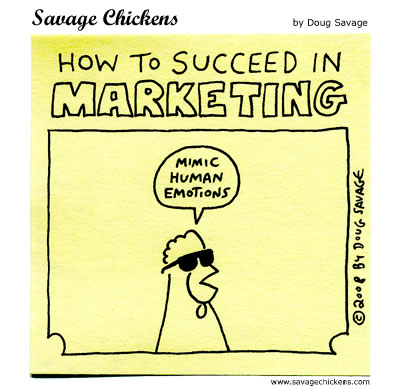
How to succeed in marketing

More Savage Chickens