


When trading conditions get tough, you have to take even more care of the customers. If that message isn’t clear from leaders at all levels in the organization, watch out for this kind of customer service as a result (the clip is about three and a half minutes):
Phil's Customer Service blog
Why I hate Ikea, Ryanair and Capital One
Jul 14th, 2008 | Customer Service | 0 Comments »
Not me. But Shaun Smith, who writes a nice piece on this in the GCCRM July e-newsletter, which you can read here:
“There are some brands that I hate: Brands like Ryan Air, IKEA and Capital One. Yet I admire them for their singularity of purpose, clarity of vision and superior returns.I hate Ryan Air because it …full story
Not all marketers should die
Jun 24th, 2008 | Customer Service | 0 Comments »
Though I sympathise with the Bill Hicks’ ‘all marketers should die’ rant that Johnnie Moore re-discovered on You Tube lately, I’d exclude the creators of this, just because it’s so creatively cheeky:
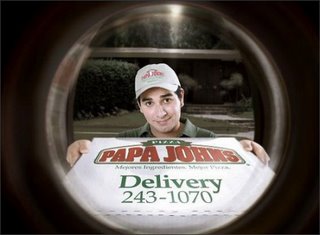
It’s a flyer for a pizza company, disguised as a pizza delivery boy that you see through your front door spy hole. Here’s how they do it:
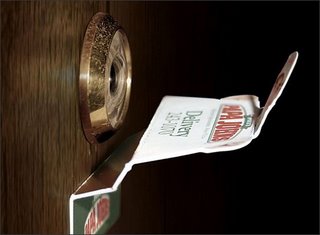
Spotted on the Firewire blog.
The secret of happiness is…
Jun 12th, 2008 | Customer Service | 0 Comments »
…low expectations.
When you have no choice and you are disappointed, the world is responsible.
When you have 100s of choices and you are still not happy with the ones you make, you blame yourself.
The more options we have, the more we regret what we didn’t choose. This opportunity cost becomes a lingering regret that subtracts from the satisfaction of the choice.
That’s a distillation of the core of Barry Schwartz’s excellent book The Paradox of Choice: Why More Is Less, which Schwartz says he wrote after counting 175 different salad dressings and 75 iced teas on his local supermarket shelves and thinking, “This is crazy”.
If you have the time, here’s a 20 minute talk Barry Schwartz gave at Ted on how the abundance of choice makes us (consumers) unhappy. Think about it if part of your customer strategy is the assumption that offering more choice makes customers happier.
What century is this?
Jun 6th, 2008 | Customer Service | 0 Comments »
Economists called the 20th century ‘The American Century’ because of the US domination of the world economy. So, will this be another American century or, as many Americans fear, will the balance of power shift to China or India, making this century The Chinese Century or The Indian Century?
None of the above. This century is The Customer Century. Last century, suppliers had the power. This century, with over-supply the major feature of the global economy, customers have the power. So, stop thinking in terms of which country will dominate; that’s a limited way of thinking and stops you focusing on where power really is.
Remember the Mattel toy recall? Most of those toys were made in China. That was an example of American consumers exercising their power over suppliers who were both American (Mattel) and Chinese (Mattel’s suppliers). China’s product quality and safety standards are being forced up by the demands of the American consumer.
So what are you doing to change your organization’s practices to recognize that power now lies with the customer?
Moments of Truth: Four people rules
Jun 6th, 2008 | Customer Service | 0 Comments »
I’m re-reading Jan Carlzon’s book Moments of Truth. He’s the CEO who turned around the Scandinavian airline SAS.
He starts the book with these four statements. They are a mini manifesto for getting people engaged and energized throughout the organization. The four rules apply particularly to the steps you need to take to free up your front line people to serve customers more effectively.

1. Everyone needs to know and feel that he or she is needed
2. Everyone wants to be treated as an individual
3. Giving someone the freedom to take responsibility releases resources that would otherwise remain concealed
4. An individual without information cannot take responsibility. An individual who is given information cannot help but take responsibility.
Source: Taken from the opening of Jan Carlzon’s book Moments of Truth.
Beware leaving frontline people with only ‘negative power’
Jun 1st, 2008 | Customer Service | 0 Comments »
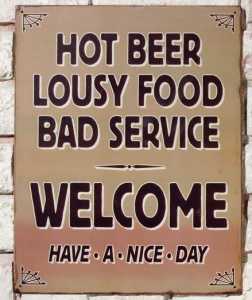 I was invited to breakfast a few weeks ago at the home of Charles Handy, the business guru and author. So I didn’t look too ill-informed or stupid, I read his latest book ‘Myself and Other More Important Matters’ before going for breakfast.
In the book, Handy reminds us that if our direct reports, co-workers, front line colleagues etc., do not feel valued or do not feel that they matter, they can easily take it out on the people they do have some power over – your customers.
Here’s what he wrote:
“In one recent survey, seventy-two percent of workers said that they were dissatisfied with their organization. Nineteen percent said that they actively wanted to sabotage it.
“…Frustrated workers can be tempted to activate the negative power that even the most humble possess. The woman in the call center who puts the phone down on me, the waiter who ignores me, the airline employee who closes the gate just as they see me rushing up – they may be exercising their negative power because it was the only way they had of demonstrating that they mattered.”
The power of stories
May 30th, 2008 | Customer Service | 0 Comments »
Circulating stories about ‘how we do things around here’ – the behaviours that mark your organization out as distinctive – models those behaviours so people know what is expected of them. The great thing about leading through stories is that they can become viral; other employees and customers take up the story and circulate it.
Here’s an example, told to me by Lyell Strambi, Executive Director of Richard Branson’s Virgin Atlantic airline.

Virgin has a number of legendary employees, who epitomize Virgin Flair. If you are a manager at Virgin and have to define Virgin Flair to a new recruit, you might have a hard time defining it. But, by telling real stories describing it in action, you get the message across.
One employee who epitomized Virgin Flair in action, said Strambi, was an in-flight attendant called Sue Rawlings, with a larger than life personality. Just before serving the ice cream that Virgin offers to passengers while they are watching the in-flight movie, this particular attendant would duck into the galley, smear ice cream all around her mouth, then emerge and start serving.
As she moved down the cabin she would pronounce very loudly, so that people would look up at her, ‘I never touch this stuff myself; I’m watching my weight, but people tell me it’s delicious. Enjoy!’ The effect was a wave of laughter that moved down the plane with her, as passengers looked up from plugging in their headphones or adjusting the volume control.
What stories do you have illustrating ‘the way we do things around here’? Are they as distinctive as this one? If not, then your customer experience probably isn’t that distinctive either.
Business is the best art
 I chaired a track session at European Customer Management World recently where part of my job was to interview Robert Stephens, founder of The Geek Squad. Here are a dozen learning points I jotted down from Robert on how to take a commoditized sector – IT service and repair – and create a cool, profitable, compelling, distinctive employee and customer experience.
Robert’s secret is that he deep themes his business, from the types of car his Geeks drive, to the way they dress, right down to the soles of their shoes. He calls his company ‘a living comic book’.
Clearly, stand-out leadership that creates stand-out organizations has evolved into something different from what it was. And by breaking the rules and treating everything as marketing (“Marketing is a tax you pay for being unremarkable”, he says), Robert seems to have re-invented marketing as well as leadership.
12 Learning Points from The Geek Squad on How to Create a Distinctive Customer Experience
1. Marketing when you have no money is the best kind of marketing. In 1994 when Robert started his IT support business, he had no money, just a mountain bike and a mobile phone to take him to his house calls. “That’s about as integrated as you can get. Everything you do in that situation is marketing.”
2. Marketing is a tax you pay for being unremarkable. Be remarkable – stand out – and you get free marketing. Because everything you do is marketing.
3. “Customer experience is the result of the employee experience. Every company is in the service business, no matter what you do.”
4. Create new rules: “I couldn’t afford to advertise. I’d never run a business before, so I had no rules to go by. I could see the company as a movie in my head. The Geeks were an audience I have to inspire, as are the customers. If you think of your companies as movie plots it is liberating.”
5. Dress the part. Our first uniform was a black SWAT jumpsuit. Our story is that we only turn up in an emergency, so it fit with the storyline. But, it scared the customers to death, so we softened it. Our uniform is now stolen from NASA – all those old black and white pics of NASA scientists huddled around the workstations in Houston, with short-sleeved white shirts, black ties…There’s something humble about that whole thing and we are a service culture. So, in the name of humility that’s how our modern day philosopher-kings, the Geeks, now dress.
6. Starve your teams on projects. They’ll be most creative that way.
7. Authenticity is one thing that can’t be copied.
8. Companies are now, in effect, focussed social networks for hire.
9. Replicating the DNA: We all need to be aware of the Founder’s Dilemma. Steve Jobs is reckoned to be 20% of Apple’s worth. What if he’s hit by a bus? My job is to influence and inspire the most efficient form of leadership. I’m a Geek too. When Iron Man comes out we all line up and go see the movie together. I’m a two-time college dropout. There isn’t that kind of separation between leader and led you might get in other organizations. My job is to lead by example and inspire. What the leader can do is influence and recognise people’s contribution. I’m the first director, if you will. But there are sequels, prequels, and other Geeks will direct those. We have one common purpose. There’s a Death Star called mediocrity. Our role is to blow it up with speed and quality.
9. Recruitment is the best form of advertising. We are starting to hold late night Kung Fu film festivals as a recruitment initiative, as the only people who go to schlock late night Kung Fu festivals are Geeks or people who know Geeks.
10. The three skills you can’t train for, that are essential for the Geek Squad, are: curiosity, ethics and drive. Curiosity in particular is that mix of enthusiasm and humility that is vital.
11. Recognize the importance of play: The key to innovation is play.
12. Most of the world is populated by boring businesses. I dropped out of art school because it was easier for me to be creative in a business setting. When companies are so boring, your opportunity to stand out by being interesting is enormous. Warhol said “Business is the best art.”
Secrets of The Concierge: Customer Service & Conversation
Apr 28th, 2008 | Customer Service | 0 Comments »
 I’ve become addicted to Slideshare. I like this (the Slideshare, below), though I think the title doesn’t do it justice (‘Customer Service is the new Marketing’).
I particularly like ‘The Secrets of The Concierge’, which you can find on Slide 21. They are:
- Put conversations at the centre of your business
- Reduce your sphere of control to increase sphere of influence
- Smash the silos
3. is now a cliche (though true). And the Cluetrain Manifesto taught us 1. ten years ago. I find 2. the most potent message at the moment. Anyway, here’s the slideshare:
[slideshare id=372622&doc=csitnm-1-1209150783625237-8]

 LinkedIn