

• The 60 Second Leader
  • Seven Secrets of Inspired Leaders
  • The Little Book of Leadership
  • Leadership Hub for Corporates
  • Learning to Live with Huntington's Disease
 

Phil's Customer Service blog

Be Different, not Better: Lessons from the pharmacy counter

Be different instead of (or, more accurately, as well as) better, because better is easier to copy and stands out less in your customers’ minds.

Being different doesn’t have to be highly imaginative and creative. Sometimes the most different things come with a slap to your own head and a ‘Duh: why didn’t anyone else do that before?’ feeling. Here’s one:

At most pharmacy/chemists counters, you have a public conversation, admittedly in a lowered voice usually, while other people waiting in line behind you either conspicuously look the other way or strain their ears to hear, depending on their level of discretion or nosiness.

At London Drugs (ironically not in London at all, but in the US) the pharmacist takes you into a private room to discuss the prescription you are getting filled. And why not? Does the doctor have a public conversation with you in front of other patients in the waiting room when you go to the doctor? Of course not. It’s private.

What can you do to stand out in your customers’ minds by being conspicuously different, in a way that is driven by customer need, of course. Your best starting point for this kind of thinking is, as Richard Branson always says, to be the customer yourself and think of what annoys you about current industry practise in your sector. Then change it.
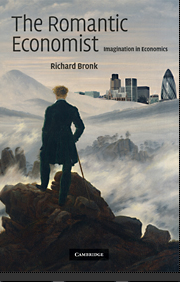

The Romantic Economist. Emotions and economic decision-making

I remember the much-missed Anita Roddick saying at an Inspired Leaders Network event: “I am NOT homo economicus.” Shouting, actually.

The post below on the ethical consumer highlights how emotions wrap into people’s economic decisions. Increasingly so in recent years, with concerns for the environment. So, I’ve been delighted at the growth of ‘behavioural economics’ (or ‘behavioral’ if you are in the US) as a discipline, to flesh out the whole 50% of the equation that classical and neo-classical economics misses out – the human element.

I’m even more delighted at Richard Bronk for writing The Romantic Economist. He draws on the work of John Ruskin and others to delve into the emotional bonds that customers form with organizations and that drive economic decisions and create economic patterns of behaviour/behavior.

A serendipity moment: see Shaun Smith’s most recent post on customer emotion and loyalty for an insight into the need to boost your emotional bonds in a downturn over on his CX Blog (Customer Experience blog).

And here’s the blurb for Richard Bronk’s new book, which is available about now:

Since economies are dynamic processes driven by creativity, social norms, and emotions as well as rational calculation, why do economists largely study them using static equilibrium models and narrow rationalistic assumptions? Economic activity is as much a function of imagination and social sentiments as of the rational optimisation of given preferences and goods. Richard Bronk argues that economists can best model and explain these creative and social aspects of markets by using new structuring assumptions and metaphors derived from the poetry and philosophy of the Romantics. By bridging the divide between literature and science, and between Romanticism and narrow forms of Rationalism, economists can access grounding assumptions, models, and research methods suitable for comprehending the creativity and social dimensions of economic activity. This is a guide to how economists and other social scientists can broaden their analytical repertoire to encompass the vital role of sentiments, language, and imagination.


Customer intimacy doesn’t have to cost much

The trick at the moment is to lower costs without damaging service levels. The weakness embedded in that thinking is that distinctive service that delivers customer empathy and intimacy costs. It doesn’t always. Here’s an example:

At the W hotel in Union Square, New York, a doorman (sorry, Door Ambassador), Jose, noticed a lot of joggers went past with their dogs. And that often the dogs looked thirsty. He had been told by his boss that the entrance to the hotel was his realm. He was king of it.

So, he started putting out funky-looking water bowls. Joggers stopped for their dogs to drink, and chatted with Jose. The entrance to the Union Square W became a happening place. Out of this grew W’s PAWs (Pets Are Welcome) programme.

Since all hotels are trying to give the impression they care, what impact does it give to reinforce that message to thousands of people passing every day, when the door ambassador seems to care about people who aren’t even guests at his hotel?

And did it cost anything?

The PAW programme that grew out of Jose’s initiative gave the trendy W hotels another string to their bow in terms of a distinctive offering, as some W’s offer special pet and owner breaks.


Death to selling 2009 (Part 2)

Well, I don’t know about the company that made this, but I do like the messages in it. And so it’s featured here as part of my ‘death to selling’ campaign for 2009.

[slideshare id=927818&doc=the-trust-roadmap-selling-program-1232260012823154-2]


Virgin One Account’s annual review

I just received my One Account annual review – It tells me how my mortgage is going and gives me advice on making best use of it.

When my bank – HSBC – calls me and offers me a ‘review’ to get the most out of my accounts with them, I know they are trying to sell me something and so I politely, or not so politely, decline.

When Richard Branson’s Virgin sold The One Account business to RBS I thought it was part of a depressing new trend for Virgin: use the founder’s charisma and undoubted commitment to customers to launch something and to attract a lot of customers. Then sell them to a big player. The ‘Virgin Countrywide’ trains that used to run through our local station suddenly became ‘Countrywide’ with no ‘Virgin’ on them, as the route had been sold. So, was there a pattern here, I wondered.

RBS always provided the banking behind The One Account, but Virgin provided the front-end branding, positioning, communications, and, most importantly, the values. Then Virgin sold the whole thing to RBS.

But, the One Account annual review stays true to Virgin’s original One Account. The opening letter says it is designed to help me make the most of my account. And it does. It includes tips on how to keep my outgoings down. It doesn’t try to sell me anything.

And, and, and…MOST interesting and revealing is that at the end of the list of bullet points on how to save money and get the most out of how the account is used, it says this:

“If you can think of anything else, then let us know and we’ll tell everyone.”

THAT is how 21st century suppliers should speak to customers – as equal partners speaking the same language and looking out for each others’ interests.

No other bank does that. So, I’ll be sticking with The One Account then. Looks like Virgin has infected RBS – this part of it at least.


Put non call centre people in your call centres

This is part of an ongoing series of tips on how to destroy your old ideas and practices about ‘the front line’- that front line people interact with customers and everyone else doesn’t – and open up the organization so people inside, on the edge, at the top, at the bottom, are ALL more connected with customers.

Intuit sends all its new hires to work between one and three months in the call centres before becoming the engineers who build the products. So, they spend up to three months talking with customers every day, answering their questions, learning from the customers themselves how their products are used. Only then – having had their brain changed by working directly with customers – are they allowed to go and build the next generation of products for those customers.

Source: I heard it from someone high up at Intuit.


Movies: When the user becomes the director

..and the script-writer. Well, kind of.

The producer / consumer split is blurring everywhere. Instead of providing a fully-formed final product to the end-user, it’s becoming increasingly common to involve them/us in its creation. Hence Alvin Tofler’s word ‘prosumer’ to describe this emerging change.

Anyway, you know all that. It’s just a preamble to introduce the latest example of it happening. Wired’s online magazine features the latest interactive movie technique that lets the viewer steer the path that the story takes:

Viewer’s Cut: Interactive Film Gives Editing Tools to You


Five Rules for a Great Customer Experience

Over in the CX (Customer Experience) blog, Shaun Smith posts an article about his own experience as a patient in a UK hospital, which prompted him, while in a hospital bed surrounded by beeping instruments, to create his own ECG – experiencecareogram – charting his satisfaction and dissatisfaction with the various points in his customer journey.

Shaun cites Daniel Kahneman’s Peak-End Rule and the work of two other behavioural/behavioral psychologists, Chase, and Dasu, to offer advice to health service operators on how to create a great experience:

Five Rules for a Great Customer Experience
“In the case of the hospital experience in particular, we can turn to two other psychologists, Richard Chase and Sriram Dasu and their research into behavioural science. They build on the ‘Peak-end’ principle by Daniel Kahneman to suggest five rules for creating a great experience. Shaun writes:

1.Finish Strong.
Customers accept waiting in-line at Disney because they manage expectations about waiting times and thus under-promise and over-deliver.
2. Get bad experiences over with early. If you have to have a bad experience, get it out of the way as quickly as possible. In the case of the hospital make the lag time from admission to surgery as quick as possible so don’t ask everyone to arrive at the same time-stagger admissions.
3. Segment pleasure, combine the pain. Spread out the pleasure-so don’t ask me to choose my menu for the next two days at one time-allow me to do this before each meal. Try to group tests together so that they are seen as one process not separate events.
4. Build customer commitment through choice. Give me full information and then allow me to make an informed choice of treatment and drugs. Research shows that patients experience less pain and faster recovery when given some control over their pain-killing medication.
5. Stick to rituals. Nurses should give information to patients about what they are monitoring and why. Include the patient in the ‘ritual’
Source of the five rules: ‘Want to perfect your company’s service? Use Behavioral Science. Chase and Dasu. HBR 2001

The above is from Shaun Smith’s CX (Customer Experience) blog


Create a new front line

In 2009, let customers inside your organization more. Stop thinking of ‘the front line’ – that imaginary place where a thin line of customer-facing people acts as the buffer or interface between you and the customers. Imagine the line is breached and people previously ‘on the inside’ of your organization are accessible to customers.

How?

Try employee blogs. Intuit, the tax software company, lets employees blog, with a relaxed corporate voice rule. I heard their MD say a while ago “Our most loyal customers love hearing tips and tricks on how to get the best from our software, direct from the people developing the products.”

If you’re even more techno-savvy than that, and your user base is, too, try a Wiki user contribution system. Again, Intuit do this: a Wiki lets your users write and re-write content. I heard Intuit’s MD say “The speed of change, such as new tax law changes, far exceeds our ability to put relevant content up ourselves. Our customers do it.”


Death of The Salesman

2009, I hope, will see the death of the salesman. And woman, of course. I’ve had arguments with sales experts over the years – people who argue that ‘sales’ is about helping people to buy what they really want, and that new disciplines like ‘consultative selling’ help the new generation of sales people to move on from the hard sell to really understanding their customers’ needs and adapt to meeting those needs.

But, really, if you think in terms of ‘selling’ and ‘sales’ you need to clear your head and start again, because you’re thinking in a dying paradigm born of a supplier-dominated world. We are in the Age of the Customer. If you do your marketing right, from the very start (right from product concept, that is) you shouldn’t have to do any selling anyway.

I was researcing something from Bertrand Russell to start 2009 for my leadership blog and came acros this from him, written in 1932 would you believe, on resistance to selling:

On Sales Resistance

“Throughout recent years, a vast amount of money and time and brains has been employed in overcoming sales resistance, i.e. in inducing unoffending persons to waste their money in purchasing objects which they had no desire to possess. It is characteristic of our age that this sort of thing is considered meritorious: lectures are given on salesmanship, and those who possess the art are highly rewarded. Yet, if a moment’s consideration is given to the matter, it is clear that the activity is a noxious one which does more harm than good…

…Everything economic is looked upon from the standpoint of the producer rather than of the consumer. In former times, it was thought that bread is baked in order to be eaten; nowadays we think that it is eaten in order to be baked. When we spend money, we are expected to do so not with a view to our enjoyment of what we purchase but to enrich those who have manufactured it.

…And so everything is done for the sake of something else. We make money not in order to enjoy what it provides but in order that in spending it we may enable others to make money which they will spend in enabling yet others to make money which…. But the end of this is bedlam.”

– Bertrand Russell, writing in the New York American, June 1932