• The 60 Second Leader
  • Seven Secrets of Inspired Leaders
  • The Little Book of Leadership
  • Leadership Hub for Corporates
  • Learning to Live with Huntington's Disease
 

Phil's Leadership blog

Purpose and motivation

“If you want to build a ship, don’t drum up the people to gather wood, divide the work, and give orders. Instead, teach them to yearn for the vast and endless sea”
Antoine De Saint-Exupery, author of The Little Prince

I’ve long been a fan of Saint-Exupery, but it took Henry Stewart to spot that quote buried in among Netflix’s rather long slideshare on its values. I’ve long been a fan of how Henry runs his business, too. He’s the founder of Happy. Henry is the only person I know who set out to run a company along the lines outlined by Maverick author Ricardo Semler. And how successful have they been? Here are some of the awards they’ve won:

2009 Best in UK for Health & Well-Being
2009 World’s Most Democratic Workplaces
2009 IT Training Company of the Year, Gold (Institute of IT Training)
2007 Best Workplaces (Financial Times): No. 2
2006 Most positive Impact on Society of any small business in UK (Business in the Community)
2003 Best Customer Service in UK (Management Today/Unisys Service Excellence UK Overall Winner)

Here’s Henry’s Happy@Work blog.

And here’s Happy’s website.


Why giving is leading

Nice post here showing a short clip from a talk given at Brigham Young University – Why Giving Matters by Arthur C. Brooks.

In the extract Barch has chosen for his blog, Brooks outlines research that shows people who give are seen by others as natural leaders.

Since many leaders are all about acquiring – power, control, influence, bigger office, bigger salary – this is a good reminder of the principle of servant leadership – you got to give before people will really see you as a leader. It’s about recognizing selflessness. People who give will tend to be driven more by principle and what’s right than by what they can get out of something. Therefore others will trust them more as leaders.

Click here for the one minute clip


High Performing Teams – The essence in 60 seconds

Forming or re-forming teams is an essential part of re-organization and restructuring. Teams are a bit like a music group – the economist Kjell Nordstrom likes to describe the Rolling Stones as the perfect team: each member knows what the other is about to do almost before they do it, instinctively, and they collaborate towards a common end (the song, the performance).

That’s fine if your team has been together for 40 years and is at the top of its industry. But, in today’s workplaces, teams form and re-form frequently. So, you need to get your team up to peak performance as fast as possible and keep it there. Here are some quick tips to help, from Katzenbach and Smith’s book The Wisdom of Teams:

What is a team? “A small number of people with complementary skills who are committed to a common purpose, set of performance goals, and approach for which they hold themselves mutually accountable.”

What are the four elements that make a team effective?

1. Common commitment and purpose
2. Performance goals
3. Complementary skills, and
4. Mutual accountability

At the heart of effective teams are shared values. “Teamwork represents a set of values that encourage listening and responding constructively to views expressed by others, giving others the benefit of the doubt, providing support, and recognizing the interests and achievements of others.

“Such values help teams perform, and they also promote individual performance as well as the performance of an entire organization.”

Adapted From: The Wisdom of Teams, by Katzenbach and Smith. More thoughts from them on how to build high performing teams in this short briefing on the Harvard site (about three to five minute read and thinking time needed) click here: The Discipline of Teams


How are you doing? 60 Second Leadership Health-check

This is a useful quick exercise to refresh your leadership, from Stewart Friedman, Professor of Management at The Wharton School. May be particularly useful when you are thinking about your Personal Development Plan:

1. First, identify the most important people in your life at work, at home, and in your community.

2. Then ask them what they want and need from you.

3. Finally, describe your expectations for your own performance.

Look for patterns you may have missed about how the different parts of your life affect each other. You’re probably overestimating what they really expect from you; you might even be missing a major priority of theirs, or putting effort into something that doesn’t matter to them at all! Talk with your key stakeholders to verify and, where it makes sense, change those expectations.”

More from Friedman here if you want more than one minute on this.

Phil


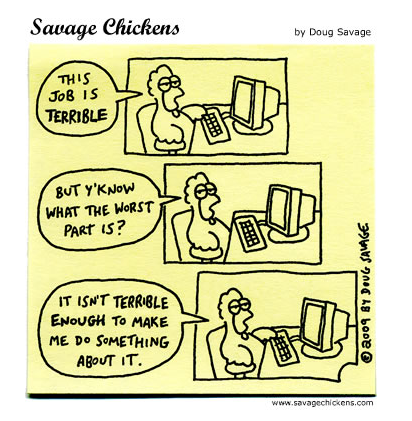
The worst part of work

More Savage Chickens on: www.savagechickens.com

PS But, it’s true, tho’, isn’t it. Even moreso in a recession, when people (you?) feel obliged to cling onto the job they’ve got.


What would your ‘leadership letter’ say?

My daughter-in-law (I mentioned this once before – sorry if you read it then) managed the children’s department of a book store. It ran fine under its previous boss. But, no-one knew what she did. When my daughter-in-law took over, she found ring binders full of procedures. For a few weeks, she was terrified of doing anything but follow them.

Then she thought “Wouldn’t this bit be better, if….” and changed it. People were pleased. She changed a bit more. They were more pleased with the results. She ended up changing a whole lot more, having shaken off the fear that this was some clockwork mechanism and if you tinkered with it the whole thing would fall apart.

She was rewarded by being offered a higher level job. All good so far, but what impressed me was the lack of ego in what she said to her successor (my daughter-in-law is an Aussie and I find the ego that is a part of UK management style is often absent with Aussie managers. Discuss).

She handed over to her successor and talked through with her all the (changed) procedures for managing the department. She said she did that so that her successor wouldn’t be left in the dark and clueless as she felt herself on walking into that job. And then she said the best thing: “When I come back in a month to visit, you need to show me what you’ve changed to make the department run better. If you haven’t changed at least one thing I used to do and replaced it with something better, I’ll be SO upset.”

Wow. How do they get that wise, that young?

Art Petty has a nice blog post over on his website called “Things I wish someone would have told me when I became a leader.”


How children, and cats, mislead us

Pic credit: http://www.obeythepurebreed.com/

Pic credit: www.obeythepurebreed.com

Overheard in the supermarket yesterday: Three-year-old sitting in shopping trolley/cart, says to his dad as I walk past them – “Wassat? Olives? I like olives. Get olives, dad.” Clunk goes olive jar as naive dad puts it into cart.

Five minutes later, on the other side of the supermarket, I pass the same leader and his dad. “Wassat?” says the driver as I pass them. “Purple hair dye,” says dad, suddenly aware of what’s coming next. “I like purp hair dye. Get purp hair dye, dad.”

As I looked over my shoulder, dad was suddenly realizing that half the contents of the trolley/cart would have to be put back due to mis-direction. Like many of us at one time or other, he’d been badly-led. And also like many of us, had no-one to blame but himself.

It’s not just kids who have mastered leading us where they want us to go. Cats apparently have learnt a particular new kind of purr to ‘enslave’ their owners, according to scientists. When we hear this particular purr (or you do, if you have one – our cat is under a little cat statue in the garden and has been for years, so we don’t any more) it triggers us to dish up food.

In The Leadership Hub this week, some things that you might like and find useful. No mis-leading cats or mis-directing babies, honest:

1. Hub TV: Ken Blanchard on leaving a legacy. What are the three things you want to be remembered for? Then it’s simple: consistently behave in a way that fulfills those three things and you will be (remembered for them, that is. Sorry, my syntax is turning to sand before my/your eyes).

2. Tom Schulte on ‘How to lead like cheese?’ What makes the cheeseburger a role model for leadership? It’s funny. And there’s a point at the end.

3. Oliver Mack, of the wonderful Common Purpose, on the problem with labels
– how developing people as leaders shouldn’t be about training people to take up positions of authority: “It’s about creating people who can lead from wherever they are, regardless of position, or hierarchical power.” Amen to that, Oliver.

Oh, and our new quotes section is coming along nicely. The Architect has added one I’ve always loved*. Feel free to add your own. And use the new ‘events’ section to let people know of any events you’ve got coming up.

You can find all the above by clicking on this link www.theleadershiphub.com

*”The first responsibility of a leader is to define reality. The last is to say thank you. In between, the leader is a servant” – Max De Pree


Alan Alda, the curious leader

Photo credit: Andy Carvin, flickr

There are people designated as ‘leaders’ in organizations – the CEO and the top bosses usually. There’s the politician as ‘leader’. And then there are people out there, in the culture, without a formal position in a hierarchy, who never call themselves a ‘leader’ but people follow them. They set agendas, make us think differently.

The actress Emily Blunt was working with Alan Alda on a new film recently and said in a newspaper article last week, “He is infectious and wise and impossible not to follow around.” She and her co-star Amy Adams, says Blunt, just loved to be near him, so much so that he would look up and see them following him and call out: “Leave me alone, I wanna eat my lunch.”

I have an Alan Alda quote on my wall. It goes:

“Be brave enough to live creatively.
The creative is the place where no-one else has ever been.
You have to leave the city of your comfort and go into the wilderness of your intuition.
You cannot get there by bus; only by hard work, risking and by not quite knowing what you are doing.”

Yes, that Alan Alda – Hawkeye from Mash. But, you see, he’s also the co-founder of the annual World Science Festival, author of ‘Dear Albert’, a play about Einstein, and when I switched on BBC Radio 4 recently someone was explaining how particle physics works and I thought “Why does that guy sound like Alan Alda?” Because it was Alan Alda, of course.

He also hosts and facilitates major seminars on subjects like ‘What it is to be human?’

Natural leaders just attract and hold our attention with new thoughts, new ideas, a clarity of explanation, a warmth and enthusiasm in Alda’s case, that almost defy analysis. It’s a form of leadership by curiosity, by asking questions, by wanting to learn.

People like Alda are rare natural leaders. They are, as Blunt says,”infectious” or, as Richard Dawkins would say, “memetic”. They are like a human equivalent of the internet – medium, message and amplifier all at the same time. They kind of get your molecules to vibrate a little faster.

Different people need or are attracted to different forms of leadership, I think. All I know is that when I hear Alda’s voice or see him on TV, I want to stop what I’m doing and see what he has to say next.

I can’t say that happens when I see an official ‘leader’ on the TV or hear them on the radio.

CEOs hamper the recovery. And the flying bunch of bananas

Apparently, US consumers are bored with the recession and out in force wanting to spend. (I’m not so sure about that. I think it’s the ones who still have their jobs. But, anyway, that’s what some US commentators are saying…) But 71% of US CEOs are stuck in last month’s or last quarter’s mindset and are too timid to take advantage of it. In fact, 71% of American CEOs are helping the recession continue, as they plan more layoffs and to horde cash.

The suggestion that CEOs are holding us back from recovery by being over-cautious shows a marked lack of leadership if it’s true. Slipping into ‘hunker down recession’ mode prolongs the downturn. The argument is put by Forbes’ publisher on the company’s talkback video site. The link is below. It’s an interesting point, weakened, unfortunately by a flying bunch of bananas.

I used to be a press officer many moons ago. And one of the things we always told interviewees going in front of the camera was – beware ‘flying bunch of banana syndrome’. That’s when your hand suddenly appears on the screen and completely distracts the viewer from what you are saying, as they are instead thinking “Whoa: looks just like a bunch of bananas flying across the bottom of the screen”.

Forbes’ media advisor needs to have a quiet word with the publisher before he does the next one of these talkback ‘to camera’ pieces. Those bananas are flying all over the place.

Here’s a link to the clip.


Normal service will be resumed

Well, excuse the interruption to this blog yet again. I juggle work with managing a care team that looks after my wife, who has Huntington’s Disease, and with raising a teenager. My wife’s illness has taken a nose dive the last couple of months and the care team has struggled to keep up with it. So, I’ve been frantically trying to reconfigure the care system we have to get back on top of that situation. 24-hour live-in carers look like the option, so I’m pursuing that and should be able to blog more often as that situation gets under control again. That plus a major contract has kept me stretched and away from this blog. Apologies.