


So, Streamline, The hosts of The Leadership Hub, seem to have decided they don’t like it and keep killing the link. Something to do with new database servers. If you use The Leadership Hub, sorry about this as it’s off at the moment. We are in deep combat with them to try and get it fixed. They say an engineer is onto it…I see a pig flying past the window.
Phil's blog
40 years of research into trust and leadership, in a two minute read
May 4th, 2009 | Leadership | 0 Comments »
Pardon the interruption in this blog – couple of weeks of launching something for a client coinciding with wife’s carers being on maternity leave or away = overstretch.
Trust and Leadership
D. L. Ferrin and K. T. Dirks examined 40 years of published research on trust in leadership and came to the following three conclusions:
1. For organizations to be effective, you need high trust in the leaders. (D’uh, you might think).
2. Trust in you as a leader develops or deteriorates through changes in psychological states – In other words, external worries about the recession, perhaps worries about the future of the company and their own job can have a lowering effect on the trust people feel in their leaders, even if those leaders haven’t acted in an untrustworthy way themselves. “I’m happy and confident, so I trust you more. I’m worried and anxious, so I trust you less.” Levels of trust in you can drop through no fault of yours.
3. Increasing complexity and ambiguities puts a strain on trust – The changes we have to go through as an organization to respond to the recession can create ambiguity & uncertainty. So, again, trust is at risk.
So what does this mean for me as a leader?
Basically, the effect of the recession is to erode trust in leaders, which can lead to a dip in performance (see item 1, above – ‘for organizations to be effective…etc.’). So, just when you need an increase in people’s performance, as we are trading through tough times, loss of trust can cause that performance to dip.
So, what can we do about it?
The Gallup Organization has researched over 10,000 people’s attitudes to their leaders. Gallup says that since the recession began, particularly since people began to worry about losing their jobs and seeing friends lose theirs, leaders have to raise their game significantly if they are to maintain levels of trust, let alone build the trust needed to sustain high performance.
Customise your on-hold messages
May 3rd, 2009 | Customer Service | 0 Comments »
I gave a keynote talk at the Contact Centre Planning Forum last week on how to improve the customer journey. It was at the Novotel, West London. When I rang the Novotel West London to check my room was booked, I got an on-hold message that was designed to reflect the values of Novotel, which is all about big spaces to relax in with natural light and things like that.
So, the on-hold message says to me something like “While you are waiting for an agent, take these few seconds to breathe deep, refocus, relax, refresh.” Too many organizations might think a branded on-hold experience means having a recorded sales message. That isn’t a pleasurable customer experience. It’s doubly irritating to be kept waiting and then have corporate messages thrown at you while you are a captive audience.
But, the whole idea of adapting your on-hold message to reflect your company values, as Novotel has done is…refreshing. My friend Shaun Smith says the new frontier for contact centres is creating a distinctive branded customer experience to replace the generic experience most contact centres offer.
It’s small but memorable – and low-cost, incidentally – things like customising your on-hold message to actually add value to the customer that will, step by step, move us towards next generation distinctive experiences delivered through the contact centre.
I asked the 450 or so people in the room if they used on-hold messages. They all put their hands up, of course. I asked them if they used a customised message that reflected their organisation’s values, or that added value to the customer, or at least was memorable for being different. No hand went up.
Sounds like an opportunity to me.
Can your contact centre agents tell you what’s really going on? Are you listening?
Apr 5th, 2009 | Customer Service | 0 Comments »
I had a sales call this week from Standard Life Healthcare. Before the agent could get very far I had to stop her and say I have two endowment policies with Standard Life designed to pay off my mortgage. When I was sold the first one, by a manager at the then Leeds Permanent Building Society (taken over by Halifax, now HBOS) I was told that not only would it pay off our mortgage, it would leave us with enough money to do something special – a trip around the world, for example.
A good number of years on, I now get red letters from Standard Life telling me I need to take action because one of the endowment policies is not going to pay up enough, leaving us £25,000 or so short, probably, by the time the mortgage comes due.
So, said I to the agent, there is no trust there anymore and, no disrespect to her, I wouldn’t dream of taking out a Standard Life Healthcare policy.
“Oh, we’re hearing that a lot,” she said. “Sorry to bother you. I’ll take you off our call list.’
I then asked what I always ask in these situations: “Do you have a mechanism there for feeding up the management chain what I just told you, and for passing on the fact that you are getting the same response from a lot of other calls?”
Eventually the agent said she would make sure she passed that onto a manager. But, I got the impression there is no open channel there with customer information flowing up the chain; that she would make a special effort. Perhaps.
Deep sigh. Amazon has its WOCAS reports (What Our Customers Are Saying) that feed this kind of customer intelligence into the system – front line people are asked to watch for recurring patterns like this. It’s a total waste of resource when most organizations aren’t similarly organized.
Even The Toilet Paper Entrepreneur knows it. In his blog post ’60 Customer Servie Tips’ he features this one:
25. Let Communication Flow – From the top to the first line supervisor, make sure your leadership team knows how to document suggestions and pass them on to the correct person who can properly evaluate and take action if needed.
-Dr. Jay McCurry, McCurry Training and Coaching
Quite right, too. All this stuff about ‘Voice of the customer’ you read about everywhere and organizations drowning in the data, and they aren’t even capturing the important stuff.
How to lead when you’re not the boss
Apr 5th, 2009 | Leadership | 0 Comments »
In flatter hierarchies, people may be leading cross-departmental project teams at certain times, though their organizational structure gives them no formal authority.
Over on Harvard Management Essentials, Christina Bielaszka-DuVernay summarizes the five steps to leading when you’re not the boss, taken from the book that was called Lateral Leadership: getting things done when you’re not the boss, but in its latest edition is called Getting It Done: How to Lead When You’re Not in Charge.
One may seem obvious. Two and Three seem the ‘killer apps’ in this list, especially Three (conduct mini-reviews and adapt as you go), which I think is the most powerful advice in here. Five (feedback) is hard to do in the way described if the people you are giving feedback to are technically ‘above’ you in terms of seniority.
1. Establish goals
People accomplish the most when they have a clear set of objectives. It follows that any group’s first order of business is to write down exactly what it hopes to achieve. The person who asks the question “Can we start by clarifying our goals here?”–and who then assumes the lead in discussing and drafting those goals–is automatically taking a leadership role, whatever his or her position.
2. Think systematically
Observe your next meeting: people typically plunge right into the topic at hand and start arguing over what to do. Effective leaders, by contrast, learn to think systematically–that is, they gather and lay out the necessary data, analyze the causes of the situation, and propose actions based on this analysis. In a group, leaders help keep participants focused by asking appropriate questions. Do we have the information we need to analyze this situation? Can we focus on figuring out the causes of the problem we’re trying to solve?
3. Learn from experience–while it’s happening
Teams often plow ahead on a project, then conduct a review at the end to figure out what they learned. But it’s more effective for teams (or individuals) to learn as they go along. Anyone who prompts the group to engage in regular minireviews and learn from them is playing a de facto leadership role.
4. Engage others
Suggest writing down a list of chores and matching them up with individuals or subgroups. If no one wants a particular task, brainstorm ways to make that task more interesting or challenging. Help draw out the group’s quieter members so that everyone feels a part of the overall project.
5. Provide feedback
If you’re not the boss, what kind of feedback can you provide? One thing that’s always valued is simple appreciation–“I thought you did a great job in there.” Sometimes, too, you’ll be in a position to help people improve their performance through coaching….Offer thoughtful suggestions for improvement, being careful to explain the observation and reasoning that lie behind them.
Click here for the full post on Harvard Management Essentials
Get on or get on with – Getting back up
Mar 30th, 2009 | Leadership | 0 Comments »
Who do you get up for in the morning? Strange question. Robert Hogan says we are driven by two desires – to get on (self-advancement) and to get on with (the need to co-operate to get things done). I think there’s an obvious third – helping others get on. Or, in the current climate, get up when they can’t see a way up.
There’s been a lot of trauma in teams and organizations over the past year. And a lot of dashing of personal aspirations of health, wealth and happiness. Well, wealth anyway.
But, the one good thing about a lot of our material aspirations being curtailed by the change in economic conditions is that it allows us to channel our need for fulfillment in what might be called less selfish ways – helping others get up.
Bill Taylor puts it this way: “The answer to ugly times? Do something beautiful,” giving a couple of examples of how random acts of kindness at work lift the spirit and remove a sense of powerlessness – both of which are casualties of the recession, and both of which we can do something about as individuals.
Taylor says:
“Now, I’m not suggesting that we can kill this recession with kindness, or that ‘senseless acts of beauty’ can cure a truly hideous financial mess. But tough economic times have a way of bring out the worst in our companies and ourselves. So let’s work hard to bring out the best in ourselves. It may not amount to a stimulus package, but it may make it easier for all of us to get through the day — and eventually get back to prosperity.”
There is a leadership essence at work here. Too often, leadership is about self-advancement – Hogan’s ‘get on’ drive. Steve Farber, in his Extreme Leadership blog, reminds us that no matter what level in the organization you are at, leadership is not about you, with his ‘Greater Than Yourself’ campaign:
“Instead of wallowing in your own despair, pick someone at work to invest in, with the intent of making that person greater than you are. Be a coach, guide, or mentor in the truest, most personal sense of the words by choosing someone to be your GTY (Greater Than Yourself) project, and see what that does to your own predicament, your own state of mind.”
How to turn customer enemies into customer friends
Mar 26th, 2009 | Customer Service | 0 Comments »
Nice slideshare here (below). I particularly think the point quite late in the Slideshare – that even customers who look like enemies on the net can be quickly turned into friends with a conversation – is extremely powerful.
It confirms some advice I read recently, but have now lost the source for; that hotel customer service or sales people should trawl through Trip Advisor and other travel sites looking for reviews of their own hotels, contact customers who post a bad review, and ask their advice on what to fix, then let them know what changes you’ve made and politely ask them if they’d consider updating their review.
Decades old research told us that a complaining customer who has their opinion turned around by a responsive organization is more loyal than a customer who has never complained. Add that to the fact that bad reviews can be seen by thousands of potential customers and therefore do untold damage to your reputation, and the cost-benefit analysis of investing time in turning around these customers is enormous.
A bad review is just free consultancy on where you need to improve. There’s an urgency in that, as long as it is unchanged, your reputation is being damaged with every potential customer who reads it. So, the clock is ticking. So, you could set up metrics based on how fast you can turn around a critical, negative review into a positive one.
This is the new marketing, kids. The old anonymous dissatisfied customers that never complain direct to you but were out there spreading negative stories about you by word of mouth were invisible to you. Invisible guerillas they used to be called. Now, they are not only visible to you, you can engage with them, contact them directly, and find out what action would turn their opinion around. Then, if it’s reasonable, do it.
If you haven’t incorporated this kind of activity in your customer engagement, service, marketing, communication or experience design , then you are behind the curve. If your mindset is “But, approaching one customer at a time can’t be cost-effective” you’re looking at it the wrong way. Think of it this way, instead: There is a negative advertisement on the web about you, reaching thousands of people. By engaging with the advertiser, you can turn it around into a positive advertisement. Does that make more financial sense to you? Because that’s the new reality.
[slideshare id=1199150&doc=howtolaunchaproductintheopen-090325201015-phpapp01]
The 6 causes of disengagement. And how the recession makes them worse.
Mar 24th, 2009 | Leadership | 0 Comments »
1. I can’t be engaged if I’m overwhelmed
2. I can’t be engaged if I don’t get it
3. I can’t be engaged if I’m scared
4. I can’t be engaged if I don’t see the big picture
5. I can’t be engaged if it’s not mine
6. I can’t be engaged if my leaders don’t face reality*
Those are the six main forces pulling against employee engagement. And you can instantly see that the recession has a direct impact on each of these causes.
Here are six tips for countering those six effects
1. Overwhelm. Yes, people are more likely to feel overwhelmed in a downturn. Doing more with less adds to people’s workloads. Don’t just divide up the work if people have had to leave. Help people assess the elements that help deliver your core purpose – that are critical to strategy execution – and those that aren’t.
2. Don’t ‘get it’. Yes, people will be disengaged if you don’t explain in a compelling way WHAT we are doing to ride out the recession and WHY we are doing it. Repeatedly.
3. Fear. Definitely, people are more scared in a recession. Get out among them and give them as clear information as you can. Uncertainty breeds fear.
4. The big picture. If people don’t have a direct line of sight between their own daily actions and the bigger picture – a clear idea of how the things they do every day contribute directly towards your organization staying ahead of the recession – then they won’t be engaged. It’s up to you to provide that if it’s lacking.
5. ‘It’s not mine’. In a recession, people feel they are not in control of events, that they don’t know what’s coming next. Admit it: you do, too. Counter that lack of control over external events by giving people control over what they do at work – make it ‘theirs’. Provide clear objectives, make them accountable, but let them run with it.
6. Leaders need to face reality. Use the people closest to the market as your ear to the ground and work out with them, with your own bosses, and with peers what you need to change, and what you need to keep the same, to adjust to the new reality in the market.
*The six main forces pulling against engagement are from Jim Haudan, CEO of Root Learning and author of The Art of Engagement. The six tips for dealing with them are from me.
The Collapse of Distinction
Mar 24th, 2009 | Customer Service | 0 Comments »
Your customer experience is probably more similar to your competitors’ than it is dissimilar. Benchmarking (copying) probably hastens the convergence.
Over on his Leading Blog, Michael McKinney recommends the new book The Collapse of Distinction by Scott McKain, and quotes what you need to do about the trend to sameness, like so:
“You do not need to change everything about how you do business to create distinction. Start by walking through your list of points of contact with customers, reframing and redefining how you perceive each moment of interaction. From these new perspectives, you can then begin to create specific points of differentiation with your customers. By developing your professional laundry list from the exercise—and recognizing that if these practices are the industry standard, then they will almost always fail to create distinction for you—you are taking an important first step in disciplining yourself as a professional to develop differentiated methods and tactics. Different is not just good, different is better.”
I used to say ‘Be different, not better’ to get across the point that difference is strategic, better is usually just operational. I like McKain’s conflation that different is the new ‘better’.
Another approach to this is to compare yourself to a competitor with two lists of customer touchpoints under the headings ‘different’ and ‘the same’. This is a good starting point for convincing colleagues and bosses, who tend to focus too much on what makes your organization different from the competition and not enough on the similarities, and so tend to have a warped view of your own ‘specialness’ or distinction.
Michael delves into the book more on his Leading Blog post here
Job Ownership: The Next Level of Engagement
Mar 23rd, 2009 | Leadership | 0 Comments »
 Engaging people behind the organization’s core purpose is a if not the key role of leadership. Yet, the recession pulls against engagement massively. I’ll post tomorrow on the six ways the recession undermines your ‘people engagement’ work.
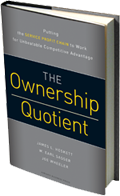
The authors of The Harvard Service Profit Chain, Sasser & Hesketh, with their co-author Joe Wheeler of The Service Profit Chain Institute, have just published The Ownership Quotient: Putting The Service Profit Chain to Work for Unbeatable Competitive Advantage.
The authors argue that the next level for putting the chain into practice is to focus on giving people ownership of their jobs. Their new acronym to add to IQ and EQ (Emotional Quotient – Daniel Goleman’s phrase for measuring Emotional Intelligence) is OQ – the Ownership Quotient. To what extent do people feel they ‘own’ their job?
I am absolutely sure they are right. And this is particularly compelling in a downturn, where people feel external forces are out of their control and they need, more than ever, a strong sense of control at work to keep them engaged and confident.
A timely book.

 LinkedIn