• The 60 Second Leader
  • Seven Secrets of Inspired Leaders
  • The Little Book of Leadership
  • Leadership Hub for Corporates
  • Learning to Live with Huntington's Disease
 

Phil's blog

How are you doing? 60 Second Leadership Health-check

This is a useful quick exercise to refresh your leadership, from Stewart Friedman, Professor of Management at The Wharton School. May be particularly useful when you are thinking about your Personal Development Plan:

1. First, identify the most important people in your life at work, at home, and in your community.

2. Then ask them what they want and need from you.

3. Finally, describe your expectations for your own performance.

Look for patterns you may have missed about how the different parts of your life affect each other. You’re probably overestimating what they really expect from you; you might even be missing a major priority of theirs, or putting effort into something that doesn’t matter to them at all! Talk with your key stakeholders to verify and, where it makes sense, change those expectations.”

More from Friedman here if you want more than one minute on this.

Phil


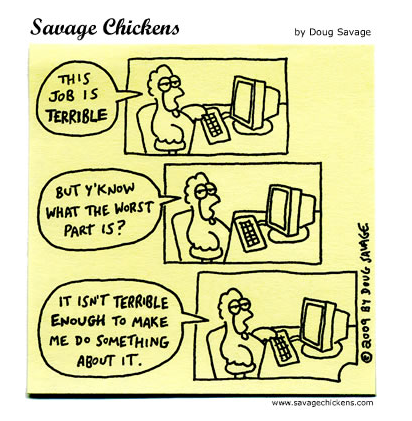
The worst part of work

More Savage Chickens on: www.savagechickens.com

PS But, it’s true, tho’, isn’t it. Even moreso in a recession, when people (you?) feel obliged to cling onto the job they’ve got.


What would your ‘leadership letter’ say?

My daughter-in-law (I mentioned this once before – sorry if you read it then) managed the children’s department of a book store. It ran fine under its previous boss. But, no-one knew what she did. When my daughter-in-law took over, she found ring binders full of procedures. For a few weeks, she was terrified of doing anything but follow them.

Then she thought “Wouldn’t this bit be better, if….” and changed it. People were pleased. She changed a bit more. They were more pleased with the results. She ended up changing a whole lot more, having shaken off the fear that this was some clockwork mechanism and if you tinkered with it the whole thing would fall apart.

She was rewarded by being offered a higher level job. All good so far, but what impressed me was the lack of ego in what she said to her successor (my daughter-in-law is an Aussie and I find the ego that is a part of UK management style is often absent with Aussie managers. Discuss).

She handed over to her successor and talked through with her all the (changed) procedures for managing the department. She said she did that so that her successor wouldn’t be left in the dark and clueless as she felt herself on walking into that job. And then she said the best thing: “When I come back in a month to visit, you need to show me what you’ve changed to make the department run better. If you haven’t changed at least one thing I used to do and replaced it with something better, I’ll be SO upset.”

Wow. How do they get that wise, that young?

Art Petty has a nice blog post over on his website called “Things I wish someone would have told me when I became a leader.”


How children, and cats, mislead us

Pic credit: http://www.obeythepurebreed.com/

Pic credit: www.obeythepurebreed.com

Overheard in the supermarket yesterday: Three-year-old sitting in shopping trolley/cart, says to his dad as I walk past them – “Wassat? Olives? I like olives. Get olives, dad.” Clunk goes olive jar as naive dad puts it into cart.

Five minutes later, on the other side of the supermarket, I pass the same leader and his dad. “Wassat?” says the driver as I pass them. “Purple hair dye,” says dad, suddenly aware of what’s coming next. “I like purp hair dye. Get purp hair dye, dad.”

As I looked over my shoulder, dad was suddenly realizing that half the contents of the trolley/cart would have to be put back due to mis-direction. Like many of us at one time or other, he’d been badly-led. And also like many of us, had no-one to blame but himself.

It’s not just kids who have mastered leading us where they want us to go. Cats apparently have learnt a particular new kind of purr to ‘enslave’ their owners, according to scientists. When we hear this particular purr (or you do, if you have one – our cat is under a little cat statue in the garden and has been for years, so we don’t any more) it triggers us to dish up food.

In The Leadership Hub this week, some things that you might like and find useful. No mis-leading cats or mis-directing babies, honest:

1. Hub TV: Ken Blanchard on leaving a legacy. What are the three things you want to be remembered for? Then it’s simple: consistently behave in a way that fulfills those three things and you will be (remembered for them, that is. Sorry, my syntax is turning to sand before my/your eyes).

2. Tom Schulte on ‘How to lead like cheese?’ What makes the cheeseburger a role model for leadership? It’s funny. And there’s a point at the end.

3. Oliver Mack, of the wonderful Common Purpose, on the problem with labels
– how developing people as leaders shouldn’t be about training people to take up positions of authority: “It’s about creating people who can lead from wherever they are, regardless of position, or hierarchical power.” Amen to that, Oliver.

Oh, and our new quotes section is coming along nicely. The Architect has added one I’ve always loved*. Feel free to add your own. And use the new ‘events’ section to let people know of any events you’ve got coming up.

You can find all the above by clicking on this link www.theleadershiphub.com

*”The first responsibility of a leader is to define reality. The last is to say thank you. In between, the leader is a servant” – Max De Pree


Re-think core and non-core: It’s what’s around the edge, not what’s in the middle, that counts

The problem with focussing all your resources on core competence is that if the ‘thing’ you provide – product, service, whatever – isn’t that exciting, then it won’t be that memorable. You’ll just ‘get it right’ and, to be frank, so what. That’s what you’re supposed to do.

It brings to mind what the former CEO of Burger King, Barry Gibbon, described as Nightmare Number 1, when he first took up the job and toured Burger Kings to find out more about the customer experience. Nightmare number 1 was this: “Even when we did it right, it was still pretty ordinary”.

Despite all the talk of passion and excellence, most companies provide pretty mundane products and services that customers will never get passionate about or never think “That was excellent!” You’re not going to make customers go ‘Wow!’, for example, if your job is to tell them what time the trains are due to arrive. Or, are you?

You are if you get the core competence right as a basic, a hygiene factor, then add something extra. The ‘something extra’ then goes from being superficial and unnecessary – which is how managers tend to see it – to the reason customers remember you. In other words, what most managers see (or don’t see – it isn’t even on their radar) as pointless and unrelated to the work is, in fact, your competitive advantage.

Here’s a story from the UK to illustrate the point:

“Passengers on the platform at Leicester aren’t just informed of train times; the railway announcer, John Palmer, also gives them a thought for the day (example: “Why is there only one Monopolies Commission?”) or a history lesson.

Last Tuesday he told them that on June 23, 1314, the battle of Bannockburn took place. “It’s a harmless way of brightening up people’s days,” says Palmer. And his bosses agree.

“We get a lot of positive feedback from passengers and hope John will carry on,” says a spokesman for East Midlands Trains.
– From The Week

Good for them. The little things, you see, are now the big things in making a difference to the customer experience. What John Palmer is doing is the best form of innovation in customer service – It’s personal, it’s unique and, hey, it doesn’t cost anything. Did he ask permission? I doubt it. Is there a process or a standard for what he does? Of course not.


Alan Alda, the curious leader

Photo credit: Andy Carvin, flickr

There are people designated as ‘leaders’ in organizations – the CEO and the top bosses usually. There’s the politician as ‘leader’. And then there are people out there, in the culture, without a formal position in a hierarchy, who never call themselves a ‘leader’ but people follow them. They set agendas, make us think differently.

The actress Emily Blunt was working with Alan Alda on a new film recently and said in a newspaper article last week, “He is infectious and wise and impossible not to follow around.” She and her co-star Amy Adams, says Blunt, just loved to be near him, so much so that he would look up and see them following him and call out: “Leave me alone, I wanna eat my lunch.”

I have an Alan Alda quote on my wall. It goes:

“Be brave enough to live creatively.
The creative is the place where no-one else has ever been.
You have to leave the city of your comfort and go into the wilderness of your intuition.
You cannot get there by bus; only by hard work, risking and by not quite knowing what you are doing.”

Yes, that Alan Alda – Hawkeye from Mash. But, you see, he’s also the co-founder of the annual World Science Festival, author of ‘Dear Albert’, a play about Einstein, and when I switched on BBC Radio 4 recently someone was explaining how particle physics works and I thought “Why does that guy sound like Alan Alda?” Because it was Alan Alda, of course.

He also hosts and facilitates major seminars on subjects like ‘What it is to be human?’

Natural leaders just attract and hold our attention with new thoughts, new ideas, a clarity of explanation, a warmth and enthusiasm in Alda’s case, that almost defy analysis. It’s a form of leadership by curiosity, by asking questions, by wanting to learn.

People like Alda are rare natural leaders. They are, as Blunt says,”infectious” or, as Richard Dawkins would say, “memetic”. They are like a human equivalent of the internet – medium, message and amplifier all at the same time. They kind of get your molecules to vibrate a little faster.

Different people need or are attracted to different forms of leadership, I think. All I know is that when I hear Alda’s voice or see him on TV, I want to stop what I’m doing and see what he has to say next.

I can’t say that happens when I see an official ‘leader’ on the TV or hear them on the radio.


CEOs hamper the recovery. And the flying bunch of bananas

Apparently, US consumers are bored with the recession and out in force wanting to spend. (I’m not so sure about that. I think it’s the ones who still have their jobs. But, anyway, that’s what some US commentators are saying…) But 71% of US CEOs are stuck in last month’s or last quarter’s mindset and are too timid to take advantage of it. In fact, 71% of American CEOs are helping the recession continue, as they plan more layoffs and to horde cash.

The suggestion that CEOs are holding us back from recovery by being over-cautious shows a marked lack of leadership if it’s true. Slipping into ‘hunker down recession’ mode prolongs the downturn. The argument is put by Forbes’ publisher on the company’s talkback video site. The link is below. It’s an interesting point, weakened, unfortunately by a flying bunch of bananas.

I used to be a press officer many moons ago. And one of the things we always told interviewees going in front of the camera was – beware ‘flying bunch of banana syndrome’. That’s when your hand suddenly appears on the screen and completely distracts the viewer from what you are saying, as they are instead thinking “Whoa: looks just like a bunch of bananas flying across the bottom of the screen”.

Forbes’ media advisor needs to have a quiet word with the publisher before he does the next one of these talkback ‘to camera’ pieces. Those bananas are flying all over the place.

Here’s a link to the clip.


Normal service will be resumed

Well, excuse the interruption to this blog yet again. I juggle work with managing a care team that looks after my wife, who has Huntington’s Disease, and with raising a teenager. My wife’s illness has taken a nose dive the last couple of months and the care team has struggled to keep up with it. So, I’ve been frantically trying to reconfigure the care system we have to get back on top of that situation. 24-hour live-in carers look like the option, so I’m pursuing that and should be able to blog more often as that situation gets under control again. That plus a major contract has kept me stretched and away from this blog. Apologies.


What you can learn from comedians

Interesting article in the Sunday Times, drawing partly on Roger Edwards Jones book ‘What Can Chief Executives Learn From Standup Comedians?’ It’s not about introducing comedy to the workplace – though there is a role for humour that is too often ignored or seen as ‘not serious’ and therefore unconfident leaders and managers avoid it.

The learning points don’t just apply to chief executives. They include:

Preparation. Good stand-up performances appear totally spontaneous, but the reality is quite different. Comedians spend hours honing those routines. The harder you work on a presentation, the more relaxed it sounds.

Less is more. A comic’s messages are not long-winded, but tight and concise. Presentations benefit from fewer, more focused, words.

Confidence. Although they may suffer horribly from nerves, a comedian must exude a natural authority or die. Equally, bosses need to think about the impression they give and may have to project an air of confidence.

Responsibility. The stage is a lonely place. When they bomb in front of an audience, comics know there is nobody to blame but themselves. It’s the same for bosses – but they may not always realise that they have to take the flak for failures as well as the rewards for success.

Courage. Comedians are constantly pushing themselves further from their comfort zone as they progress to bigger performances and new material. All executives can benefit from re-examining their comfort zones and pushing outside it now and again.

You can read the full article here

Roger’s pocket book (It’s 64 pages) on Amazon.co.uk is here


Keynes was wrong and Obama is a communist

Well, that’s what my Californian friend Janice tells me is the Republican mantra at the moment. Since unfettered free market economics with its unhidden hand – greed – brought us a global market collapse, it’s a shame people still line up in opposing camps – pro or anti Keynes. With people choosing a position based entirely on their political dogma.

We’re in a different place now, it seems to me. The imagination of the financial idiots savants who came up with derivatives and other complex financial instruments was the equivalent of the warped imagination behind the 9/11 attacks. The unreal, unimaginable, became real. The old rules don’t seem to apply. If they ever did.

What theories of economics – including Keynes’s General Theory – fail to recognize is that capitalism evolves. We’ve never been at this stage of capitalism before. Consumer and what might be called post-consumer behaviour isn’t predictable. But, some things – on the supply side of the equation – are. It just suits us to look the other way or not believe.

There is massive over-supply in the car industry globally, for example. And there has been for years. I used to write about the car industry and couldn’t understand how on earth it could continue disguising the fact that it was making more cars than the world would want to buy.

The big US car giants have been heading towards a cliff for at least five years. Now they’ve fallen off it. Their business models and plans for continuous growth in the face of too much supply were faulty because they were backward-looking, based on what worked before, patterns of demand and growth that existed before. Where’s the surprise that denial failed and reality bit them hard?

Similarly, those who label the public sector pumping money into the private sector as ‘communist’ are walking backwards into the future: their view of how the world works is shaped by patterns from the past that no longer apply.

Having said that, there is a smart piece in Forbes on ‘Why Keynes was Wrong’. I don’t agree with it. It still has an ‘Obama is a communist’ sub-plot lurking in the distant background. But, at least it’s smartly argued. And doesn’t caricature Keynesian economics. Here it is:

Forbes Magazine: Why Keynes Was Wrong