• The 60 Second Leader
  • Seven Secrets of Inspired Leaders
  • The Little Book of Leadership
  • Leadership Hub for Corporates
  • Learning to Live with Huntington's Disease
 

Phil's blog

The Six Basic Skills of Heroes

‘To create frontline heroes you have to concentrate on developing what we call The Six Basic Skills of Heroes, which are: empathy, social skills, motivation, self-regulation, self-awareness and emotional skills.’

– I heard this from Gerry Farrelly, Director of Training & Creatology, Farrelly Facilities & Engineering. Gerry combines ancient Chinese philosophy (the Tao Te Ching) with the principles in the best-selling book Funky Business and other inspiring sources to create possibly the world’s funkiest and most customer-focussed facilities management and engineering company. They are based in the UK’s Midlands.

This tip is a sample from a book I am putting together called
Take One A Day
365 Ways to
Get Closer
to Your Customer


From behind a desk is no place to view the world

When did you last join the front line and work there for a few hours? The best leaders keep connected with their staff and market by going ‘back to the floor’ regularly. I recently came across this example from Richard Branson:

“I…insist that we continually ask our staff for any suggestions they might have, and I try my hand at their jobs. When I tried pushing a trolley down the aisle of a jumbo, I found I crashed into everyone. When I talked to the crew about this they suggested we introduce a more waitress-style service and keep the trolleys to a minimum. As it turned out, by getting rid of trolleys altogether in Upper Class, we were able to use up some of the aisle space to provide the longest and largest seats in the air.”

– Richard Branson, frm his book Losing My Virginity, challenging the conventional wisdom that leaders operate from the centre and don’t get involved in detail out at the front line. Richard Branson will be sharing more of his leadership techniques live by satellite in his session at Leaders in London at the end of November.


It’s NOT about the Internet

‘It’s not the age of the Internet. It’s the age of customer control.’

– Tom Peters, speaking at a seminar I chaired* a while ago, quoting American Express’s Anne Busquet.

(Note: I’ve heard Richard Branson and Patricia Seybold come out with exactly the same words. Don’t know which of them said it first, but it’s obviously TRUE).

Through the late 1990s there was a shift in power that coincided with the Internet reaching a tipping point and breaking out to become a mass medium. The widespread assumption at the time was that the Net was what was causing the disruption of the balance between suppliers and customers. It wasn’t. It was just a symptom and accelerator of a shift of power to customers that was already going on.

*All that means is I introduced him to the audience and he did the rest.


In praise of a genuine leader

I’m a week late on this one, so apologies for being even more behindhand than usual…

A week and a bit ago Muhammad Yunus received the Nobel Peace Prize for his work as ‘banker to the poor’. I’m not one for the ‘great man’ (it’s always men) school of history, but there are a few obvious Mandela-stature exceptions and Muhammad Yunus is one of them.

With Grameen Bank and Grameen Phone, Yunus proved that the poor and even destitute can be customers, using the collateral of their own skills and hard work.

I remember back in the 1980s when the New York banks were widely condemned for practising a secret policy of ‘red-lining’ – drawing a red line around deprived areas of the city on a map and creating a blanket policy of not lending to the people who lived there, as they were assumed to be a bad credit risk.

Cutting off whole sections of the population from banking services stinks in moral terms, leaving them with no option but loan sharks and pawn brokers; no ladder out of the cycle of poverty. Yunus showed it stinks in capitalist terms, too. When the major banks laughed at his suggestion that they break destitute Bangladeshis out of the poverty cycle with a new concept that gave them an alternative to loan sharks – micro-lending – they laughed in his face.

So, he leant a group of villagers the money in his own pocket – £14 – to buy the materials they needed to set up smallscale businesses. They all paid him back with interest. His new idea – microlending – grew into the £2.5 billion Grameen Bank that is owned by its users, is estimated to have helped hundreds of thousands of people out of poverty AND continues to make a profit.

The proportion of borrowers who default on their loan is tiny compared to traditional bank lending. Yunus then spotted that with mobile phones, local growers and crafts people – mostly women – could jump past middle-men who tended to exploit them with very low prices, to find out what actual prices were in markets and negotiate direct with buyers further away, increasing their bargaining power.

So, he launched Grameen Phone, a phone rental scheme with its own network to get mobile phones in the hands of the poor. Now if you go to Bangladesh ‘GrameenPhone’ is likely to pop up on your phone screen as your local provider as it has become, like the bank, a highly profitable success story.

Yunus, an economics professor, still lives in a tiny flat in Bangladesh. He explained once that he developed the idea for the Grameen Bank during the Bangladeshi famine in the 1970s, when he became increasingly disillusioned that people were dying while he and other economics professors were sitting around in Chittagong University teaching elegant economic theories “whereas in fact the starvation all around us showed we knew nothing. What we were teaching wasn’t helping.”

He once said to The Guardian newspaper “One day we will look in museums and say to our children, ‘That’s what poverty looked like.'”

That sounds naive. Until you look at what he has achieved so far. Fifty other countries – including the US – have taken up micro-lending. Yunus’s work helped prompt C K Prahalad’s book The Fortune At The Bottom Of The Pyramid, which looks at practising a new form of global capitalism that includes the world’s poorest and that makes healthy profits while at the same time helping people out of poverty.

Now, like I said, I am wary of the whole ‘great man as leader’ or ‘great man as forger of history’ school of thinking. But, every now and again one comes along that makes us see the world afresh and inspires us by showing us we can do the apparently un-doable and take the lead to make change happen. Sounds like a leader to me.

Too much choice

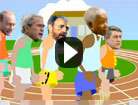
Too much choice will actually stop a lot of people from buying. See Barry Schwarz’s book The Paradox of Choice.

And here’s a Borat clip spotted on Lee McEwan’s Serendipity Book to prove it. Click on the big ‘play’ button in the middle then the small one bottom left:


Disney’s Service Principles

1. Pay fantastic attention to detail
2. Everything you do walks the talk
3. EveryONE walks the talk
4. Customers are best heard through many ears
5. The competition is anyone the customer compares you with
6. Reward, Recognize and Celebrate
7. Everyone makes a difference or ‘Xvxryonx makxs a diffxrxncx’ (just one defective typewriter key makes a massive difference)

SOURCE: From a friend of mine who runs the business banking division of one of the major banks. He stole the Disney service principles and his people agreed to adopt them as their own. How do yours compare? What do you mean you haven’t got any? Rip these off, adapt them if necessary and ask your service people if they will adopt them as their own. If they don’t fit, ask your people to look at them and come up with their own suggestions then adopt the ones that get the most votes. People buy into it if they made it.

This tip is a sample from a book I am putting together called
Take One A Day
365 Ways to
Get Closer
to Your Customer


The New Golden Rule

The NEW Golden Rule: “We’re always told to treat customers as we would want to be treated. That’s not right. Treat customers as THEY want to be treated. Find out. Don’t assume. The golden rule isn’t ‘Do as you would be done by.’ It’s ‘Do unto others as they would like to be done unto’. ”

SOURCE: I heard this from Ken Pasternak, President, Inter Associates Ltd

This tip is a sample from a book I am putting together called
Take One A Day
365 Ways to
Get Closer
to Your Customer


The Tao of Martin Scorcese

More on Martin Scorcese’s leadership as a director:

“He’s the kind of director who makes you think it was your idea.”
– Ray Winstone, on his role in The Departed.

All the best leaders do. Lao Tsu (or Tse, depending on how you want to spell it) noted this in the Tao Te Ching centuries ago:

“The good leader is he whom the people revere.
The great leader is he of whom the people say,
‘We did it ourselves’.”


Why most leadership sucks

OK, time to admit something weird in a leadership blog – I am absolutely ambivalent about the whole idea of leadership. We lead ourselves. Full stop. I don’t want anyone leading me. Do you?

I love being inspired by people who provoke in me that feeling of “Wow, I could do that, too,” or “I never thought of it like that before”. I would love it if some of the things I do even occasionally provided inspiration to other people. But, I don’t want to be a ‘leader’ and I don’t want to be ‘led’. I guess it’s the old communitarian in me.

But, the great thing is that traditional notions of leadership don’t work any more anyway. So, I work in this area because we have a tabula rasa – a blank sheet where we can virtually start again and get it right this time; allow distributed leadership cultures to emerge in which everyone leads.

Peter Senge has updated his Fifth Discipline book with 100 extra pages that help relaunch the battle for distributed leadership after a decade or so when the CEO as hero-leader seemed, depressingly, to be back in fashion.

I couldn’t agree more with this from him (my emphasis in bold):

“Most leadership strategies are doomed to failure from the outset…The first problem with all of the stuff that’s out there about leadership is that we haven’t got a clue what we’re talking about. We use the word “leader” to mean “executive”: The leader is the person at the top. That definition says that leadership is synonymous with a position. And if leadership is synonomous with a position, then it doesn’t matter what a leader does. All that matters is where the leader sits. If you define a leader as an executive, then you absolutely deny everyone else in an organization the opportunity to be a leader.”

Oh yes, oh yes, oh yes…


How Offline Customer Behaviour Can Be Used Online

Loyalty is not about customers being loyal to you. It’s about you being loyal to your customers. You earn loyalty by giving it. One way you do that is noticing how they wish to interact with you in the real world and trying to duplicate that, where appropriate, in the virtual world.

For example: Most of our searching is visual in the real world of supermarket shopping. Our memory relies on colours, shapes and positions to navigate through a vast range of choices. This is hard on the Web. Tesco, the world’s largest home delivery grocer (now helping Safeway in the US get its web/home delivery act together), found that customers were giving up halfway through filling up their on-line basket using an A-Z product finder. The process was much faster than in the store itself. But, it didn’t feel fast: it felt tedious.

So, Tesco offered first-time web visitors a ‘favourite list’ drawn from ClubCard data, which came from the customer’s off-line behaviour – how they shop in real-world stores. Instead of the customer’s favourite products lying hidden in an alphabetical list, there they were at the top, ready to buy. Click through rates soared.

And the point is…the on-line and off-line worlds are not two different places. Customer behaviour in one is a guide to customer behaviour in the other.

Source: I learnt this from Clive Humby, whose company Dunnhumby, created Tesco’s Club Card, possibly the only loyalty card I’ve come across that deserves the name ‘loyalty card’.

This tip is a sample from a book I am putting together called

Take One A Day
365 Ways to
Get Closer
to Your Customer